MIT Scientists Crack Code for Carbon-Storing Concrete
Researchers watched cement transform in real time as it captured carbon dioxide, revealing why climate-friendly concrete sets faster and stronger. The discovery could accelerate adoption of building materials that permanently lock away greenhouse gases.
Scientists at MIT just watched something that's been invisible to researchers for decades: the exact moment carbon dioxide transforms fresh concrete into a stronger, climate-fighting material.
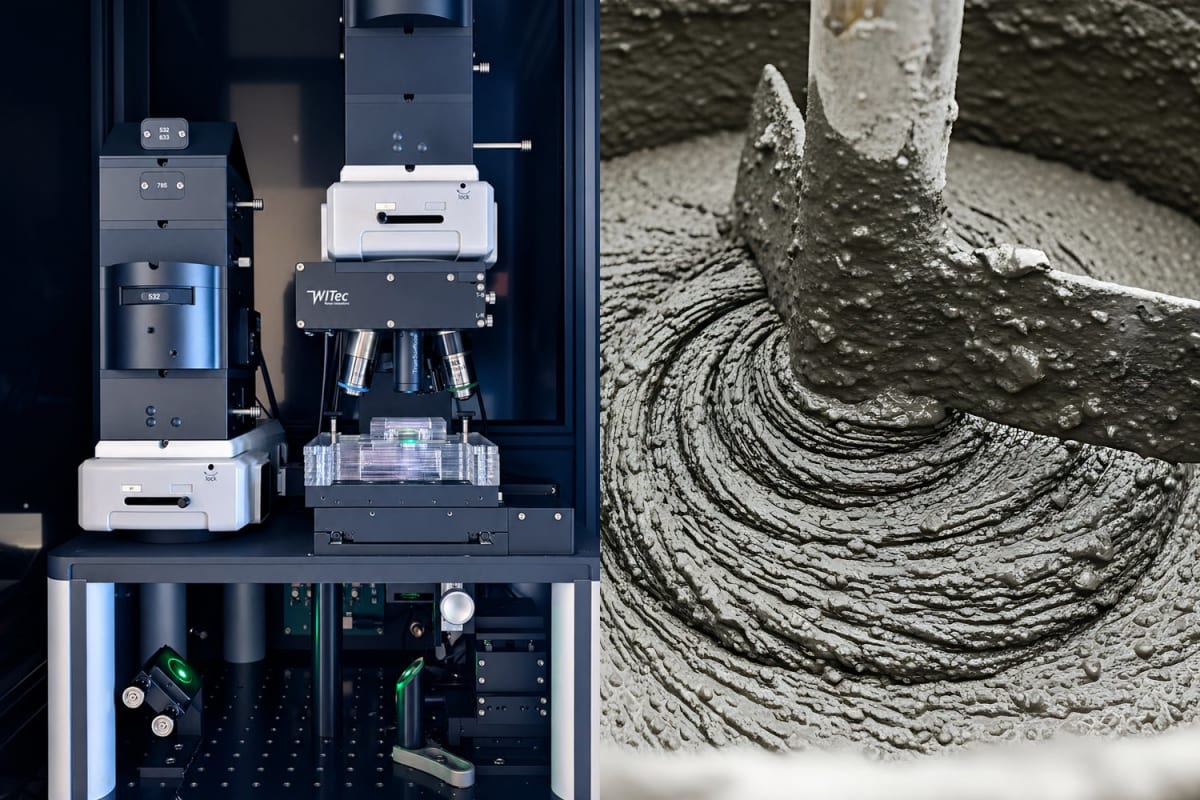
Using laser microscopy, the team captured a fleeting chemical reaction that explains why CO2-injected concrete gains strength faster than traditional mixes. The discovery could help scale up a promising technology that permanently stores carbon emissions inside the buildings around us.
The experiment itself had an unexpected start. One September day in MIT's Pierce Laboratory, researchers intentionally depressurized a tank of liquid CO2, creating indoor snow. They mixed the frozen flakes into cement paste and watched through microscopes for 24 hours straight.
What they saw was a three-stage chemical transformation that had never been directly observed before. When CO2 meets fresh cement, it immediately grabs calcium from the mixture and forms calcium carbonate, temporarily pausing the normal hardening process.
Here's where it gets interesting. Without calcium available, other compounds in the cement form a ghostly gel network that spreads throughout the entire mixture. This gel only exists for a few hours, but its brief appearance changes everything.
Once the CO2 is fully absorbed around four hours later, normal cement chemistry resumes. The calcium returns and reacts with that waiting gel network, creating the compounds that give concrete its strength. But instead of forming in scattered clusters like normal concrete, these binding compounds spread evenly throughout the material.
The result is concrete that's stronger at an early age and happens to lock away carbon dioxide permanently. Graduate student Marcin Hajduczek, who led the research, initially thought the disappearing gel was a measurement error. It vanished so quickly that it seemed impossible, but the pattern repeated in every sample.
The Ripple Effect
Several companies already sell CO2-injected concrete commercially, but they've been working somewhat in the dark without understanding the underlying chemistry. This research gives them a roadmap to optimize their processes and potentially create even better formulations.
The technology addresses two problems at once. Concrete production accounts for about 8% of global carbon emissions, while the world desperately needs ways to permanently store CO2 already in the atmosphere. Injecting carbon dioxide into concrete tackles both challenges simultaneously.
Associate Professor Admir Masic, who has used similar techniques to study ancient Roman concrete and the Dead Sea Scrolls, notes that cement paste might seem less exciting than historical artifacts. But pointing lasers at hardening concrete revealed chemistry that researchers had tried to capture for years using indirect methods that were never quite fast enough.
The findings appeared in the Journal of the American Ceramic Society and involved collaborators from IIT Jodhpur and CarbonCure Technologies. The research transforms CO2 injection from a trial-and-error process into a science-backed technique with clear explanations for why and how it works.
Building a cleaner future might literally mean building with captured carbon.
Based on reporting by Google News - Science
This story was written by BrightWire based on verified news reports.
Spread the positivity!
Share this good news with someone who needs it