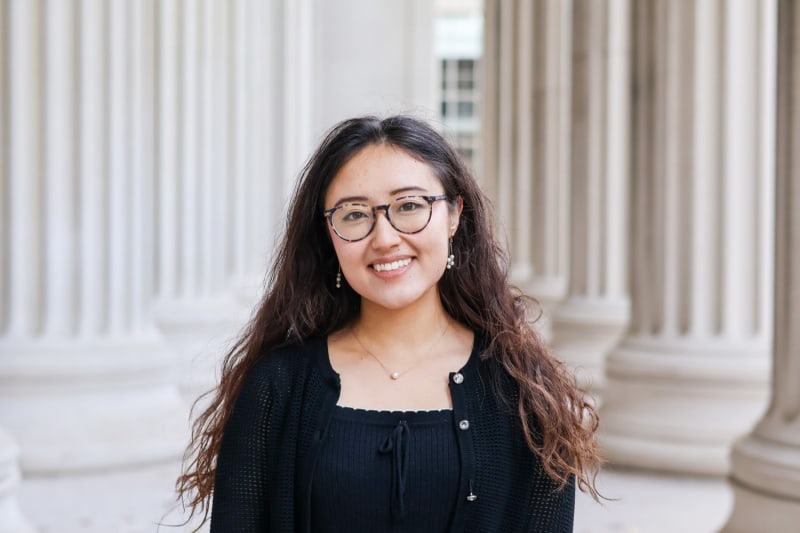
MIT Senior Katie Spivakovsky Wins Churchill Scholarship
Katie Spivakovsky, an MIT senior studying biological engineering and artificial intelligence, has been selected as a 2026-27 Churchill Scholar. She'll pursue graduate studies at Cambridge University while continuing her groundbreaking work in cancer treatment and gene therapy.
A brilliant MIT student who's already co-authored research published in Science is heading to Cambridge University this fall with one of the most prestigious scholarships in STEM.
Katie Spivakovsky has been selected as a 2026-27 Churchill Scholar, joining just 16 American students chosen annually for this highly competitive honor. The scholarship will fund her master's degree in biological sciences at Cambridge's renowned Wellcome Sanger Institute.
Spivakovsky isn't your typical college senior. She's double-majoring in biological engineering and artificial intelligence while also completing minors in mathematics and biology. But her real passion shows in the lab, where she's working on solutions that could change lives.
At MIT's Bathe BioNanoLab, Spivakovsky investigates DNA origami, tiny DNA-scaffolded nanoparticles designed to deliver genes and mRNA into cells. Her work has already resulted in a manuscript accepted by Science, one of the world's top scientific journals.
Her most exciting project tackles cancer cachexia, a devastating condition where cancer patients lose dangerous amounts of weight and muscle. Spivakovsky leads a team developing an immune therapy treatment through MIT's BioMakerSpace. That work earned a silver medal at iGEM, an international synthetic biology competition, and was published in MIT's Undergraduate Research Journal.
She's also gained real-world experience at pharmaceutical giant Merck, studying cancer-associated protein mutations, and at the New York Structural Biology Center, improving microscopy models that help scientists see molecular structures.
The Ripple Effect
Spivakovsky doesn't keep her knowledge to herself. She serves as director of the Undergraduate Initiative in the MIT Biotech Group and has taught or assisted in four different courses. She's trained the next generation of biological engineers while pursuing her own research breakthroughs.
Her goal is clear: integrate computation and bioengineering to develop solutions that promote equitable health outcomes for everyone, not just those with access to expensive treatments. She wants her research to scale and reach people who need it most.
"Katie is a brilliant researcher who has a keen intellectual curiosity that will make her a leader in biological engineering in the future," says Kim Benard, MIT's associate dean of distinguished fellowships.
The Churchill Scholarship honors former British Prime Minister Winston Churchill's vision for scientific collaboration between the United States and United Kingdom. Established in 1963, it has helped launch countless careers in science and engineering.
At Cambridge, Spivakovsky will continue pushing the boundaries of what's possible when biology meets artificial intelligence, bringing us closer to breakthrough treatments for cancer and other diseases.
Based on reporting by MIT News
This story was written by BrightWire based on verified news reports.
Spread the positivity!
Share this good news with someone who needs it