MIT Student Helps Indian Teens Run Real Experiment at CERN
Six high school students from across India cold-emailed an MIT physics grad student for help. Now they're conducting particle physics research that could advance one of the world's largest neutrino experiments.
When Manu Srivastava opened an unsolicited email from six Indian high schoolers last spring, he almost deleted it. The MIT physics PhD student usually declines mentoring requests, especially from companies charging families for access to prestigious university students.
But this message felt different. The teenagers had found his contact information and reached out directly, hoping he'd mentor them for Beamline for Schools, an international competition giving students access to particle accelerator beams at CERN in Geneva.
"I've also cold-emailed a lot in my early career, and it usually never works," Srivastava says. "But this email seemed very genuine."
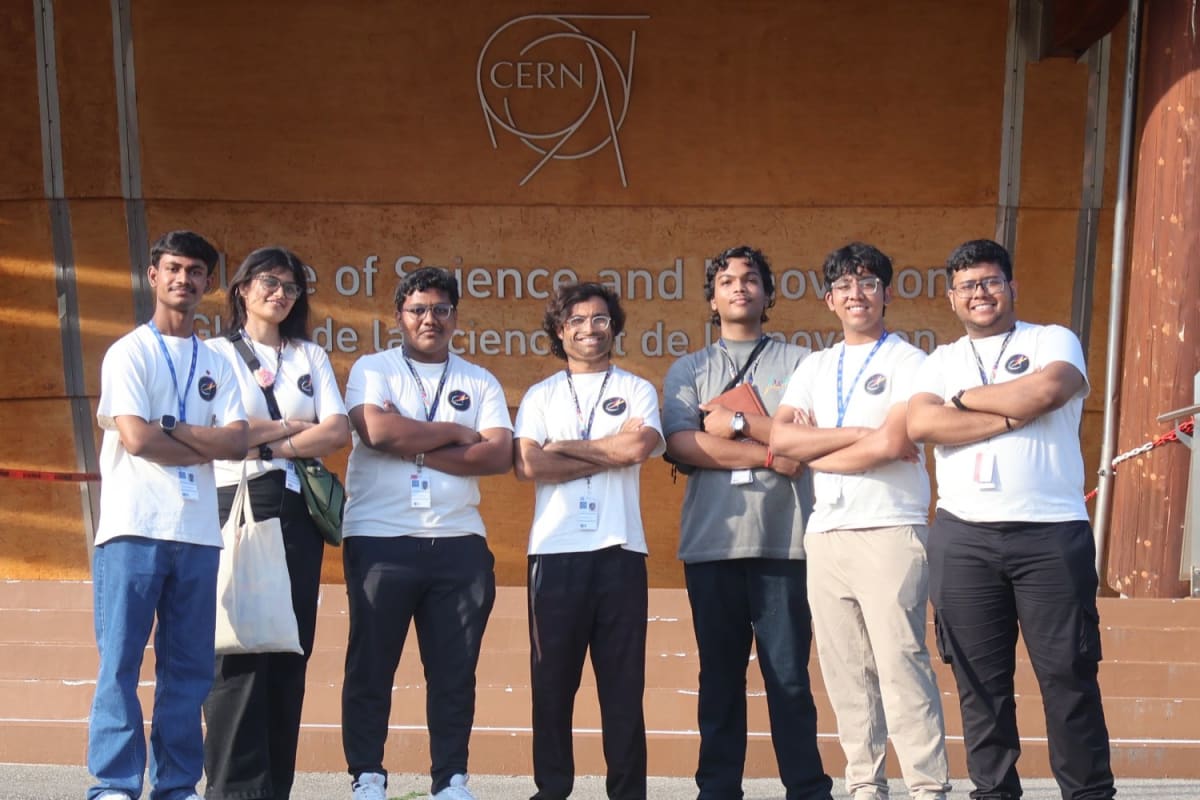
The gamble paid off for everyone involved. Calling themselves Team attoPION, the six students from four different cities became one of just five teams selected from a record 712 teams representing 89 countries and more than 4,500 students.
Their project measures something called pion charge exchange, tracking how often a positively charged pion interacts with a neutron to produce a neutral pion and a proton. These subatomic particles exist for just fractions of a second, making them incredibly challenging to study.
What started as a student project quickly attracted serious scientific attention. Dave Newbold, a co-spokesperson for the Deep Underground Neutrino Experiment (DUNE), confirmed the teenagers aren't just doing a classroom demonstration.
"The proposal is real experimental particle physics," Newbold notes. Understanding how pions interact with matter helps researchers reduce uncertainties in DUNE's measurements, potentially improving how scientists detect neutrinos and search for new physics.
If the students succeed, their work could lead to a publishable scientific result. That outcome would place their achievement far beyond typical high school science projects.
At CERN this summer, the team spent two weeks working hands-on with detectors and data systems. They quickly discovered their target reaction occurs extremely rarely, forcing them to problem-solve in real time with limited equipment and just 12 days of beam access.
Why This Inspires
Srivastava grew up in India without knowing what CERN was during high school. Now he's opening doors for the next generation of scientists from his home country, showing how a single response to an email can change young lives.
The experience pulled him far outside his specialty in quantum gravity and theoretical physics, but MIT's culture of exploring beyond narrow research boundaries prepared him for the challenge. He credits the students with doing the hard work themselves.
"These students, they are just that good," he says. "They deserve all the credit."
Their journey proves that curiosity, genuine passion, and one well-written cold email can unlock opportunities that seemed impossible just months earlier.
Based on reporting by MIT News
This story was written by BrightWire based on verified news reports.
Spread the positivity!
Share this good news with someone who needs it