MIT Students Study Plasma Physics Under Alaska's Aurora
A team of MIT graduate students traveled to Fairbanks, Alaska, where they braved temperatures as low as -25°F to study the aurora borealis as a living laboratory for understanding plasma physics. They witnessed the strongest solar storm in 20 years while deploying cutting-edge instruments across 100 miles of frozen terrain.
Imagine waking up at noon just to start your workday under a sky filled with dancing lights at negative 25 degrees.
That's exactly what a group of MIT graduate students signed up for when they traveled to Fairbanks, Alaska, to study one of nature's most breathtaking phenomena. Their mission was to use the aurora borealis as a natural laboratory for understanding plasma physics, the same science that powers fusion energy research and helps us understand space weather.
The conditions tested everything. Laptops drained from full battery to empty in just 10 minutes because of the extreme cold. The students raced to transfer data before their equipment shut down completely, working mostly in darkness with only red headlamps for visibility.
"Walking through thick snow can burn up to 900 calories in an hour," explains Leon Nichols, a PhD student in physics. The team used cross-country skis to reach remote camera locations that would have taken hours to access on foot.
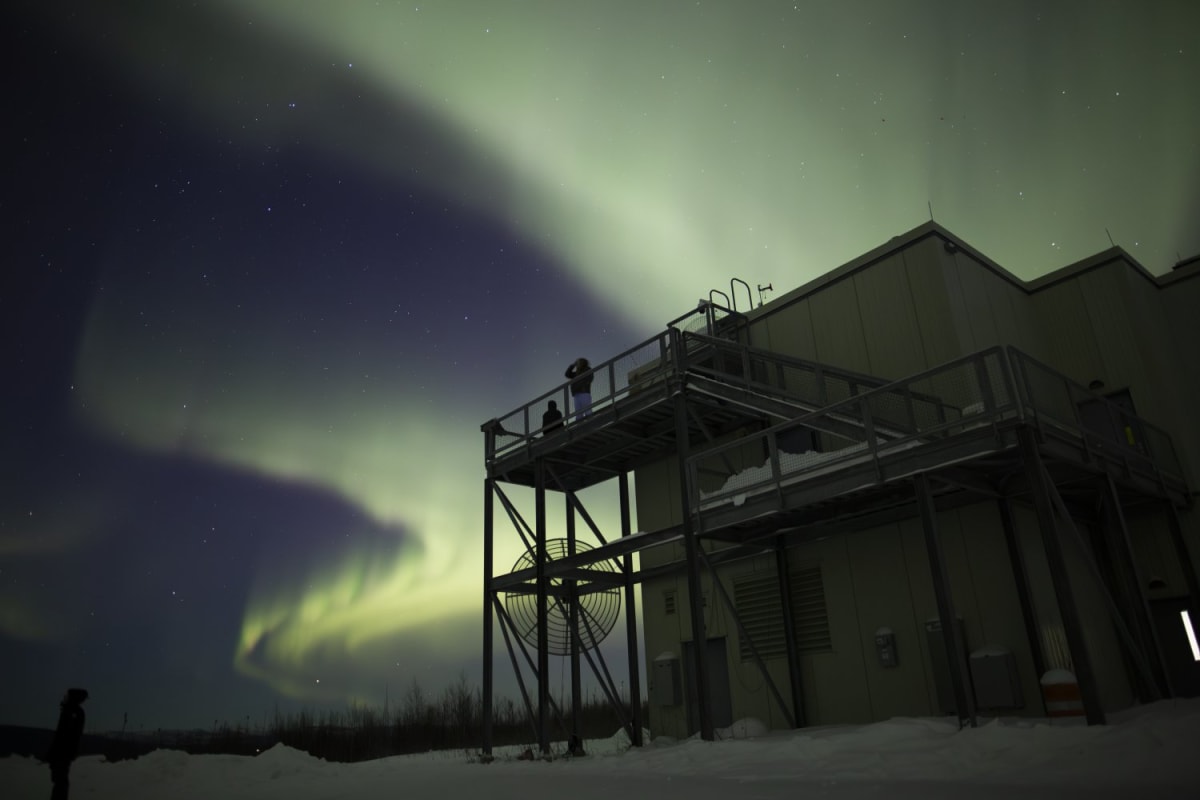
But their timing couldn't have been better. During their expedition, the team witnessed the strongest solar storm in two decades, creating an aurora display few will ever experience. "It felt like we were removed from the Earth and just entirely surrounded by the aurora, fully immersed in it," recalls Sydney Menne, a PhD student in nuclear science and engineering.
The students deployed multiple 360-degree camera systems across distances up to 100 miles, paired with magnetometers to track how the visible aurora correlates with changes in Earth's magnetic field. They even used muon detectors to explore connections between the shimmering lights overhead and high-energy particles in the upper atmosphere.
The team captured a rare pulsating aurora, where strips of light blink on and off multiple times per second. These observations help scientists understand space weather patterns that affect satellites, communications systems, and power grids on Earth.
Why This Inspires
For Leonardo Corsaro, a PhD student at MIT's Plasma Science and Fusion Center, seeing plasma physics come to life changed everything. "In my research, it is easy to associate these phenomena with colorful plots and simulations, losing touch with the physical process," he says. Watching electric currents and flows form and shift overhead reminded him that real plasmas are far messier and more beautiful than any theory suggests.
This expedition represents the third year of the Geophysical Plasma Observation Expedition, a student-driven project that sends MIT researchers to Fairbanks annually. What started as a student initiative now has faculty support, with each year's participants training the next cohort to continue the work.
By combining low-cost instruments in creative ways and deploying them across vast distances, these students are pioneering new approaches to studying phenomena that have puzzled scientists for decades. Their work bridges the gap between laboratory plasma physics and the spectacular natural displays that light up the Arctic sky.
The northern lights aren't just beautiful anymore—they're helping us understand the invisible forces that shape our technological world.
More Images
Based on reporting by MIT News
This story was written by BrightWire based on verified news reports.
Spread the positivity!
Share this good news with someone who needs it