MIT Unlocks CO₂-Injected Concrete That Gets Stronger Faster
Scientists at MIT captured for the first time how carbon dioxide transforms cement chemistry, revealing why CO₂-injected concrete gains strength faster while permanently storing greenhouse gases. The breakthrough could accelerate commercial adoption of concrete that fights climate change instead of fueling it.
One September morning, it started snowing inside an MIT laboratory. But this wasn't a broken air conditioner—it was frozen carbon dioxide, and researchers were about to crack open a mystery that's puzzled the concrete industry for years.
Scientists at MIT's Concrete Sustainability Hub mixed the CO₂ snow into fresh cement paste and watched with lasers as a remarkable chemical transformation unfolded. For 24 hours straight, they observed reactions that moved too fast for any previous technique to catch.
What they discovered could change how we build while fighting climate change. Injecting CO₂ into concrete doesn't just trap greenhouse gases permanently—it actually makes the material stronger, faster.
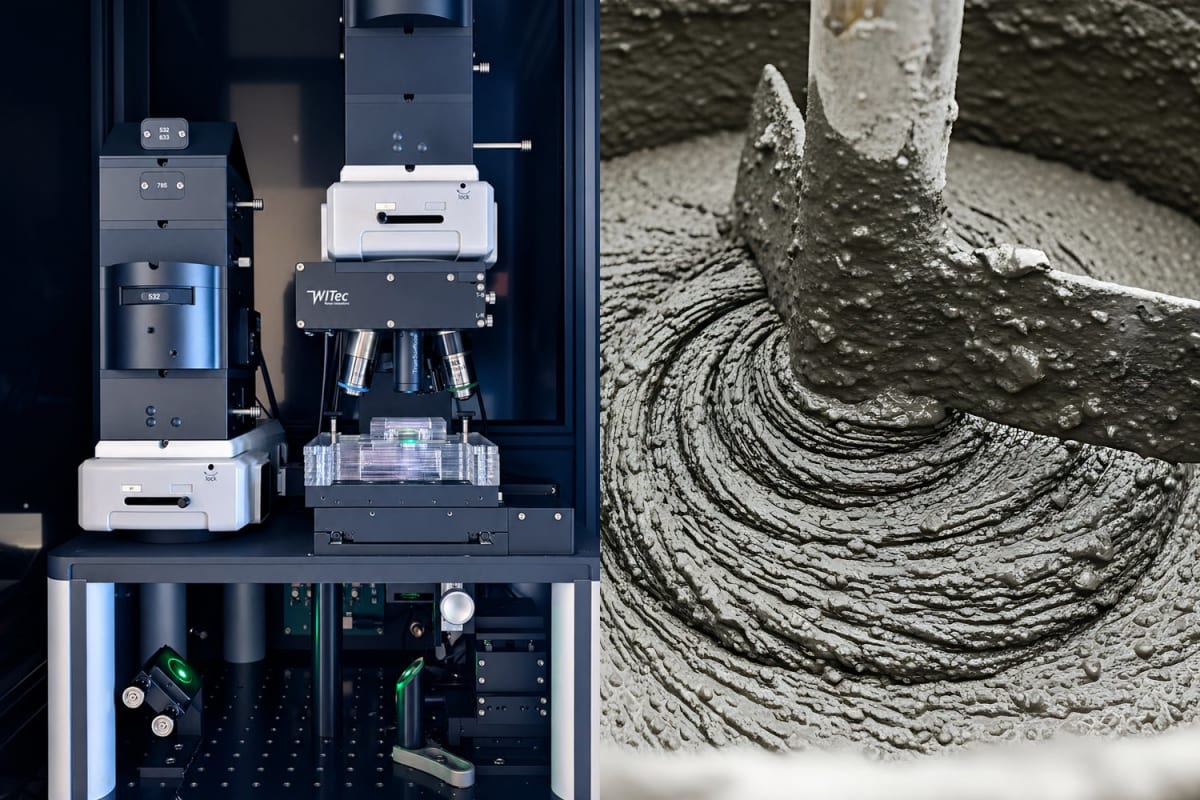
The team used Raman spectroscopy, which works like a molecular detective. Shine a laser on a material, and the scattered light reveals its chemical identity, even if that chemical only exists for a few hours.
Associate Professor Admir Masic and graduate student Marcin Hajduczek led the research, published in the Journal of the American Ceramic Society. "We've used this technique on Ancient Roman concrete and the Dead Sea Scrolls," says Masic. "Cement paste may seem less glamorous, but pointing a laser at it reveals things never seen before."
Here's what happens inside CO₂-injected cement: The carbon dioxide immediately grabs calcium from the mixture, forming calcium carbonate and temporarily slowing normal hardening. Meanwhile, silicate molecules spread throughout the paste, creating an invisible gel network.
Then around five hours in, normal chemistry resumes. Calcium returns to the mix and encounters that waiting gel network everywhere at once. The two react instantly, producing the compound that gives cement its strength—but distributed far more evenly than in regular concrete.
By eight hours, the gel has vanished completely, transformed into extra binding material spread throughout the entire structure. "At first, the gel's sudden disappearance looked like a fluke in our data," says Hajduczek. "But it became clear this was a consistent, undeniable feature."
The result? Concrete that's measurably stronger at early ages and uses carbon dioxide as an ingredient instead of releasing it into the atmosphere.
The Ripple Effect
Several companies already offer CO₂-injected concrete mixes commercially, but this research provides the scientific foundation they've been building on blind. Understanding exactly how CO₂ rewires cement chemistry means engineers can now optimize the process with precision instead of guesswork.
Cement production accounts for roughly 8% of global CO₂ emissions. If concrete could store carbon instead of producing it, one of construction's biggest climate problems becomes part of the solution.
The technique works with existing concrete production, requiring no massive infrastructure overhaul. Early strength gains also mean faster construction timelines, which builders love.
Concrete is the world's most-used building material after water—we produce about 4 billion tons annually. That scale means even small improvements ripple across the entire planet.
Now the chemistry is no longer invisible, and the path forward just got a lot clearer.
Based on reporting by MIT News
This story was written by BrightWire based on verified news reports.
Spread the positivity!
Share this good news with someone who needs it