MIT's Ultrasound Wristband Reads Hand Movements in Real-Time
Scientists at MIT created a wristband that uses ultrasound to perfectly track every finger movement, teaching robots to move with human-like precision. The breakthrough could revolutionize everything from virtual reality to surgery.
📺 Watch the full story above
Imagine controlling a robotic hand so precisely it can play piano, all from a small band around your wrist. MIT researchers just made it happen using ultrasound technology that reads your hand movements better than any system before.
The innovation solves a problem that's stumped scientists for decades. Human hands are incredibly complex, using over 100 tendons and ligaments plus dozens of muscles just to scroll your phone or hold a cup.
Previous tracking methods all had serious drawbacks. Cameras lose sight when objects block the view. Sensor gloves restrict natural hand movement. Muscle sensors miss subtle motions and pick up interference.
The MIT team's solution is elegantly simple. They placed tiny ultrasound stickers about the size of a watch onto a wristband that creates continuous images of muscles and tendons as fingers move.
Researcher Gengxi Lu explains it with a perfect analogy. "The tendons and muscles in your wrist are like strings pulling on puppets, which are your fingers," he says. "Each time you take a picture of the state of the strings, you'll know the state of the hand."
Each finger has 22 possible movements, all visible in the ultrasound images. Rather than trying to match movements manually, the team trained AI to recognize patterns and predict hand positions, and it worked flawlessly.
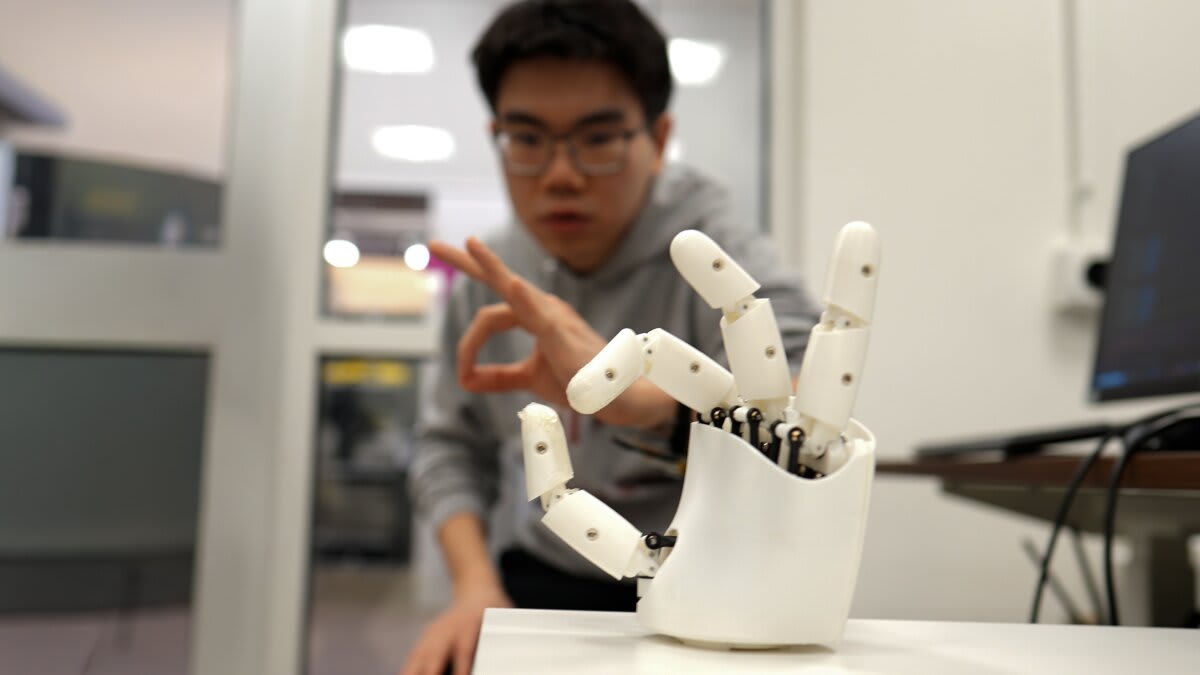
Testing proved the technology's versatility. Volunteers performed all 26 letters of American Sign Language with perfect accuracy. The wristband tracked hands holding pencils, scissors, and tennis balls. A robotic hand controlled by the device even played simple piano tunes in real time.
Why This Inspires
This breakthrough represents more than just better robot control. The technology opens doors to touchless device operation for people with limited mobility. It could transform virtual reality into truly immersive experiences where every finger twitch translates perfectly into digital worlds.
Surgeons might someday use the system to control precise robotic instruments during delicate procedures. Sign language could be instantly translated, breaking down communication barriers. The applications grow as the AI learns from more hand movement data.
The prototype is already small, but researchers plan to shrink it further into something anyone could wear comfortably throughout the day. What started as puppet strings pulling fingers might just pull us into a future where human and machine movement merge seamlessly.
The research appears in Nature Electronics, marking another step toward technology that enhances rather than replaces human capability.
More Images


Based on reporting by New Atlas
This story was written by BrightWire based on verified news reports.
Spread the positivity!
Share this good news with someone who needs it