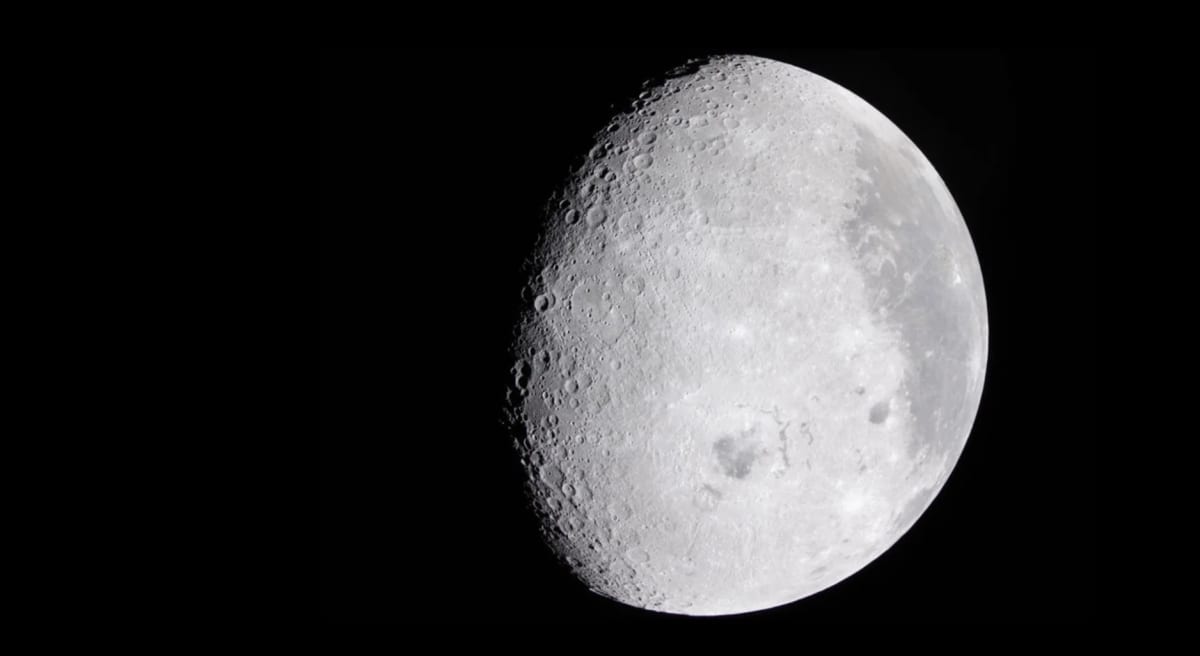
NASA and IBM Release Free AI Model for Moon Exploration
Scientists worldwide now have access to a groundbreaking AI tool that can unlock decades of lunar data to help establish a permanent human presence on the Moon. The NASA-IBM Lunar Foundation Model, released as free open-source software, turns mountains of complex satellite observations into insights no single instrument could provide alone.
Imagine trying to piece together a massive puzzle where each piece comes from a different box, in different sizes, and shows the Moon from completely different angles. That's the challenge lunar scientists have faced for decades, until now.
NASA and IBM just released the Lunar Foundation Model, one of the first publicly available AI systems designed specifically for Moon exploration. The free tool helps researchers connect the dots across petabytes of data collected by dozens of instruments over the years, revealing patterns that were previously invisible.
The Moon's surface tells an incredible story. Over billions of years, it has formed craters, hidden ice beneath shadowed regions, and experienced volcanic activity that shaped the landscape we see today. But studying these features has required scientists to either manually examine thousands of maps and images or rely on low-resolution AI models that miss crucial details.
This new AI changes that game entirely. Trained on a unified dataset combining information from nine different instruments across four space missions, the model can identify hidden relationships between different types of lunar observations at unprecedented accuracy.
The practical applications are already impressive. The model reduced errors in identifying potential lunar ice deposits by up to 22% compared to existing technology. That matters because lunar ice means water and oxygen, both essential resources for future Moon bases and producing rocket fuel for missions to Mars.
For crater detection, the AI achieves comparable accuracy to cutting-edge models while using just half the training data, making it far more efficient. Craters reveal vital clues about the Moon's age, geology, and chemical composition, plus they help NASA select safe landing sites and plan locations for long-term infrastructure.
The model also helps scientists better understand the Moon's volcanic history by identifying features called Irregular Mare Patches with 3% greater accuracy than previous methods. Understanding these changing regions is critical for planning future surface operations.
What makes this release truly special is the open-source approach. IBM and NASA built the first publicly available unified lunar dataset of its kind, combining tens of thousands of images and maps from NASA's Lunar Reconnaissance Orbiter, the GRAIL mission, and Japan's SELENE/Kaguya spacecraft.
"NASA has spent decades building an extraordinary scientific record of the Moon, but collecting data is only part of the job," said Kevin Murphy, NASA's chief science data officer. "We also have to make data easier for scientists to explore and use."
The Ripple Effect: This model joins IBM and NASA's Prithvi family of open foundation models covering Earth, weather, and space science. By making cutting-edge AI freely available to the entire scientific community, researchers worldwide can now accelerate discoveries that might have taken years using traditional methods. Universities, space agencies, and independent scientists in any country can download the model and contribute to humanity's next giant leap.
The Moon has kept its secrets long enough, and now scientists everywhere have the tools to unlock them together.
Based on reporting by Google: scientific discovery
This story was written by BrightWire based on verified news reports.
Spread the positivity!
Share this good news with someone who needs it