NASA Finds Earth-Like Phenomenon on Mars for First Time
Scientists discovered an atmospheric effect on Mars that was thought impossible on planets without Earth's protective magnetic field. The breakthrough could reveal how space weather shapes alien worlds.
Scientists just spotted something in Mars' sky that nobody thought could exist there.
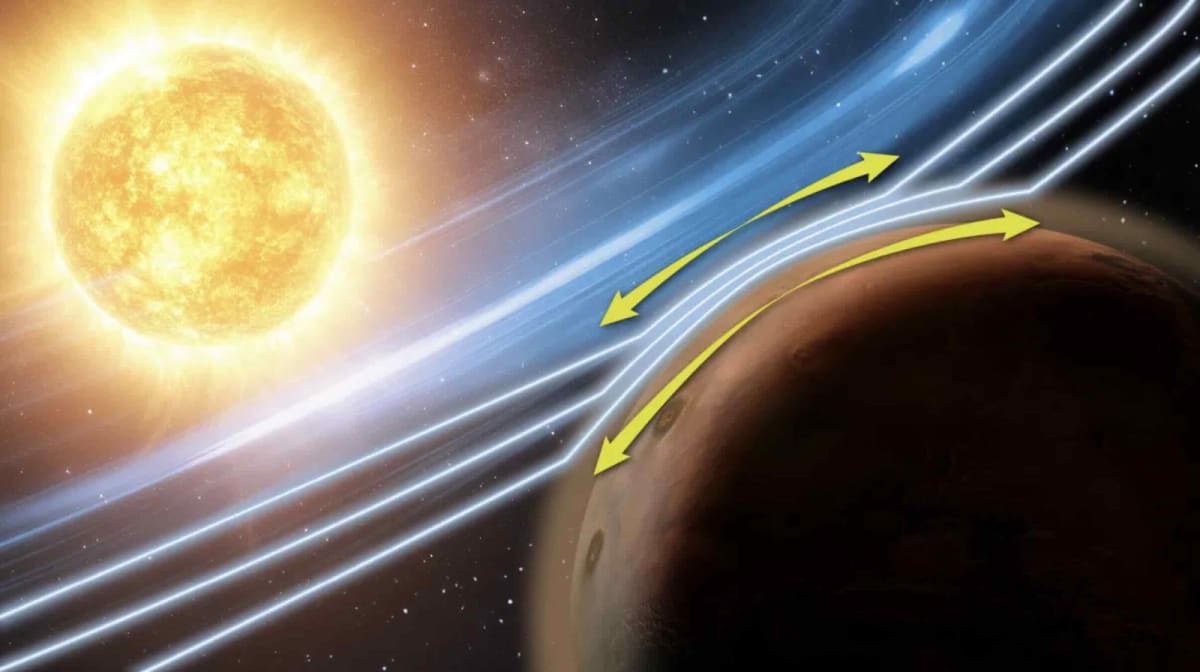
NASA's MAVEN spacecraft detected the Zwan-Wolf effect in the Martian atmosphere, marking the first time this phenomenon has been observed beyond Earth. The effect happens when charged particles get squeezed out of magnetic structures called flux tubes, helping deflect dangerous solar wind away from the planet.
Christopher Fowler, a researcher at West Virginia University, wasn't looking for anything groundbreaking when he started analyzing the MAVEN data in 2023. Then he noticed what he called "very interesting wiggles" in the magnetic field measurements.
"I would never have guessed it would be this effect, since it's never been seen in a planetary atmosphere before," Fowler said. He's now the lead author of the study confirming the discovery.
The finding seemed impossible at first. Mars has a much thinner atmosphere than Earth and lacks our planet's global magnetic field, which normally drives this kind of atmospheric behavior.
Despite those differences, MAVEN's instruments caught the effect happening below 200 kilometers in the Martian atmosphere. The charged particles were being squeezed and spread exactly like they do around Earth, just in a completely different environment.
The discovery was partly lucky timing. The team believes the Zwan-Wolf effect is actually happening constantly on Mars, but it's usually too subtle for instruments to detect.
Space weather events in 2023 amplified the effect enough for MAVEN to finally see it. Those seemingly small wiggles in the data revealed decades of assumptions about planetary atmospheres needed updating.
Why This Inspires
This discovery opens a new window into understanding how the Sun shapes worlds beyond Earth. Scientists can now study the Zwan-Wolf effect in unmagnetized environments like Venus and Saturn's moon Titan, places where the physics work completely differently than our home planet.
The research also helps explain how space weather events change atmospheric conditions on Mars, which matters for future human missions to the Red Planet. Understanding these invisible forces could help protect astronauts and equipment from solar radiation.
The universe just got a little less mysterious, one wiggle at a time.
Based on reporting by Google: NASA discovery
This story was written by BrightWire based on verified news reports.
Spread the positivity!
Share this good news with someone who needs it