NASA Finds Wandering Black Hole Blazing Like 10 Billion Suns
NASA's Swift Observatory spotted a rogue supermassive black hole eating a star 30,000 light-years from its galaxy's center, briefly outshining its entire host galaxy. The discovery validates a new technique for finding invisible black holes wandering through space.
Scientists just caught a cosmic monster in the act of devouring a star while sitting in the most unexpected place imaginable.
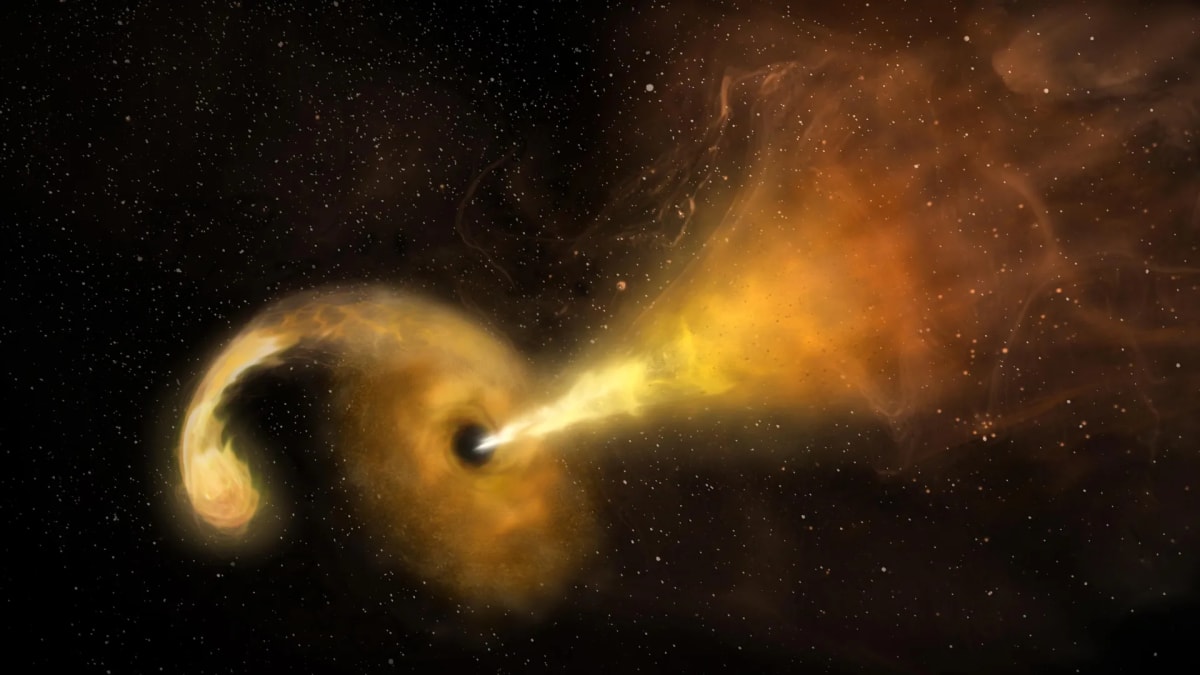
NASA's Swift Observatory detected a supermassive black hole tearing apart a star more than 30,000 light-years from the center of a distant galaxy, 750 million light-years from Earth. For several months, the brilliant flare from this cosmic feast shone brighter than its entire surrounding galaxy.
"We were looking for these star-shredding events as a way to find otherwise invisible supermassive black holes wandering away from the galactic cores where they usually reside," said Robert Stein, a research fellow at the University of Maryland and NASA's Goddard Space Flight Center. This discovery validates a completely new way to hunt for hidden black holes.
The show started in November 2025 when an artificial intelligence algorithm monitoring the Zwicky Transient Facility sky survey flagged an unusual burst of light. Out of half a million flashes detected each night, the AI recognized something special about this one, despite its strange location in a galaxy's outskirts rather than its center.
At its peak, the event blazed with the brilliance of roughly 10 billion suns. Swift's instruments measured temperatures reaching 54,000 degrees Fahrenheit as the black hole, about a million times more massive than our Sun, ripped the unfortunate star to shreds.
Before 2024, astronomers had only found these violent events called tidal disruptions at galaxy centers, where supermassive black holes normally live. This discovery happened at an unprecedented distance from a galactic core, raising fascinating questions about how it got there.
Why This Inspires
This wandering black hole tells an incredible story about cosmic history. Scientists believe it likely started in the center of a smaller galaxy that merged with a larger one, either getting flung outward during a gravitational battle between multiple black holes or still riding along with its original dwarf galaxy as it joins a bigger system.
The discovery proves that the universe still holds surprises in unexpected places. By training AI to spot these rare events anywhere in galaxies, not just at their centers, astronomers can now find black holes that were completely invisible before.
Jonathan Carney, a doctoral student who helped confirm the finding, notes that combining data from multiple observatories ruled out other explanations. The teamwork between ground telescopes and NASA's Swift spacecraft made the discovery possible.
Astronomers typically detect only about 30 of these star-shredding events across the entire universe each year. Finding one so far from home opens up entirely new hunting grounds for understanding these mysterious cosmic giants.
The technique works, the AI is watching, and there are likely more wandering black holes out there waiting to reveal themselves.
Based on reporting by Science Daily
This story was written by BrightWire based on verified news reports.
Spread the positivity!
Share this good news with someone who needs it