NASA Launches $30M Mission to Save 20-Year-Old Telescope
A private spacecraft is racing to rescue NASA's Swift Observatory from burning up in Earth's atmosphere, marking the first time a commercial company will attempt to save a government satellite. The $30 million mission costs less than replacing the telescope and demonstrates a breakthrough approach to extending the life of valuable space assets.
When NASA's $500 million Swift Observatory began falling toward Earth after two decades of stellar service, the agency faced a choice: let it burn up or try something never done before.
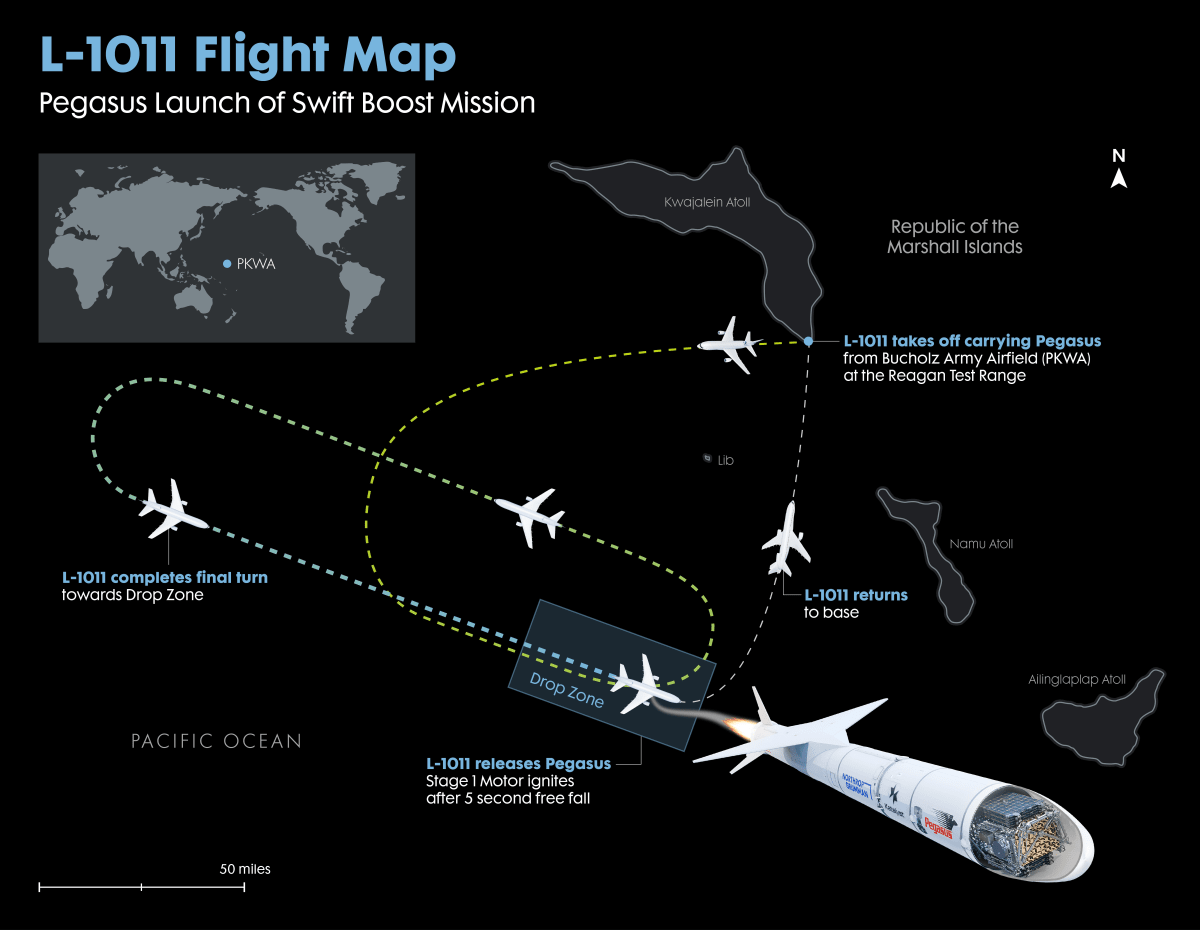
They chose rescue. On July 1, a private spacecraft called LINK will launch aboard the final flight of the historic Pegasus XL rocket, beginning a daring mission to save one of astronomy's hardest working telescopes from destruction.
Swift has spent over 20 years studying gamma-ray bursts and high-energy events across the universe, providing scientists with invaluable data about some of the most powerful explosions in space. But the telescope was never designed to be serviced, and it lacks the thrusters needed to raise its own orbit as atmospheric drag slowly pulls it downward.
That's where Arizona-based Katalyst Space Technologies comes in. Their LINK satellite, standing just under five feet tall, will chase down the 12-foot Swift Observatory using three robotic arms to grapple and stabilize it.
After capturing Swift, LINK will fire gentle ion thrusters over several months to slowly push both spacecraft back to their original altitude of 373 miles above Earth. The careful maneuver will buy Swift several more years of scientific discovery.
The mission showcases remarkable efficiency. NASA selected Katalyst in September 2025, giving the company less than a year to design, build, and test LINK. The entire rescue operation costs just $30 million, a fraction of what replacing Swift's unique capabilities would require.
The Pegasus rocket launching LINK has its own storied history. Since 1990, it has completed 45 missions by launching from beneath a modified jet aircraft, allowing it to reach orbital paths that traditional ground launches can't access. This final flight caps three decades of innovation in air-launched space technology.
Why This Inspires
This mission represents a turning point in how we think about spacecraft. Instead of treating satellites as disposable, we're learning to repair and extend their lives, just like we maintain valuable equipment on Earth.
The collaboration between NASA and a private company also shows how space exploration is evolving. Katalyst had less than a year to pull off something never attempted before, proving that agility and innovation can solve problems once thought impossible.
Most inspiring is the choice itself. NASA could have simply let Swift fall, but instead saw an opportunity to demonstrate that rescue missions are possible and affordable, opening the door for saving other valuable spacecraft in the future.
Swift will get its second chance, continuing to unlock secrets of the universe while teaching us that even in space, nothing worth saving is truly out of reach.
More Images


Based on reporting by Google News - Science
This story was written by BrightWire based on verified news reports.
Spread the positivity!
Share this good news with someone who needs it

%2Fhttps%3A%2F%2Ftf-cmsv2-smithsonianmag-media.s3.amazonaws.com%2Ffiler_public%2F1a%2F72%2F1a72d8cc-970c-48cf-83f6-b16e605ff5c0%2Flow-res_f26-plastic-cookies-hr.jpg)