NASA Mission Could Reveal Secrets of Metal Asteroid Psyche
Scientists are closer to solving a 200-year mystery about a giant metal asteroid that might be the exposed heart of a destroyed planet. New crater simulations will help NASA's spacecraft unlock Psyche's secrets when it arrives in 2029.
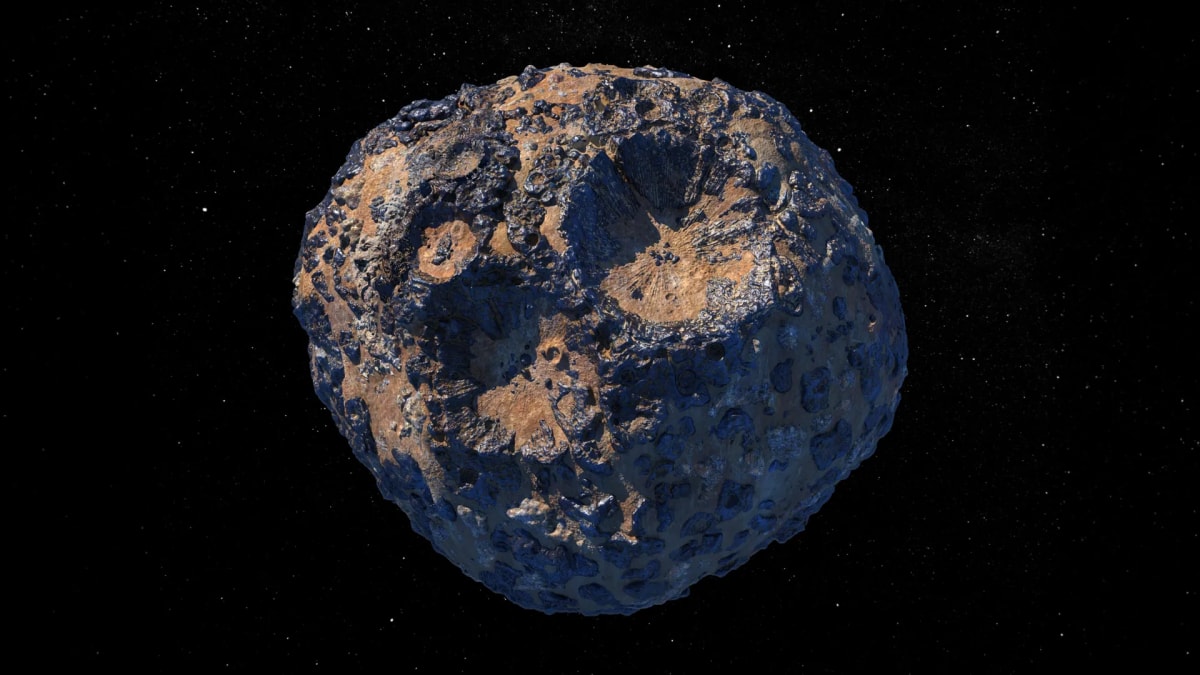
A massive metal asteroid floating between Mars and Jupiter could finally reveal what planet cores look like, and scientists just figured out how to read its story.
Asteroid Psyche has puzzled researchers for over two centuries. At 140 miles across, it's the largest known object made mostly of metal in our solar system, and nobody knows for sure how it formed.
NASA's Psyche spacecraft is racing toward the asteroid right now, scheduled to arrive in 2029. But scientists at the University of Arizona decided not to wait. They created detailed computer simulations of a giant crater near Psyche's north pole to predict what the spacecraft will find.
The results, published in JGR Planets, could finally answer whether Psyche is the stripped core of a failed planet or something completely different. "By simulating the formation of one of its largest craters, we were able to make testable predictions for Psyche's overall composition when the spacecraft arrives," said Namya Baijal, the doctoral candidate who led the research.
The key discovery involves something called porosity, which is basically how much empty space exists inside the asteroid. Most asteroids aren't solid rocks but contain gaps and fractures from billions of years of cosmic collisions.
The team found that porosity dramatically changes how craters form. Asteroids with more empty space absorb impact energy differently, creating deeper, steeper craters with less scattered debris. By comparing their simulations to real observations from the spacecraft, scientists will be able to tell whether Psyche has distinct layers like a planet or is a chaotic mixture of rock and metal.
The research team tested two main scenarios. In one, Psyche is a layered body with a metal core and thin rocky shell, the remains of an early planet that got its outer layers violently ripped away. In the other, it's a uniform mixture created when a catastrophic impact blended everything together.
Their simulations showed that an impactor about three miles wide, traveling at typical asteroid belt speeds of three miles per second, created Psyche's 30-mile-wide crater. Both scenarios could match what we see today, which means the spacecraft's detailed measurements will be crucial.
Why This Inspires
This research represents something remarkable about human curiosity. We can't drill into Earth's core or visit the centers of other planets, but we might get to explore the core of an ancient world that didn't survive.
Professor Erik Asphaug, who co-authored the study, compared their work to investigating an abandoned pizza shop. "The cooks have long left, but you can look at what's left behind and make inferences about how the pizzas were made," he explained.
If Psyche really is an exposed planetary core, it would offer a rare window into the violent early days of our solar system, when forming planets smashed into each other and broke apart. These building blocks, now floating as asteroids, hold clues about how Earth and its neighbors came to be.
The 2029 mission will carry the most advanced instruments ever sent to a metal world, and thanks to this research, scientists will know exactly what to look for when they arrive.
Based on reporting by Science Daily
This story was written by BrightWire based on verified news reports.
Spread the positivity!
Share this good news with someone who needs it