NASA Predicts Solar Storm to Within 30 Minutes
Scientists using NASA's new PUNCH mission forecasted a solar storm's arrival time 10 times more accurately than current methods, getting within 30 minutes of the actual impact. The breakthrough could revolutionize how we protect power grids, satellites, and astronauts from dangerous space weather.
Scientists just proved they can predict when a solar storm will hit Earth with stunning accuracy, giving us precious extra time to protect our technology and astronauts in space.
Using NASA's PUNCH mission, researchers tracked a massive solar eruption from the Sun nearly all the way to Earth and predicted its arrival to within 30 minutes. That's 10 times better than current forecasting methods, which only offer a five-hour window.
"This could be the space weather equivalent of going from a steam engine to a modern internal combustion engine," said Craig DeForest, principal investigator for PUNCH at Southwest Research Institute in Boulder, Colorado.
Solar storms happen when the Sun launches huge explosions of material called coronal mass ejections into space. When these storms slam into Earth, they can knock out power grids, damage satellites, and endanger astronauts. Knowing exactly when they'll arrive is critical for protecting our infrastructure.
Until now, scientists could only see these eruptions for about one-fifth of their journey from the Sun to Earth. That meant guessing what happened over the remaining 80% of the trip.
PUNCH changed everything when it launched in 2025. The mission uses four spacecraft in low Earth orbit to continuously watch the inner solar system, capturing a new image every four minutes. For the first time, scientists can track solar storms almost their entire journey.
The Bright Side
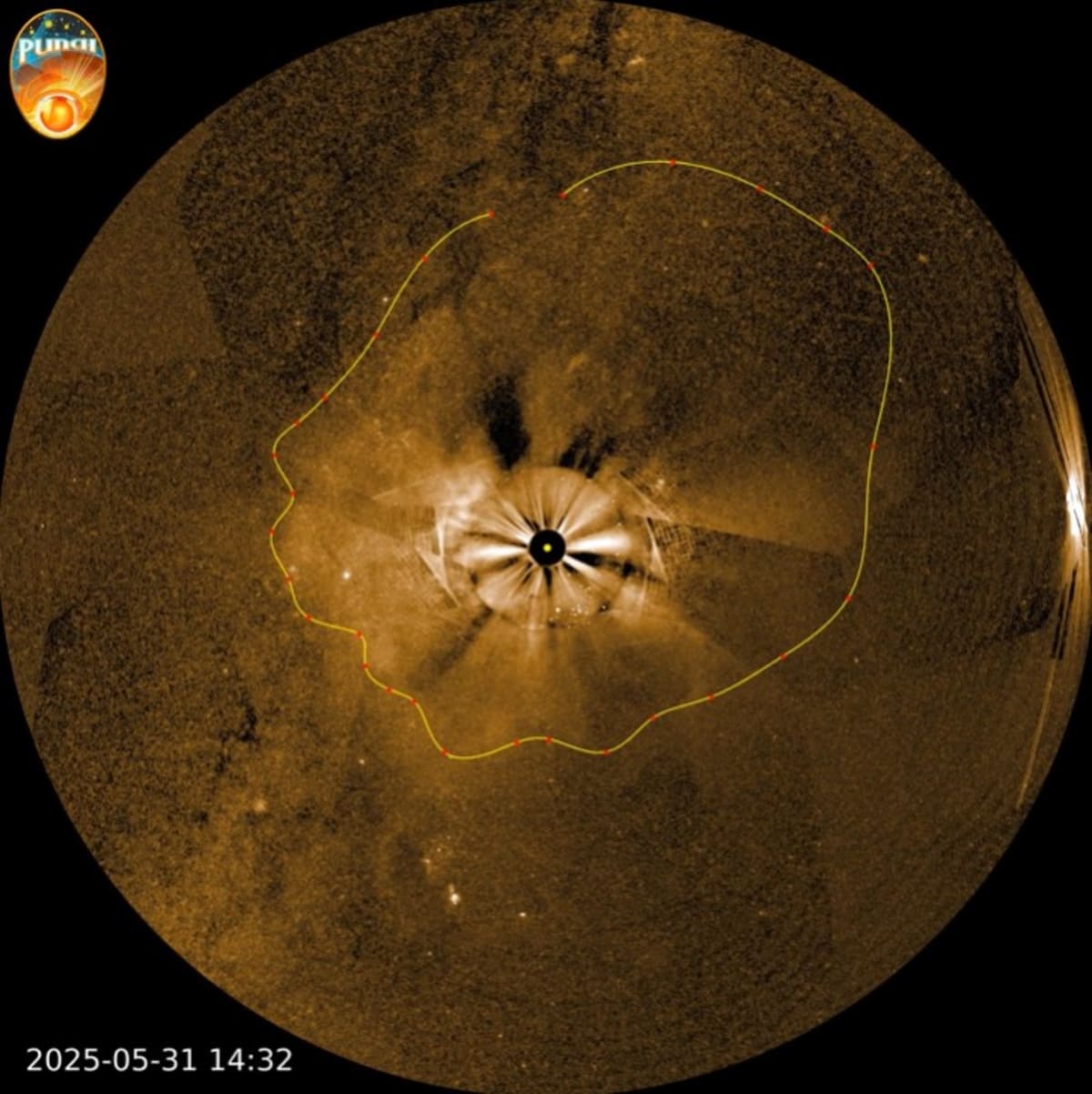
In their proof-of-concept test, researchers analyzed a solar storm that erupted on May 31, 2025. They fed PUNCH images into a computer model that tracked the storm's speed and shape as it crossed space.
Just 12 hours after the eruption left the Sun, the model locked in its final prediction. Eight hours later, the storm arrived exactly when predicted, within a 30-minute margin of error.
The model even revealed when the prediction had stabilized, so forecasters could issue warnings with full confidence. No more guessing games during those nail-biting hours before impact.
The breakthrough goes beyond better forecasts. PUNCH's high-resolution images revealed that these solar storms are clumpier and more complex than scientists thought, continuing to evolve as they travel through space.
Scientists presented their results at the Committee on Space Research Scientific Meeting, with findings under review at the journal Space Weather. They believe that with more refined data and improved models, they could predict arrival times even further in advance.
The same data helping protect Earth is also unlocking secrets about how plasma behaves across the galaxy, helping astrophysicists understand star-forming regions millions of light-years away.
Our ability to see danger coming from 93 million miles away just got exponentially better.
Based on reporting by NASA
This story was written by BrightWire based on verified news reports.
Spread the positivity!
Share this good news with someone who needs it