NASA Robot to Touch Saturn's Rings for First Time Ever
NASA is developing an AI-powered robot that will make history by collecting samples directly from Saturn's rings, something humanity has never done before. The PRAXIS mission could unlock mysteries about how planetary rings form and evolve across our solar system.
Humanity is about to reach out and touch one of space's most beautiful mysteries for the very first time.
NASA scientists are designing PRAXIS, a groundbreaking robotic explorer that will collect actual particles from Saturn's iconic rings. No spacecraft has ever attempted this before, and the mission could answer fundamental questions about how ring systems form around planets throughout the universe.
Saturn's rings are a constantly shifting dance of ice particles, ranging from grains smaller than sand to chunks bigger than houses. They crash together and break apart in an endless cosmic ballet that's captivated scientists since Galileo first spotted them in 1610.
The Cassini spacecraft gave us stunning views of the rings during its mission, but it could only look from afar. PRAXIS will go one giant leap further by actually touching and analyzing individual ring particles up close.
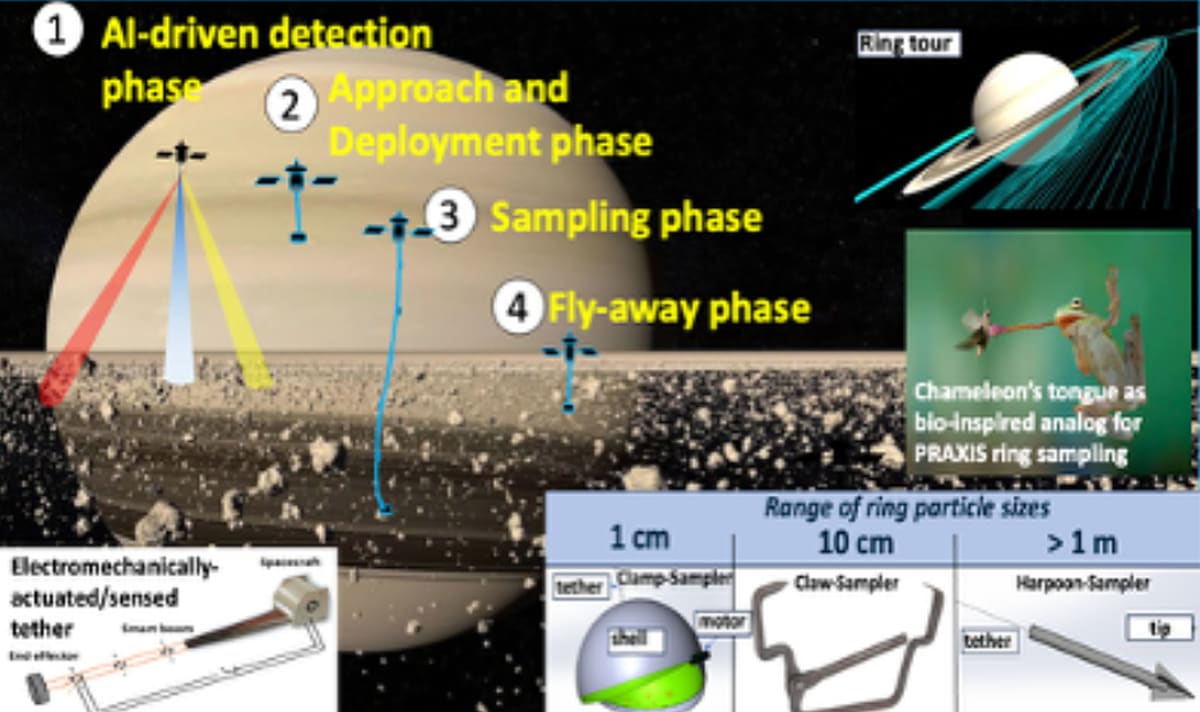
The mission uses artificial intelligence inspired by sports technology to safely navigate this chaotic environment. The spacecraft will extend a long, soft boom to gently collect samples while staying far enough away to avoid collisions with the constantly moving particles.
Once it grabs a sample, PRAXIS will analyze the particle's size, texture, and what it's made of in real time. Then it moves to a different section of the rings to collect more samples from diverse regions, building a complete picture of how these structures work.
Why This Inspires
This mission represents more than just touching pretty space ice. Understanding Saturn's rings helps scientists decode how all ring systems form, from the faint bands around Uranus and Neptune to the dusty disks around distant asteroids.
The technology could even shed light on protoplanetary disks, the swirling clouds of material where new planets are born around young stars. What we learn from Saturn's backyard might help us understand how solar systems across the galaxy come to life.
The AI-powered autonomous sampling system being developed for PRAXIS won't stop at Saturn either. NASA plans to adapt this technology for the upcoming Uranus Probe mission, pushing the boundaries of what robotic explorers can accomplish.
Right now, the team is building computer simulations and designing prototypes to prove the concept works. If all goes well, a physical prototype will follow, bringing us closer to the day when a robot from Earth reaches out to touch particles that have been orbiting Saturn since the dawn of our solar system.
After centuries of gazing up at Saturn's rings in wonder, we're finally going to hold a piece of them in our hands.
More Images



Based on reporting by NASA
This story was written by BrightWire based on verified news reports.
Spread the positivity!
Share this good news with someone who needs it