NASA Satellites Help Scientists Protect South African Water Quality
Advanced satellite technology is enabling researchers to monitor and understand algae blooms in South Africa's Hartbeespoort reservoir, paving the way for better water management and ecosystem protection. This innovative approach demonstrates how space-based monitoring can help communities safeguard their precious water resources.
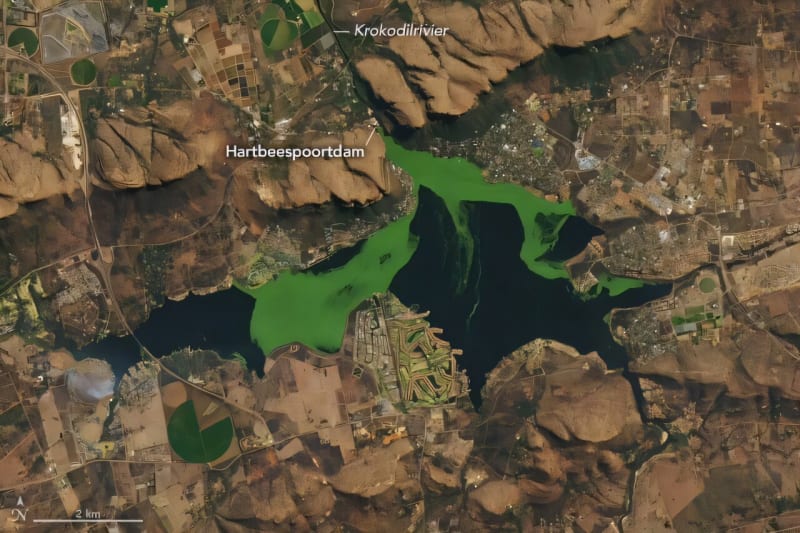
From high above Earth, NASA satellites are capturing stunning images that tell an important story about water quality and environmental stewardship. In South Africa's Hartbeespoort reservoir, located just west of Pretoria, swirling patterns of green and blue paint a picture that scientists are using to better protect this vital water resource.
These vibrant patterns represent algae blooms, and while they can pose challenges to water quality, the real story here is how innovative technology and dedicated researchers are working together to understand and manage them. Using imagery from NASA's Harmonized Landsat and Sentinel-2 satellites, scientists can now observe these natural phenomena with unprecedented detail, tracking how blooms develop, move, and fade over time.
Bridget Seegers, a NASA scientist studying freshwater ecosystems, uses a relatable analogy to explain the process: "It's like having a garden. If you add a lot of nutrients, you're going to have a lot of growth." This insight helps communities understand how agricultural practices influence water quality, opening doors for positive change.
The research conducted at Hartbeespoort represents a triumph of long-term scientific monitoring. In a fascinating study published in Remote Sensing, researcher Adam Ali and his team analyzed four decades of satellite data from 1980 to 2020. This comprehensive approach revealed patterns that ground-level monitoring alone could never capture, demonstrating the power of space-based observation.
The findings tell an encouraging story of human adaptability and problem-solving. When researchers discovered that a bioremediation program in the late 1980s successfully limited algae growth, it proved that thoughtful intervention works. This knowledge is invaluable for developing future solutions and shows that communities can make a real difference when armed with the right information.
What makes this research particularly exciting is how it combines cutting-edge technology with practical applications. By analyzing different wavelengths of light reflected from the water, scientists can estimate chlorophyll-a concentrations and track algae biomass over time. This sophisticated method provides crucial information without the expense and difficulty of constant ground-based monitoring, making water quality management more accessible for communities worldwide.
The future looks even brighter. NASA's PACE mission, launched in 2024, represents a quantum leap forward in water monitoring capabilities. By collecting data across hundreds of precise wavelength bands, PACE can help scientists identify specific types of algae, which is crucial for determining potential risks and appropriate responses. The next Landsat satellite will include wavelengths specifically designed to detect harmful algal blooms, further enhancing our protective capabilities.
Ali and his colleagues are already working to integrate these new tools into future studies, demonstrating the scientific community's commitment to continuous improvement. This collaborative spirit, combining resources from NASA, the European Space Agency, and researchers worldwide, showcases humanity's ability to work together for environmental protection.
The Hartbeespoort reservoir serves as both a valuable recreational resource and an irrigation source for local communities. By better understanding the natural processes that affect it, scientists are helping ensure this water body remains healthy and usable for generations to come. This research proves that with dedication, innovation, and the right tools, we can monitor and protect our precious water resources more effectively than ever before.
More Images

Based on reporting by Phys.org
This story was written by BrightWire based on verified news reports.
Spread the positivity! 🌟
Share this good news with someone who needs it
More Good News
 🌍 Planet Wins
Taiwan's Formosan Salmon Population Thrives Despite Natural Challenges
 🌍 Planet Wins
Ancient Greek Ruins Become Thriving Sanctuaries for Endangered Wildlife
🌍 Planet WinsAncient Ruins Become Unexpected Sanctuaries for Endangered Wildlife
Joke of the Day
Why did the librarian get kicked out of class?
Explore Categories
Quote of the Day
"Do not go where the path may lead, go instead where there is no path and leave a trail."
— Ralph Waldo Emerson