NASA Telescope Finds Galaxy From 280M Years After Big Bang
NASA's James Webb Space Telescope just confirmed a bright galaxy that formed only 280 million years after the Big Bang, revealing the early universe was far busier and brighter than scientists ever predicted. The discovery is rewriting our understanding of how quickly galaxies formed after the universe began.
Scientists just got their clearest look yet at the cosmic nursery where galaxies were born, and it turns out the early universe was throwing a much bigger party than anyone expected.
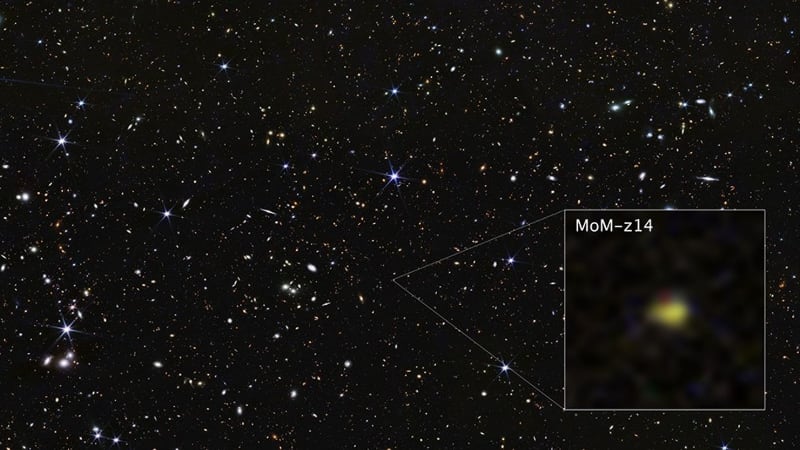
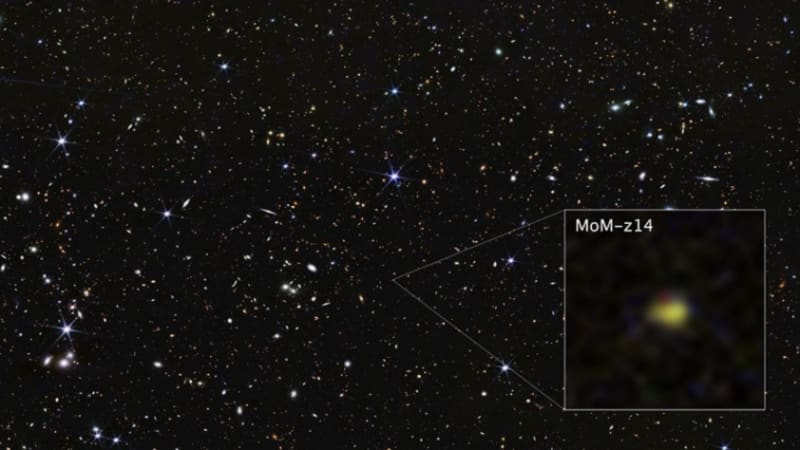
NASA's James Webb Space Telescope has confirmed the existence of a galaxy called MoM-z14 that formed just 280 million years after the Big Bang. The light now reaching Earth from this ancient galaxy has been traveling through space for roughly 13.5 billion years.
What makes this discovery remarkable isn't just how far back we can now see. It's that Webb keeps finding dozens of bright, massive galaxies in the early universe, roughly 100 times more than models predicted before the telescope launched.
"With Webb, we are able to see farther than humans ever have before, and it looks nothing like what we predicted," said Rohan Naidu of MIT's Kavli Institute for Astrophysics and Space Research, who led the study. The research was published in the Open Journal of Astrophysics.
To confirm the galaxy's age and distance, astronomers used spectroscopy, which analyzes light to verify exactly when an object existed. Pascal Oesch of the University of Geneva, a co-principal investigator, explained that when looking this early in cosmic history, estimates aren't enough.
MoM-z14 holds another surprise. The galaxy shows elevated levels of nitrogen despite forming so soon after the universe began, suggesting the early universe may have contained extremely massive stars capable of producing heavier elements much faster than stars today.
The galaxy also appears to be clearing hydrogen gas around it, offering clues about cosmic reionization. This was the period when early stars and galaxies began breaking through the dense hydrogen fog that filled the young universe, allowing light to travel freely through space for the first time.
Why This Inspires
This discovery fundamentally changes how we see our cosmic origins. Instead of a dark, slow beginning, the early universe was a brilliant, busy nursery churning out galaxies at an astonishing pace.
Webb builds on earlier work from the Hubble Space Telescope, which found galaxy GN-z11 from about 400 million years after the Big Bang. Now Webb is reaching even further back, and the upcoming Nancy Grace Roman Space Telescope will expand the search by surveying much larger areas of sky.
"To understand what's happening in the early universe, we need both depth and numbers," said graduate researcher Yijia Li. "Webb gives us detail, and Roman will give us scale."
By peering into this ancient light, we're watching the universe turn on its lights for the very first time. Each new discovery brings us closer to understanding where it all began.
More Images
Based on reporting by Google: NASA discovery
This story was written by BrightWire based on verified news reports.
Spread the positivity!
Share this good news with someone who needs it
%2Fhttps%3A%2F%2Ftf-cmsv2-smithsonianmag-media.s3.amazonaws.com%2Ffiler_public%2Ff0%2Ffe%2Ff0fe19e4-e68b-474d-b0a4-19c5beb9d19d%2Fspeedy-star.webp)