NASA Telescopes Reveal Saturn in Stunning New Detail
Two of NASA's most powerful telescopes teamed up to capture the clearest views of Saturn ever seen, revealing secrets hidden in its swirling atmosphere. The cosmic collaboration between Hubble and James Webb is giving scientists an unprecedented look at the ringed planet's weather patterns and mysterious clouds.
Saturn has never looked this good.
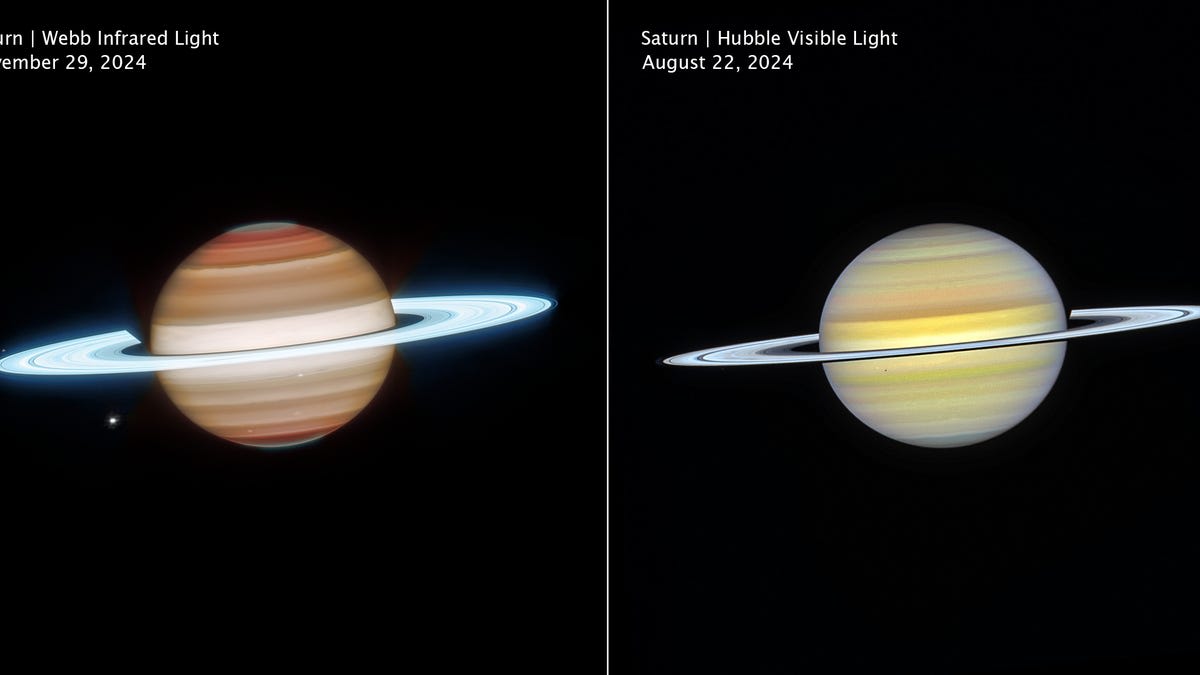
NASA's Hubble Space Telescope and James Webb Space Telescope joined forces to capture what the agency calls "the most comprehensive view" of Saturn to date. The stunning images reveal intricate details of the gas giant's atmosphere that scientists have never been able to see before.
The two telescopes work like a tag team. Hubble captured Saturn in visible light on August 22, 2024, showing subtle color variations across the planet's banded clouds and its bright ring system.
Then Webb stepped in with its infrared vision on November 29, 2024, peering through layers of atmosphere invisible to the naked eye. The result reveals distinct cloud bands, temperature fluctuations, and dynamic weather patterns churning across the second largest planet in our solar system.
The collaboration isn't just about pretty pictures. Each telescope tells a different part of Saturn's story, helping scientists understand how this massive world's atmosphere actually works.
Hubble has been faithfully observing Saturn for 35 years since launching in 1990, building a decades-long record of the planet's evolving atmosphere. Webb, which began operations in July 2022, now extends what researchers can measure about Saturn's atmospheric structure with its powerful infrared capabilities.
The images also captured several of Saturn's moons, including Janus, Mimas, Dione, and Enceladus. Saturn has a whopping 274 observed moons, with 128 discovered just this March. Some are shaped like potatoes or ravioli, and at least two might harbor water beneath their icy surfaces.
Why This Inspires
This cosmic partnership shows what's possible when different tools work together toward a common goal. Hubble and Webb complement each other perfectly, with one telescope observing what the other cannot.
The collaboration extends humanity's ability to explore worlds millions of miles away, revealing beauty and complexity we couldn't have imagined just decades ago. As Webb continues its mission with enough propellant to operate for more than 20 years, we're only beginning to see what these telescopes can uncover together.
We're living in a golden age of space exploration, where our best tools are getting even better by working together.
Based on reporting by Google: James Webb telescope
This story was written by BrightWire based on verified news reports.
Spread the positivity!
Share this good news with someone who needs it