NASA Tests Supersonic Mars Helicopter Rotor Blades
NASA engineers just tested helicopter blades that broke the sound barrier without falling apart, bringing us closer to faster, more capable aircraft exploring Mars. The breakthrough could transform how we explore the Red Planet.
NASA engineers have successfully tested next-generation helicopter rotor blades that can spin faster than the speed of sound, opening new possibilities for exploring Mars.
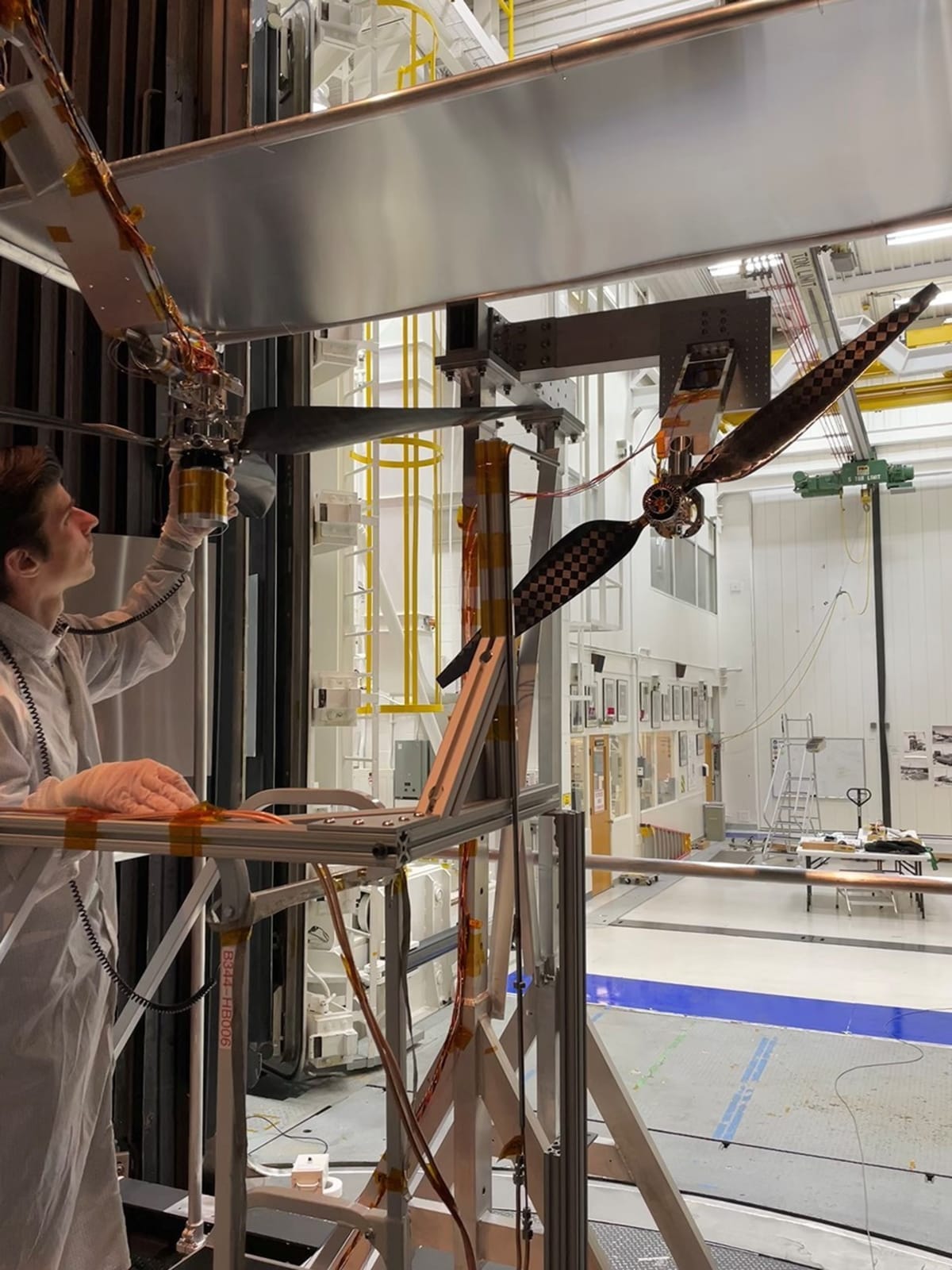
At NASA's Jet Propulsion Laboratory in Southern California, engineer Jaakko Karras and his team pushed a three-bladed rotor beyond Mach 1 in November 2025. The blades survived, proving that future Mars helicopters could fly faster and farther than ever before.
The test took place inside the 25-Foot Space Simulator, where engineers recreated the thin Martian atmosphere. They used a clever trick: a two-bladed rotor spinning vertically created artificial "wind" that pushed the three-bladed test rotor past supersonic speeds.
This matters because Mars presents unique challenges for flight. The Red Planet's atmosphere is just 1% as dense as Earth's, meaning helicopter blades must spin incredibly fast just to generate lift. Current Mars helicopters are limited by how fast their rotors can safely spin.
The data showed something remarkable. Not only did the blades survive supersonic speeds, but they maintained their structural integrity throughout the test. This means engineers can confidently design faster, more capable aircraft for future Mars missions.
Why This Inspires
This breakthrough represents years of problem-solving and innovation. The original Ingenuity helicopter, which made history as the first aircraft to fly on another planet, proved that Martian flight was possible. Now, engineers are pushing those boundaries even further.
Faster helicopters could cover more ground, reach difficult terrain, and scout locations for future human missions. They could explore ancient river valleys, peek into deep craters, and investigate geological features that rovers can't reach.
The Mars Exploration Program funded these tests specifically to maximize what future aircraft can accomplish. It's part of NASA's broader mission to prepare for human exploration of Mars while conducting groundbreaking science today.
Future Mars helicopters equipped with these advanced rotors could serve as aerial scouts for astronauts, carrying heavier scientific instruments and traveling dozens of miles in a single flight instead of just a few hundred feet.
The sky on Mars just got a lot more interesting.
More Images


Based on reporting by NASA
This story was written by BrightWire based on verified news reports.
Spread the positivity!
Share this good news with someone who needs it