NASA's Webb and Hubble Team Up to Reveal Saturn's Secrets
Two of humanity's most powerful space telescopes have joined forces to capture Saturn like never before, revealing hidden storms, mysterious glowing poles, and the planet's iconic hexagon weather pattern. It's our best look yet at the ringed giant, and possibly the last detailed view of some features for decades.
NASA's James Webb Space Telescope and Hubble Space Telescope have teamed up to give us the most detailed portrait of Saturn ever captured, revealing a dynamic world of swirling storms and atmospheric mysteries.
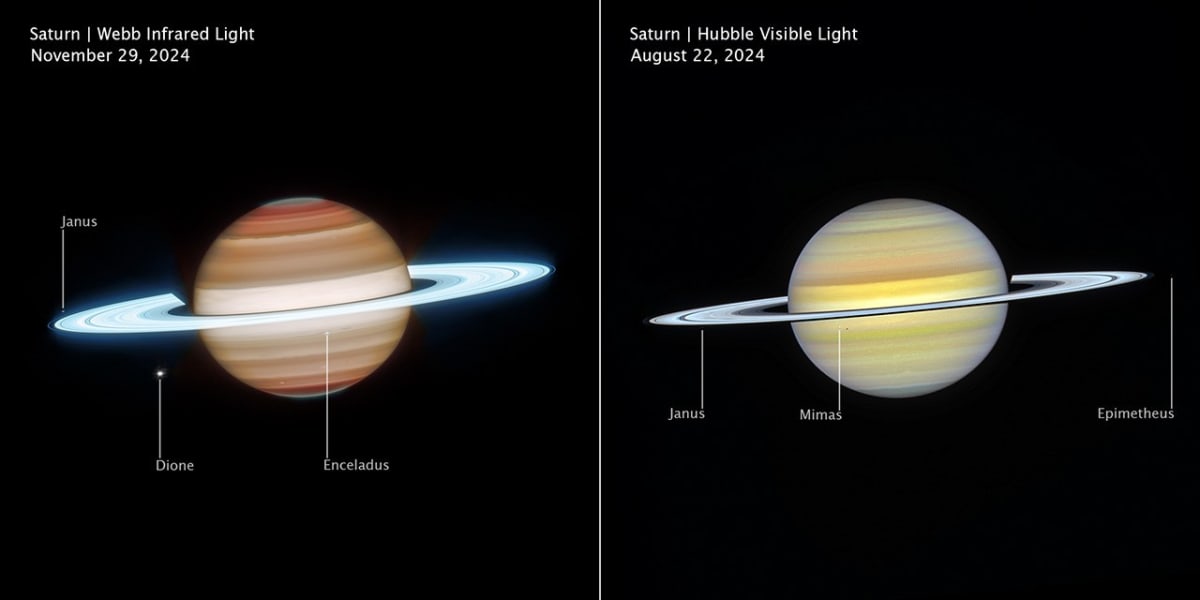
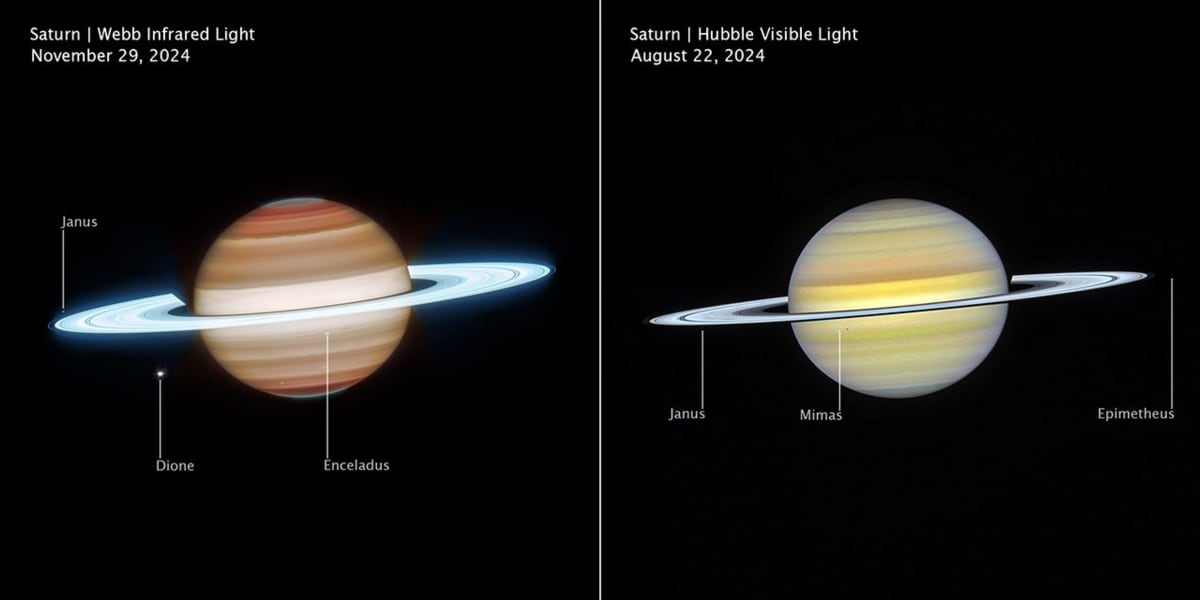
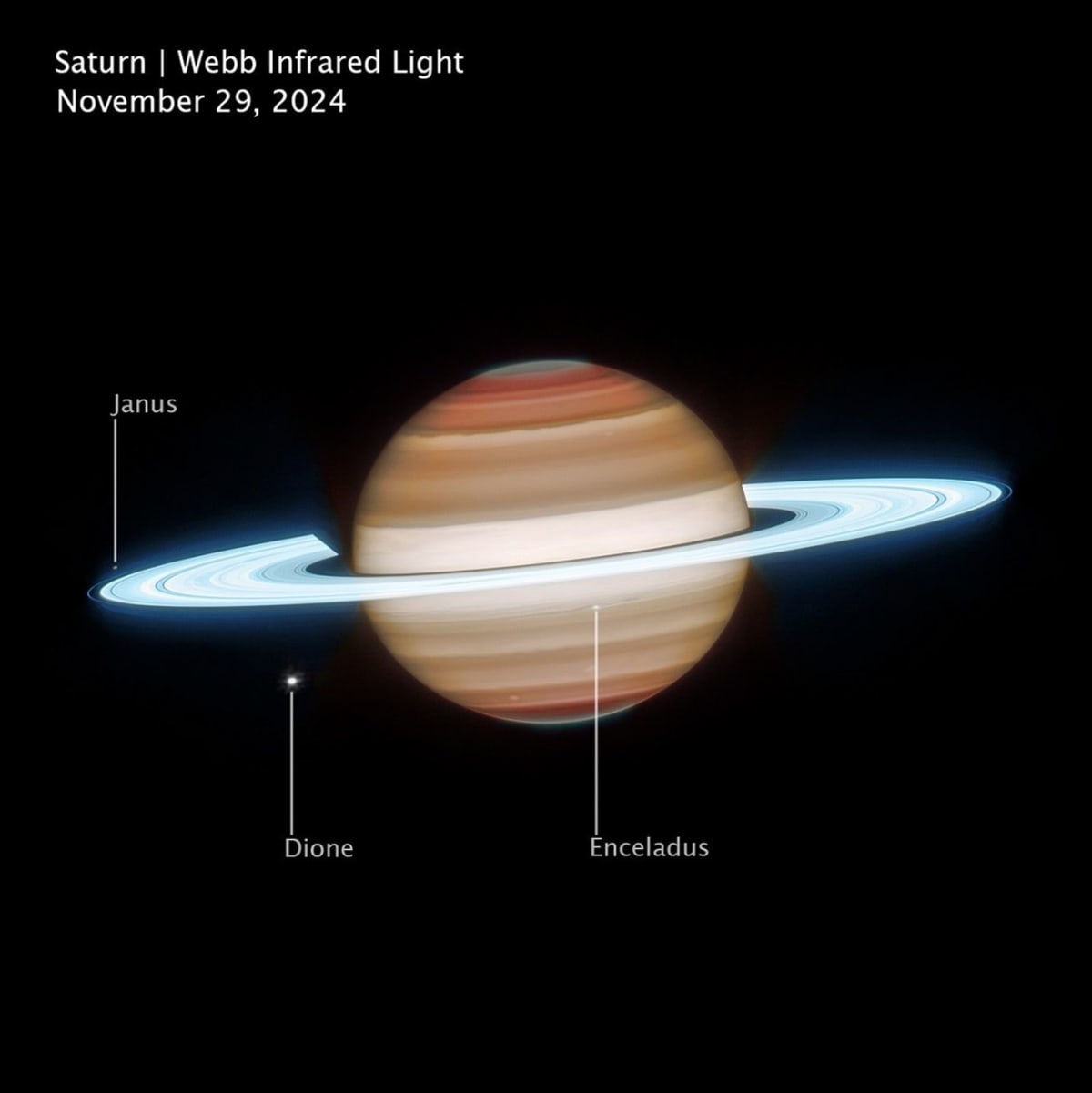
The complementary observations, taken in 2024, show Saturn in two completely different lights. Hubble captures the planet's subtle color variations in visible light, while Webb's infrared vision peers deep into the atmosphere, detecting clouds and chemicals at multiple layers like slicing through an onion.
Together, they've revealed features scientists have been tracking for years. A long-lived jet stream called the "ribbon wave" meanders across Saturn's northern hemisphere, influenced by invisible atmospheric waves. Just below it sits a small remnant from the massive "Great Springtime Storm" that raged from 2010 to 2012.
The images also capture several storms dotting Saturn's southern hemisphere. These features are shaped by powerful winds and waves beneath the visible clouds, making Saturn a natural laboratory for studying extreme weather conditions.
Both telescopes caught glimpses of Saturn's famous hexagon-shaped jet stream at the north pole, first discovered by Voyager in 1981. This bizarre weather pattern has persisted for over 40 years, highlighting how stable some atmospheric processes can be on giant planets.
These might be our last high-resolution looks at the hexagon until the 2040s. Saturn's northern pole is entering winter and will shift into darkness for 15 years, making detailed observations impossible during that time.
Why This Inspires
The collaboration between these two telescopes shows how different perspectives reveal deeper truths. Webb's infrared eyes spotted mysterious grey-green coloring at Saturn's poles, which could be high-altitude aerosols scattering light differently or possibly auroral activity from charged particles interacting with the planet's magnetic field.
The rings themselves tell different stories through each telescope's lens. In Webb's view, they shine brilliantly because water ice reflects infrared light incredibly well. Both telescopes captured subtle features like spokes and structures in the B ring, each appearing differently based on the wavelength observed.
Saturn's orbit, combined with Earth's position, gives us changing viewing angles of the planet's face and rings. These observations, taken 14 weeks apart, showcase how our perspective shifts throughout the year.
The observations build on decades of work from NASA's Cassini orbiter, which studied Saturn from 1997 to 2017. By combining historical data with these new multi-wavelength views, scientists are piecing together how Saturn's atmosphere works as a connected three-dimensional system.
This partnership between Webb and Hubble demonstrates the power of combining technologies to unlock secrets that neither could reveal alone.
More Images
Based on reporting by Google News - Science
This story was written by BrightWire based on verified news reports.
Spread the positivity!
Share this good news with someone who needs it