New Crystal Breakthrough Powers Next-Gen UV Lasers
Chinese scientists just cracked a decades-old puzzle in laser technology, creating safer, more powerful crystals that could revolutionize everything from medical diagnostics to computer chip manufacturing. The breakthrough solves problems that have stumped researchers for years.
Scientists in China have developed a new type of crystal that makes deep-ultraviolet lasers far more powerful and practical than ever before.
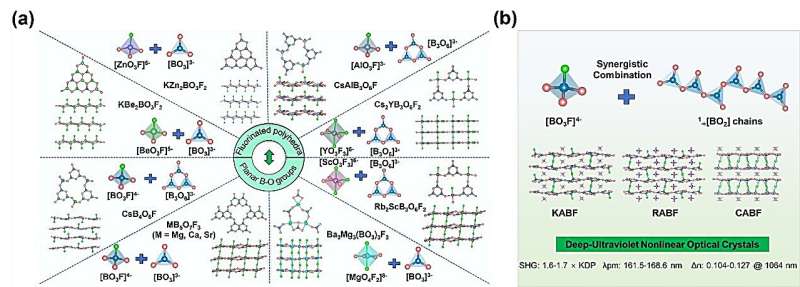
The team at the Xinjiang Technical Institute of Physics and Chemistry created three new materials called KABF, RABF, and CABF. These crystals overcome major obstacles that have limited laser technology for decades.
Deep-ultraviolet lasers are invisible to the human eye but essential for modern life. They analyze materials at the molecular level, manufacture computer chips, and help doctors diagnose diseases. The problem? The crystals powering these lasers have been difficult to make safely and effectively.
Previous crystal designs faced a frustrating trade-off. Materials like KBBF worked well but grew in problematic layered structures and required toxic ingredients. Other options simply couldn't generate the right wavelengths through direct frequency doubling.
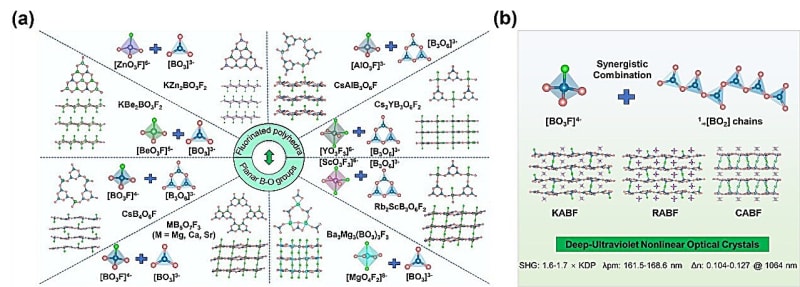
The research team solved this by combining fluorinated structures with boron-oxygen groups in a new way. Think of it like arranging building blocks so they all face the same direction, creating a uniform structure that light can pass through efficiently.
The results are impressive. These new crystals generate UV light at wavelengths as short as 161.5 nanometers, pushing deeper into the ultraviolet spectrum than most existing materials. They're also beryllium-free, eliminating one of the toxic elements that made previous crystals dangerous to manufacture.
The Ripple Effect
This advancement opens doors across multiple industries. Computer chip makers need deep-ultraviolet light for photolithography, the process that etches microscopic circuits onto silicon wafers. The more precise the UV wavelength, the smaller and more powerful chips can become.
Medical researchers use these lasers to study proteins and detect early signs of disease. Environmental scientists rely on them to identify pollutants at incredibly low concentrations. Even space agencies use UV lasers for satellite communications and atmospheric research.
The new crystals also demonstrate a broader principle: that combining different molecular structures strategically can unlock properties neither possesses alone. The fluorinated polyhedra act like molecular guides, lining up the light-active components in perfect parallel formation.
Perhaps most importantly, the team created not just one but three variations of the crystal. This proves the design strategy is flexible and reliable, not a lucky accident. Other researchers can now apply these principles to develop even more specialized materials.
The work, published in Advanced Functional Materials, represents years of experimentation with crystal growth and molecular design. Each version of the crystal showed similar performance metrics, confirming that the underlying approach is sound.
Manufacturing these crystals remains complex, but they're significantly safer and more practical than previous options. As production techniques improve, these materials could become the new standard for deep-ultraviolet laser systems worldwide.
A new generation of laser technology just became possible, bringing clearer medical imaging, faster computers, and more precise scientific instruments within reach.
More Images
Based on reporting by Phys.org
This story was written by BrightWire based on verified news reports.
Spread the positivity!
Share this good news with someone who needs it