New Solar Cell Hits 30% Efficiency and Bends Without Breaking
Scientists in China just created flexible solar panels that are thinner than a credit card and 30% more efficient at converting sunlight to electricity. The breakthrough could bring lightweight solar power to everything from spacecraft to your jacket.
Imagine solar panels so thin and flexible you could roll them up like a yoga mat, yet powerful enough to rival the best technology on the market today.
That's exactly what researchers at the Chinese Academy of Sciences just achieved. Their new solar cells are thinner than two strands of hair stacked together but pack a serious punch, converting 30.04% of sunlight into usable electricity.
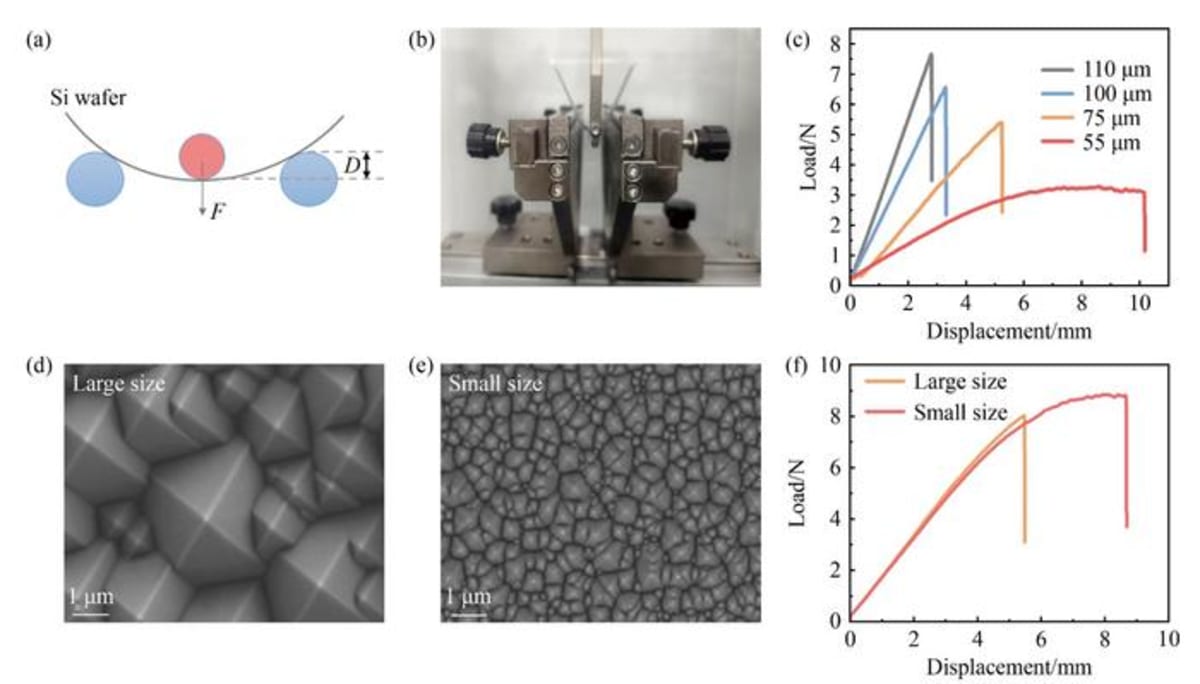
The secret lies in tiny pyramids. Traditional silicon solar cells have large pyramid shapes on their surface that trap light effectively but create weak points where the material cracks under stress. The research team figured out how to shrink these pyramids down to less than a thousandth of a millimeter while keeping them perfectly uniform.
This matters because current solar technology faces a frustrating tradeoff. Silicon solar cells work great but are rigid and heavy. Adding a layer of perovskite material on top boosts efficiency, but the two materials don't play well together when you try to make them flexible. The stress between layers causes the cells to peel apart and fail.
The Shanghai team solved this by using a carefully timed chemical bath to etch ultrathin silicon wafers. After testing different durations, they found that exactly 360 seconds created the ideal surface: densely packed submicron pyramids that spread stress evenly across the material instead of concentrating it at breaking points.
The results exceeded expectations. The microscopic pyramids allowed the perovskite layer to spread evenly and bond strongly with the silicon underneath. The improved connection reduced energy loss and boosted overall performance.
The Ripple Effect
This isn't just a laboratory curiosity. Lightweight, flexible solar panels could transform industries that can't use today's heavy, rigid panels.
Aerospace engineers could wrap satellites and drones in efficient solar skins without adding weight. Architects could integrate solar power directly into curved building facades and windows. Even clothing designers could weave solar charging capability into jackets and backpacks for hikers and emergency responders.
The technology also promises to make solar power more accessible in developing regions where traditional installation is difficult or expensive. Flexible panels are easier to transport, install, and adapt to unconventional surfaces.
Beyond flexibility, the 30% efficiency milestone puts these cells among the best performing solar technology available today, all while using materials that are becoming cheaper to produce at scale.
The team's breakthrough shows that sometimes the smallest changes create the biggest impact: shrinking pyramids by a fraction of a millimeter just opened up entirely new possibilities for clean energy.
More Images
Based on reporting by Google: solar power breakthrough
This story was written by BrightWire based on verified news reports.
Spread the positivity!
Share this good news with someone who needs it