New Study: Scrapping Your Gas Car for an EV Cuts Emissions
Scientists just proved that replacing a working gas car with an electric vehicle usually reduces carbon emissions, even when counting manufacturing costs. The greenest choice might not be the car you already own.
📺 Watch the full story above
That old saying about keeping your current car being the greenest choice? New science says it's probably wrong.
Researchers at UC Santa Cruz and UC Santa Barbara just published groundbreaking findings that challenge conventional wisdom. They discovered that in 92% of scenarios they tested, scrapping a working gas car and buying an electric vehicle produced fewer emissions over time.
The study examined real-world conditions across 16 years, comparing continued gas car use with replacement EVs. They varied everything from battery size to regional electricity sources to annual mileage, making their findings remarkably robust.
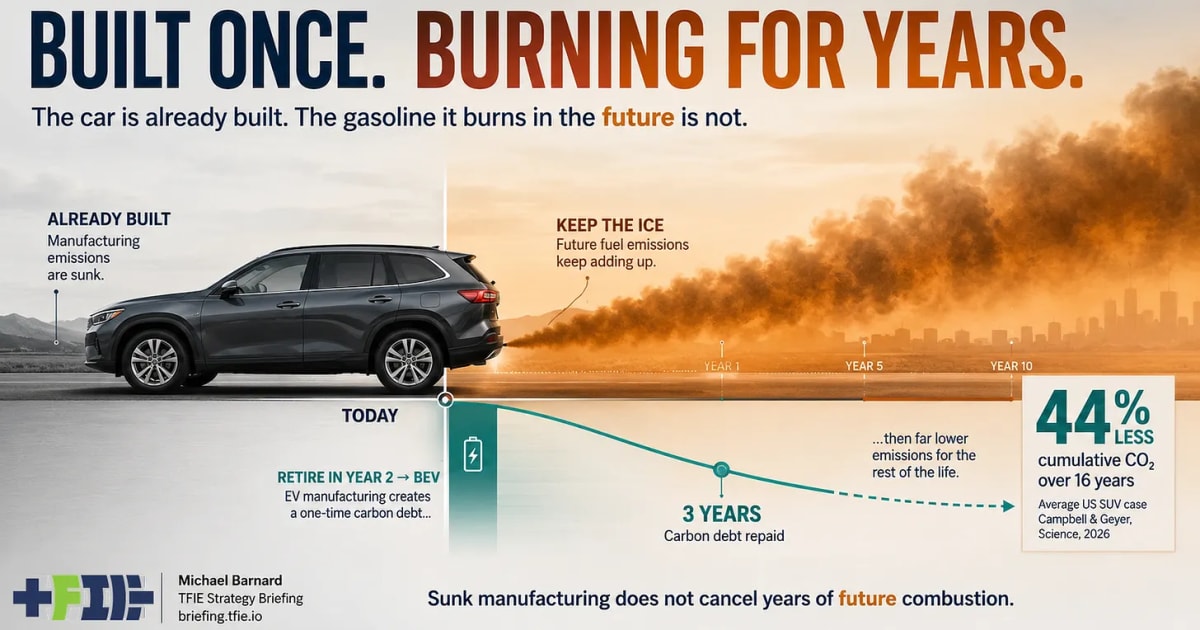
Here's the surprising part: for an average SUV on the typical US power grid, making the switch in year two cut total emissions by 44%. Yes, manufacturing a new EV creates an initial carbon bump, but cleaner driving erases that debt in just three years.
Lead researchers J. Elliott Campbell and Roland Geyer found that what matters most isn't the manufacturing emissions everyone worries about. The real game-changer is how much gasoline your old car keeps burning year after year.
They tested battery production emissions across a wide range, from very clean to quite dirty factories. That difference only changed results by 13 percentage points. Meanwhile, how efficiently vehicles burn fuel or use electricity mattered more than twice as much.
The math is straightforward once you think about it. Your old gas car's manufacturing emissions are already in the atmosphere, so they don't count in the decision you face today. The real question is whether future gasoline burning outweighs making one new electric vehicle.
Not every gas car makes sense to replace, though. Vehicles driven fewer than 4,400 miles yearly should probably stay on the road. Very efficient hybrids also aren't great candidates for early retirement.
The study found replacing plug-in hybrids with battery EVs actually increased emissions by 11%. The greenest strategy targets gas-guzzling SUVs and high-mileage trucks that burn the most fuel.
The Ripple Effect
This research gives both individual car owners and policymakers clearer guidance on accelerating emissions reductions. Previous programs paid people the same amount regardless of which vehicle they scrapped, essentially wasting money retiring efficient cars when gas-guzzlers stayed on roads.
Earlier modeling showed that targeting payments toward the worst polluters could cut public costs in half while removing the same amount of carbon. Smart policy could transform America's 280 million passenger vehicles from climate liability to climate solution much faster than waiting for natural turnover.
The findings arrived at the perfect moment, as electric vehicle prices drop and charging infrastructure expands across the country. What once seemed like an environmental trade-off turns out to be a clear win for the planet.
Your next car choice just got a lot simpler.
More Images
Based on reporting by CleanTechnica
This story was written by BrightWire based on verified news reports.
Spread the positivity!
Share this good news with someone who needs it