New Tool Tracks Air Pollution Across State Lines
Scientists created a simple tool that shows which states are responsible for deadly air pollution that crosses borders. The breakthrough could help protect communities suffering from pollution they didn't create.
A groundbreaking tracking system is revealing which states are sending deadly air pollution across their borders and which communities are paying the price with their health.
Researchers at the University of Notre Dame developed a straightforward tool that maps how microscopic particles called PM2.5 travel between states. These tiny pollutants contribute to 100,000 premature deaths in America each year, and the new study shows that 40% of these deaths come from pollution that crosses state lines.
The research team created something surprisingly simple yet powerful. Instead of relying on complex models that only experts can use, they built a practical framework that any policymaker can understand and apply.
The findings published in Environmental Research Letters reveal stark inequalities. More than half of U.S. states are net exporters of air pollution, meaning they send more pollution to their neighbors than they receive. Meanwhile, less than one fifth are net importers, bearing the health burden of pollution created elsewhere.
Florida emerged as the largest exporter, affecting Georgia and the Carolinas. States across the Upper Midwest, Mid-Atlantic, and Southeast also export significant pollution, along with California, Oregon, and Washington.
The timing matters deeply. In January 2026, the Environmental Protection Agency announced it would stop calculating the economic value of health benefits from air pollution rules. This new research offers an alternative approach focused purely on health data rather than economic calculations.
"Our analysis gives states an evidence-based way to demonstrate when cross-state pollution exceeds safe thresholds and threatens public health," said Drew Marcantonio, one of the study's authors. Policymakers can now use clear health risk data instead of relying solely on economic evaluations.
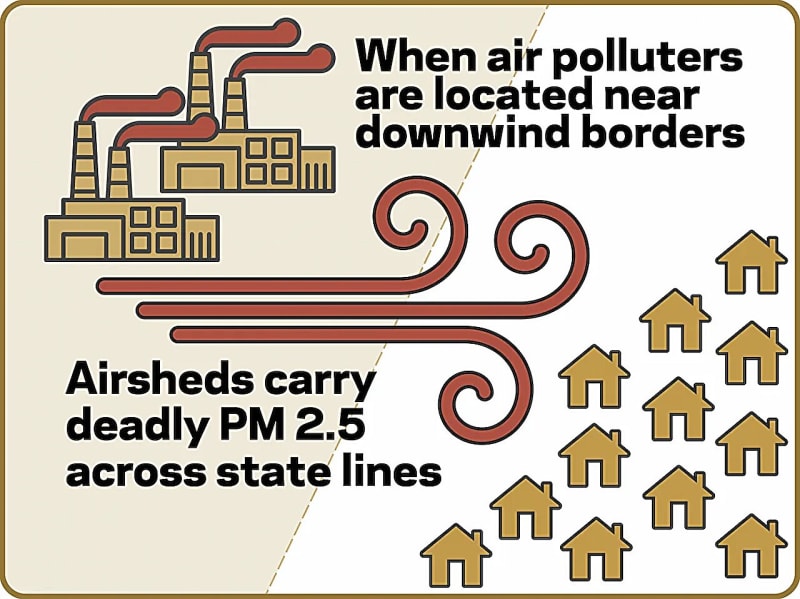
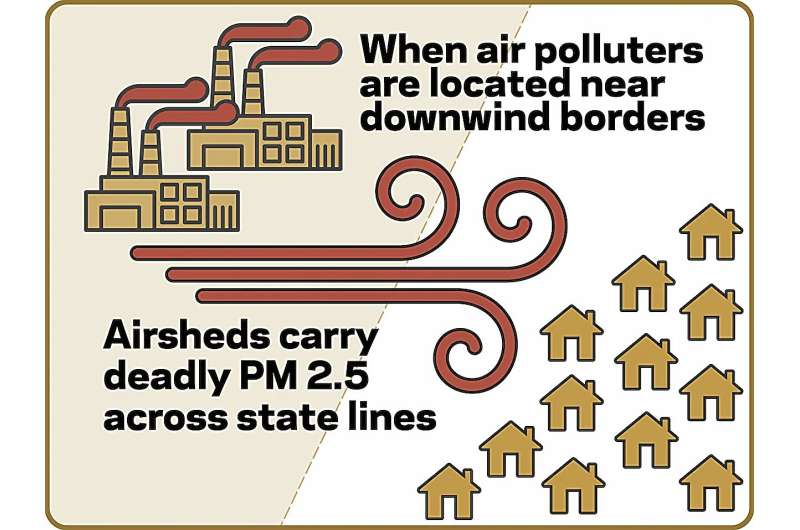
The tool works by tracking concentrations of PM2.5 that exceed safety limits and mapping how prevailing winds push these particles across state boundaries. It's based on the concept of an airshed, where air moves together as a single unit, similar to how water flows through a watershed.
Previous research showed that major polluters are more likely to locate near downwind state borders. This allows states to enjoy economic benefits from industry while avoiding the worst health consequences, which fall on neighboring communities instead.
The Ripple Effect
The research team designed their tool to work globally, not just in America. In many countries, regulators lack access to expensive, complex air quality models but face the same problem of pollution crossing political boundaries and harming innocent communities.
The framework is already being extended worldwide through a multi-year project aimed at helping resource-limited regions protect their residents. Simple, data-driven approaches mean more communities can identify pollution sources and advocate for their health.
Even as overall air pollution has dropped 35% since 1998, the percentage of deaths from cross-state pollution has stayed constant at 40%. This shows that location matters as much as total pollution levels when it comes to protecting public health.
The tool gives downwind communities something they've never had before: clear evidence of exactly where harmful pollution originates and who bears responsibility for protecting them.
More Images

Based on reporting by Phys.org - Earth
This story was written by BrightWire based on verified news reports.
Spread the positivity!
Share this good news with someone who needs it