Osaka AI Robot Boosts Solar Efficiency to 24.4%
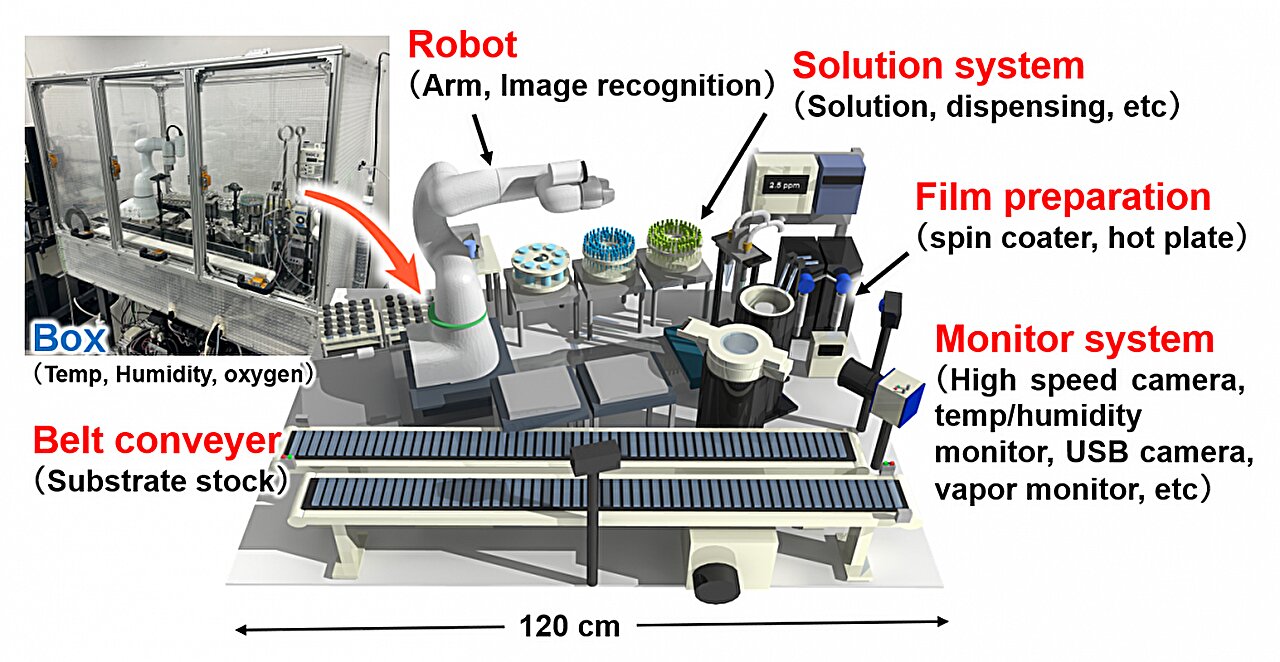
Osaka University researchers developed an automated robotic platform that uses artificial intelligence to perfect perovskite solar cell production in real time. The innovative approach captures droplet physics at millisecond speeds, propelling cell efficiency to an impressive 24.4%.
Harnessing the full power of the sun just became remarkably easier thanks to an ingenious fusion of robotics and smart software. Clean energy dreamers have long celebrated next-generation solar technology as the future of renewables, and today that vision took a massive leap forward.
Researchers at Osaka University in Japan have unveiled a robotic platform that solves one of clean energy's most frustrating scientific challenges. Their automated system monitors and perfects the delicate fabrication of perovskite solar films in real time, unlocking an impressive 24.4% power conversion efficiency.
Traditional solar panels rely on thick silicon wafers that require intense heat and complex manufacturing to produce. In contrast, perovskite materials can absorb light in microscopic layers while being printed from inexpensive liquid solutions.
Despite their massive potential, perovskites have long presented a tricky hurdle for laboratory researchers. Creating high-performance films has traditionally felt like an unpredictable baking experiment where the slightest draft ruins the cake.
Tiny shifts in ambient humidity, room temperature, or evaporation rates can cause crystalline defects in the drying liquid. When these microscopic flaws appear, the final solar cell loses its ability to convert sunlight into electricity efficiently.
For years, researchers had to rely on slow and tedious trial-and-error testing to find ideal manufacturing recipes. Scientists would adjust one variable by hand, wait hours for the film to set, and hope for a decent outcome.
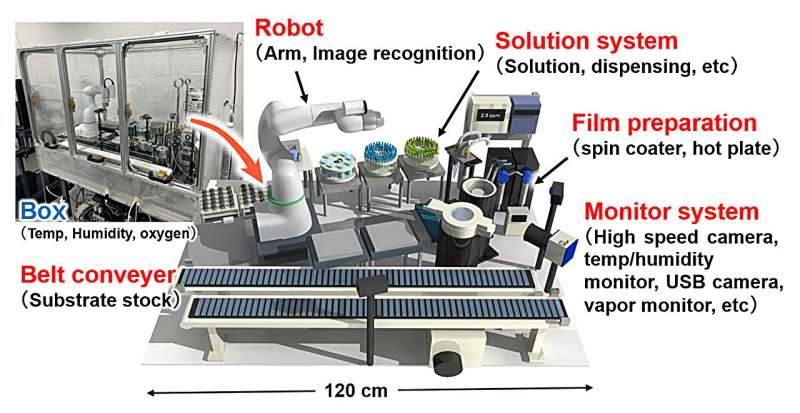
The Osaka University team decided to eliminate this guesswork by bringing artificial intelligence and high-speed robotics into the cleanroom. They engineered a dynamic setup that observes crystal formation as it happens on a millisecond scale.
Lead author Ryosuke Kado explained that the mission was to move beyond blind luck by measuring physical reactions during active synthesis. The innovative platform synchronizes liquid deposition with hyper-fast optical cameras and environmental sensors.
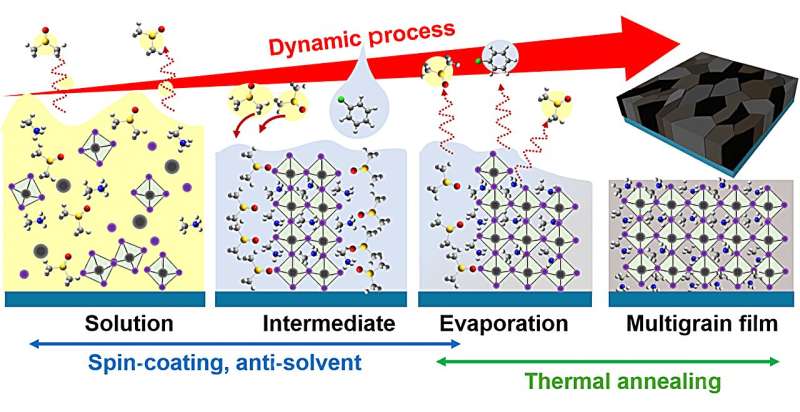
To make a pristine perovskite film, technicians drop an antisolvent liquid onto the spinning base material to trigger crystallization. Until now, no human could track exactly how those splashing droplets altered the material at the molecular level.
This robotic system captures color shifts across the liquid film in mere fractions of a second. High-speed optical tools resolve the exact motion, trajectory, and impact behavior of antisolvent droplets within two milliseconds.
Machine learning algorithms then digest this avalanche of high-speed visual and environmental information. The artificial intelligence uncovers hidden connections between droplet timing and crystalline quality that human eyes could never detect.
Senior author Akinori Saeki emphasized that automated data collection provides richer insights than any manual process could ever yield. By translating complex physics into clear mathematical guideposts, the algorithm revealed the exact recipe for flawless crystal growth.
Using these precise calculations, the Japanese team fabricated a lead-based perovskite solar device under fully optimized robotic conditions. The completed solar cell reached a remarkable 24.4% efficiency rating, proving that real-time observation directly improves renewable hardware.
The Ripple Effect
This robotic breakthrough extends far beyond the walls of an academic laboratory in Osaka. Because perovskite films are remarkably flexible and lightweight, mastering their production opens up endless possibilities for green architecture.
Builders could soon integrate these ultra-thin solar coatings directly into curved skyscraper windows, roof tiles, and exterior facades. Electric vehicles and consumer electronics could also generate continuous self-charging power from ambient daylight without heavy, bulky panels.
The automation platform also paves the way for commercial factories to mass-produce perovskite solar cells with consistent, dependable quality. Overcoming manufacturing variance has been the primary barrier holding this clean technology back from store shelves.
Furthermore, this research model offers an exciting blueprint for other clean energy discoveries across the globe. Materials scientists can now deploy similar AI robotics to accelerate the design of longer-lasting electric vehicle batteries and green hydrogen devices.
By allowing smart machines to decode complex physical transformations, researchers can shave decades off the development of vital climate technologies. Scientific discoveries that once took whole careers of manual labor can now unfold in a matter of weeks.
With intelligent robots illuminating the mysteries of solar energy, a cleaner and more vibrant planet is racing closer than ever.
More Images
Based on reporting by Phys.org - Technology
Building Something New? Try the BrightWire Tech Stack Advisor
Compare modern frameworks, cloud hosting, and AI tools tailored to your project budget and scale.
Spread the positivity!
Share this good news with someone who needs it