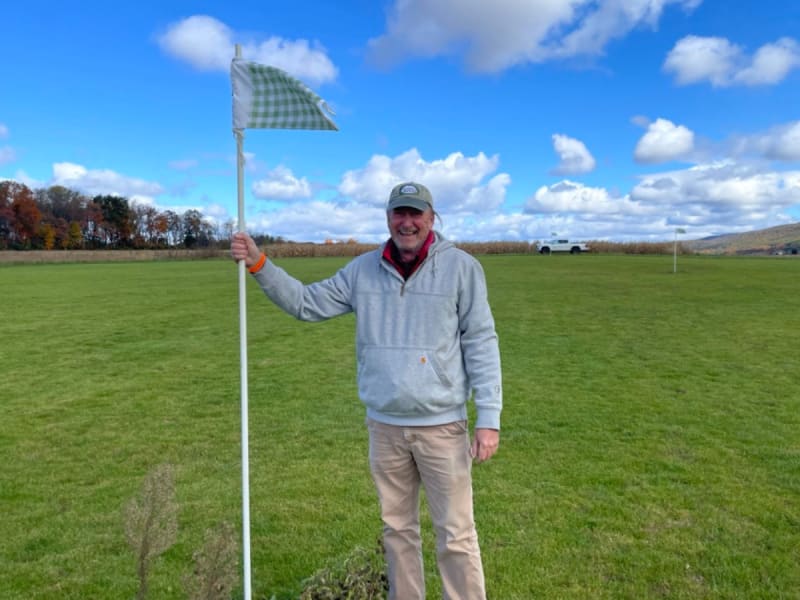
Professor's 26-Year Grass Project Becomes Thriving Startup
After 26 years of research, Penn State professor David Huff solved a century-old golf course problem and launched a startup that sold out its entire inventory in its first year. His specialty grass seeds are now booked through 2027.
A Penn State professor who spent more than two decades perfecting a seemingly impossible grass is now running a booming business that's changing golf courses across America.
David Huff came to Penn State in 1994 with one goal: breed better annual bluegrass for golf courses. The grass had perfect traits like dense growth and natural dwarfism, allowing it to survive extreme mowing heights of less than one-tenth of an inch.
But there was a massive problem. No commercial seed existed, forcing golf courses to either use inferior grass or wait 50 to 100 years for wild bluegrass to naturally evolve into the premium strain they needed.
"There was no one out there helping the golf industry with this problem," Huff said. After collecting seeds from across the U.S. and Europe, he spent 13 years breeding and perfecting 10 beautiful grass strains.
Then disaster struck. When Huff tried producing seeds from his perfect grasses, they lost their valuable dwarf traits and reverted to common weeds. It took another 13 years and three graduate students to solve the mystery and develop a production process that maintained the grass's prized characteristics.
After 26 years of research, Huff finally had seeds ready for testing. Five golf courses across the country confirmed what he'd been working toward: the grass performed beautifully.
Huff originally planned to license his discovery to a seed company. But the production process was so complex and novel that Penn State's Office of Technology Transfer suggested something bigger: launch a startup.
"I thought, 'I can't do that, I'm faculty, it's a conflict of interest,'" Huff recalled. Penn State assured him they had support systems in place to manage exactly that.
Huff won the People's Choice Award at the Ben Franklin Technology Partners Big Idea Contest. He connected with Martin Brill, a business consultant who became his mentor. He attended entrepreneurial workshops and learned from other first-time founders who were just as uncertain as he was.
"Starting a new company like this was very scary," Huff said. "I wasn't planning on it, and I haven't been trained for it. But everyone encouraged me, and that's what propelled me forward."
The Ripple Effect
PennPoa launched sales in 2025 and immediately sold out both its 2024 and 2025 crops. Orders are already coming in for 2026 and 2027, meaning golf courses nationwide won't have to wait a century for premium grass anymore.
The startup received funding through Penn State's Research Applications for Innovation grants program and now leases college-owned land for seed production. Huff recently joined the Invent Penn State Startup Leadership Network Board of Advisors program to help guide the company's next phase.
What started as an academic curiosity became a thriving business solving a problem the entire golf industry had simply accepted as unsolvable.
Based on reporting by Google News - Startup Success
This story was written by BrightWire based on verified news reports.
Spread the positivity!
Share this good news with someone who needs it