Punjab Farmer Doubles Income Growing 40 Exotic Flowers
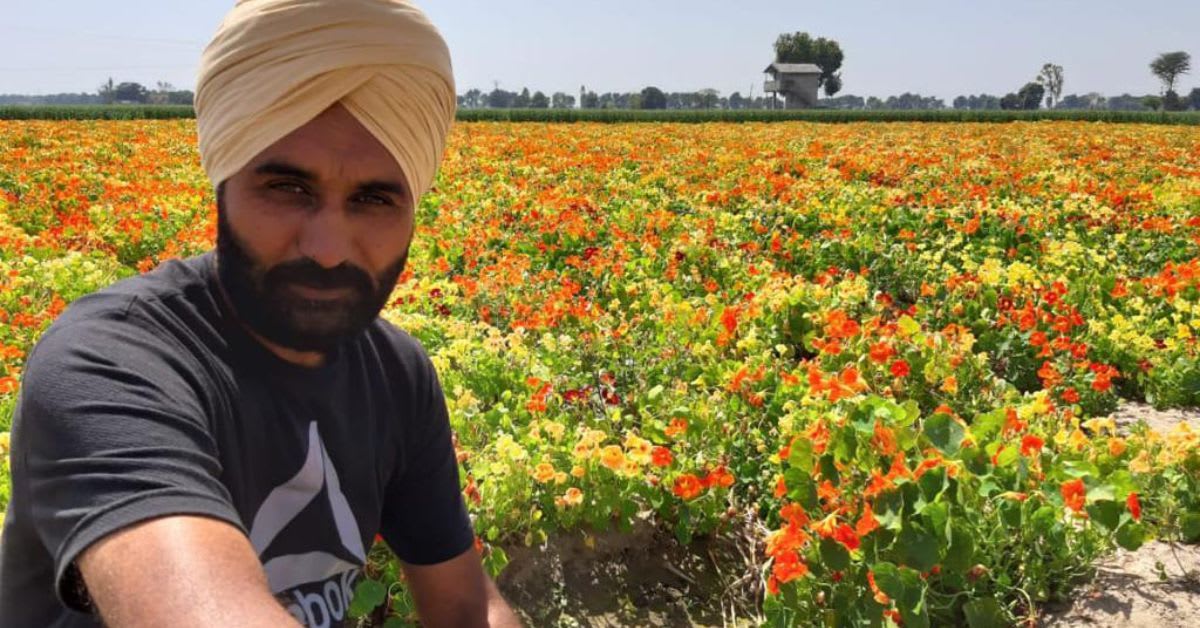
A Punjab farmer ditched traditional wheat cultivation for exotic flowers and now earns twice as much from 22 acres of blooms. He even invented a machine to help other farmers do the same.
While his family farmed wheat for generations in Punjab's Nanowal village, Gurwinder Singh Sohi saw farmers working endless hours for minimal income and knew there had to be a better way.
In 2008, the 45-year-old made a bold switch from wheat to flowers, becoming the first farmer in Fatehgarh Sahib district to grow exotic blooms. Today, he cultivates 40 varieties including California poppies, gladiolus, and lupins across 22 acres, earning around Rs 1 lakh per acre.
"Despite the hard work farmers put into their fields day and night, they struggle to earn a decent income," Gurwinder tells reporters. "Floriculture can yield two to three times the income compared to traditional wheat farming."
The journey to flower farming wasn't straightforward. After finishing high school in 1993, Gurwinder tried his hand at selling tea leaves, running a poultry farm, and even customizing jeeps, but nothing stuck.
Everything changed when he learned the Punjab Horticulture Department was offering free Holland gladiolus bulbs. His father reluctantly gave him a tiny plot to experiment on, skeptical after years of watching his son quit various ventures.
Those first 10,000 bulbs bloomed after 90 days, and Gurwinder sold them in local markets. The success convinced him to expand, eventually growing his flower operation to 22 acres while introducing European and Israeli varieties.
But hand-planting thousands of flower bulbs was backbreaking work. A team of 30 laborers needed an entire day to plant just one acre, making the process expensive and slow.
The Ripple Effect
Gurwinder spent three years developing a semi-automatic planting machine that changed everything for flower farmers. His invention, which attaches to a tractor and drops bulbs through circular plates, now plants an acre with just five people in the same time it once took 30 workers a full day.
Punjab Agriculture University recognized the innovation's potential and awarded him a Rs 12 lakh grant. The machine doesn't just save time and labor costs, it proves that traditional farming wisdom can be improved with creative thinking.
While many of Gurwinder's cousins and his sister moved abroad for work, he chose to stay in his village and build something meaningful. He produces around 10 tonnes of flowers each five-month season, proving that innovation and traditional agriculture can bloom together.
Punjab's sandy loam soil and ideal pH levels make it perfect for flower cultivation, a resource Gurwinder believes more farmers should tap into. His success shows that sometimes the path to prosperity means planting something entirely different.
More Images
%2Fenglish-betterindia%2Fmedia%2Fpost_attachments%2Fuploads%2F2023%2F09%2Fgurwinder-singh-1693544222.jpg)

%2Fenglish-betterindia%2Fmedia%2Fpost_attachments%2Fuploads%2F2023%2F09%2Fgurwinder-singh-3-1693544589.jpg)
Based on reporting by The Better India
This story was written by BrightWire based on verified news reports.
Spread the positivity!
Share this good news with someone who needs it