Punjab's Hidden Craft: Making Sports Gear for Global Brands
For decades, a mid-sized city in Punjab quietly made footballs and cricket bats for Nike, Adidas, and Puma, supplying 130 countries. Despite losing ground to Chinese automation, Jalandhar's craftspeople still produce hand-stitched gear for the world's biggest sports brands.
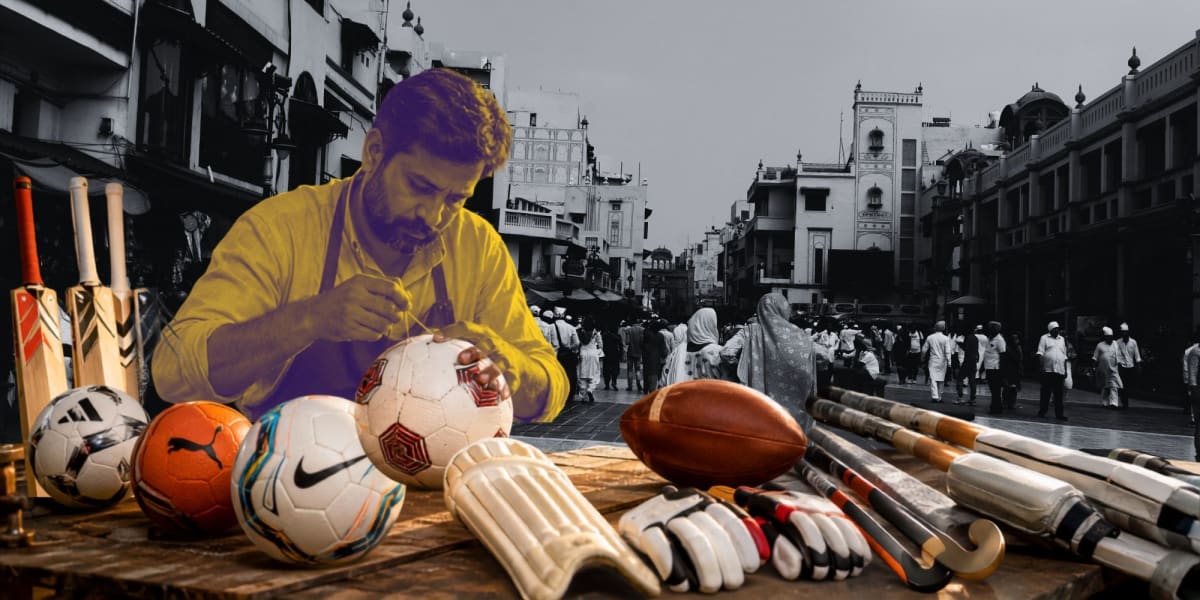
The next time you open a box containing a brand-new football or cricket bat, there's a good chance it was hand-stitched by someone in Jalandhar, a city in Punjab that once dominated the global sports equipment trade.
After the 1947 Partition, skilled craftspeople migrated from Sialkot in Pakistan and rebuilt their sporting goods industry from scratch in Jalandhar. By the 1980s and 90s, this single cluster supplied 90% of India's sports goods exports to more than 130 countries.
This wasn't cheap assembly line work. Jalandhar became known for labor-intensive craftsmanship: hand-stitched footballs, precision-carved cricket bats using Kashmir willow, and carefully crafted hockey sticks. Small workshops and home-based artisans produced gear stamped with names like Nike, Reebok, Adidas, Puma, and Slazenger.
Then came the shift. Chinese manufacturers introduced automation and lower production costs that traditional workshops couldn't match at scale. Jalandhar's share of India's sports goods exports dropped from 90% to around 35%, with inflatable balls still making up about 60% of production.
But here's what's remarkable: Jalandhar didn't disappear.
The Bright Side
What saved the industry is exactly what made competing on price difficult in the first place. Hand-stitched balls and traditional protective gear don't automate easily, and Jalandhar's craftspeople still hold a genuine edge in these specialized categories.
The workshops continue serving buyers across Europe and North America, with the UK, US, Germany, France, and Australia among their largest customers. More than 500,000 livelihoods across India depend on the sports goods sector, most tied to these clusters, with many positions filled by women in this historically labor-intensive trade.
India's sports goods exports reached $400 million in 2025, up 8% from the previous year. While that's a fraction of China's global market position, Jalandhar proves that specialized craftsmanship can carve out space even against cheaper, automated competition.
The city's arc tells an important story about manufacturing: owning an industry completely doesn't guarantee owning it forever, but deep skills and specialized knowledge can keep you in the game even when the rules change.
Those hand-stitched seams on your new football represent more than just quality craftsmanship, they're proof that tradition and expertise still have market value in an automated world.
More Images

Based on reporting by YourStory India
This story was written by BrightWire based on verified news reports.
Spread the positivity!
Share this good news with someone who needs it