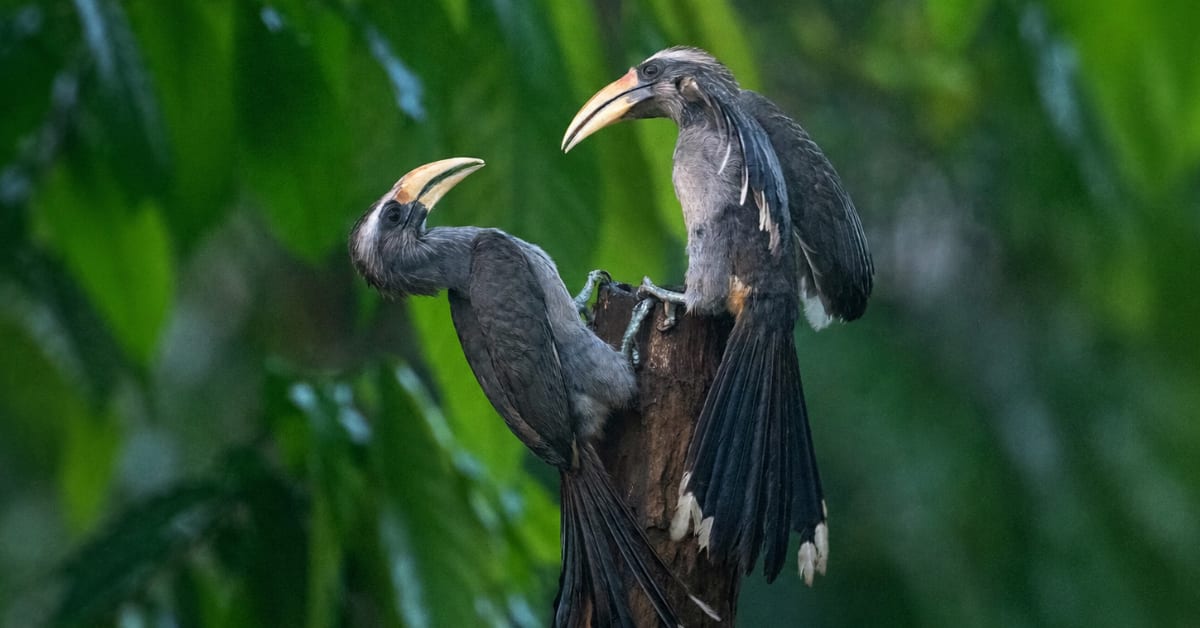
Rare Hornbills Return to India's Gir After 60 Years
For the fourth year running, Indian grey hornbills are breeding in Gujarat's Gir forest after vanishing for six decades. Their comeback proves the forest is healthy enough to support one of nature's pickiest birds.
After disappearing from Gujarat's Gir landscape in the 1960s, Indian grey hornbills are raising chicks again for the fourth consecutive year.
The bird's return marks more than just a conservation victory. It reveals that Gir's forest has regained the ancient trees, connected habitats, and ecological balance these choosy birds absolutely require.
Between 2021 and 2023, conservationists released around 40 hornbills in carefully planned phases. Scientists now say the population shows signs of becoming self-sustaining, with birds nesting, raising young, and claiming territories just like their wild ancestors did.
Unlike adaptable species that settle anywhere, hornbills refuse to compromise. They need mature forests filled with giant native trees that have developed natural cavities over decades, perfect for their unusual nesting habits.
When breeding season arrives, female hornbills enter these tree hollows and seal themselves inside with mud and fruit pulp, leaving only a narrow slit. The male spends weeks delivering food through this opening until the chicks mature enough to emerge.
This remarkable strategy works only when old trees survive. Cut down a nesting tree, and an entire breeding season vanishes with it.
The Ripple Effect
Hornbills do more than just live in forests. They actively build them.
These birds feast on figs, berries, and large fruits that smaller birds cannot carry. After feeding, they fly several kilometers before dropping seeds far from parent trees, giving new saplings room to grow without competition.
Researchers call them "farmers of the forest" because many native tree species depend on hornbills to spread their seeds across long distances. Without these winged gardeners, forests struggle to regenerate naturally.
Their presence also signals forest health to scientists. When hornbills thrive, it means the landscape has retained its structure, diversity, and ecological balance needed to support countless other species.
The Gir program succeeded because teams did more than release birds. Forest officials restored habitat, tracked movements, monitored breeding success, and involved local communities in protecting the landscape for years before the first hornbills arrived.
Now those efforts are paying off. The birds that once abandoned Gir are planting the seeds of tomorrow's forest, one flight at a time.
More Images
%2Fenglish-betterindia%2Fmedia%2Fmedia_files%2F2026%2F07%2F17%2Findian-grey-hornbills-gir-2026-07-17-15-47-09.png)
%2Fenglish-betterindia%2Fmedia%2Fmedia_files%2F2025%2F11%2F20%2Fwild-at-heart-banner-image-microsite-banner-2025-11-20-16-17-04.jpg)
%2Ffilters%3Aformat(webp)%2Fenglish-betterindia%2Fmedia%2Fmedia_files%2F2026%2F07%2F17%2Findian-grey-hornbills-gir-2026-07-17-12-53-24.png)
Based on reporting by The Better India
This story was written by BrightWire based on verified news reports.
Spread the positivity!
Share this good news with someone who needs it