Ravens Outsmart Wolves Using Memory, Not Tracking
Scientists thought ravens followed wolves to find food. New tracking data from Yellowstone reveals these brilliant birds use spatial memory instead, flying up to 155 kilometers directly to where kills are likely to happen.
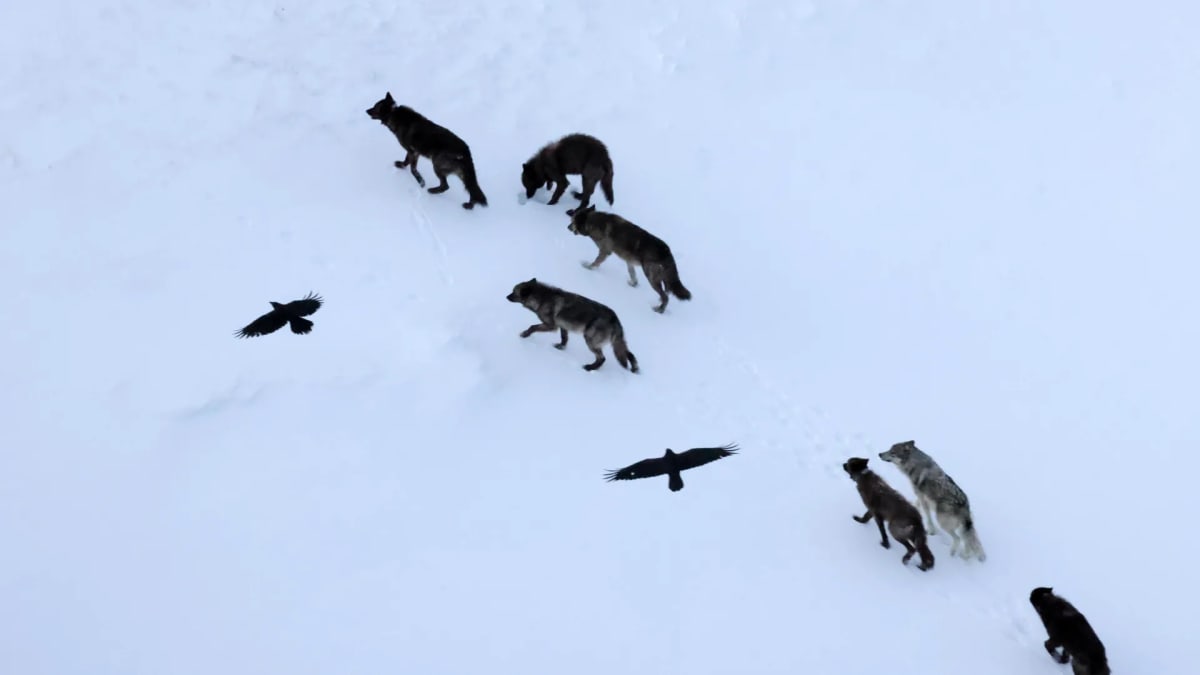
When wolves take down prey in Yellowstone, ravens arrive so quickly it seems like magic. For years, scientists assumed these clever birds simply followed wolf packs around, waiting for dinner.
They were completely wrong.
A groundbreaking study tracking 69 ravens and 20 wolves over two and a half years reveals something far more impressive. Ravens memorize the landscape like a mental map, learning exactly where wolf kills are most likely to occur and flying straight there from huge distances.
Dr. Matthias Loretto from the Max Planck Institute of Animal Behavior led the research published in Science. His team discovered that ravens traveled up to 155 kilometers in a single day, heading directly toward productive hunting zones even when no kill had happened yet.
The researchers found only one instance of a raven actually following a wolf for more than a kilometer. "At first, we were puzzled," says Loretto. If ravens weren't tailing wolves, how did they arrive so fast at fresh kills?
The answer lies in pattern recognition. Wolves hunt more successfully in certain areas like flat valley bottoms. Ravens remember these high-yield zones and check them regularly, even flying six hours nonstop to reach them.
Getting the data wasn't easy. Ravens are so observant they rarely fall for traps. The team had to disguise their equipment carefully, sometimes using fast food wrappers near campsites to blend in naturally.
Dr. Dan Stahler, a Yellowstone biologist who has studied wolves since their reintroduction in the mid-1990s, thought the connection seemed obvious. "We all assumed that the birds had a very simple rule: just stick close to the wolves," he says. Nobody had tested it until now.
The research shows ravens still use wolves as short-range clues, listening for howls or watching behavior when nearby. But for long-distance navigation, they rely on something more sophisticated: learning where the landscape itself creates opportunities.
Why This Inspires
This discovery changes how we think about animal intelligence. Ravens aren't just opportunistic scavengers reacting to what's in front of them. They're strategic planners who study their environment, recognize patterns over time, and make calculated decisions about where to invest their energy.
"We already knew that ravens can remember stable food sources, like landfills," Loretto explains. "What surprised us is that they also seem to learn which areas wolf kills are more common." They understand that while a single kill is unpredictable, some parts of the landscape consistently deliver better results.
It's a reminder that the natural world contains intelligence we're only beginning to understand. Ravens have been sharing Yellowstone with wolves for millions of years, and they've developed strategies that make perfect sense once you see the world from their perspective.
Sometimes the smartest move isn't following the crowd. It's remembering what worked before and trusting your own brilliant mind to get you there.
Based on reporting by Science Daily
This story was written by BrightWire based on verified news reports.
Spread the positivity!
Share this good news with someone who needs it