Red Lake Entrepreneur Builds 80 EV Stations on Tribal Land
Bob Blake turned a protest moment into action, building a network of 80 electric vehicle charging stations owned by tribal nations across the Midwest. His nonprofit keeps revenue flowing to rural Native communities instead of outside developers.
A decade ago, Red Lake Nation member Bob Blake stood at a pipeline protest in North Dakota, sand swirling from helicopter blades above, and realized there had to be a better way to fight for energy independence.
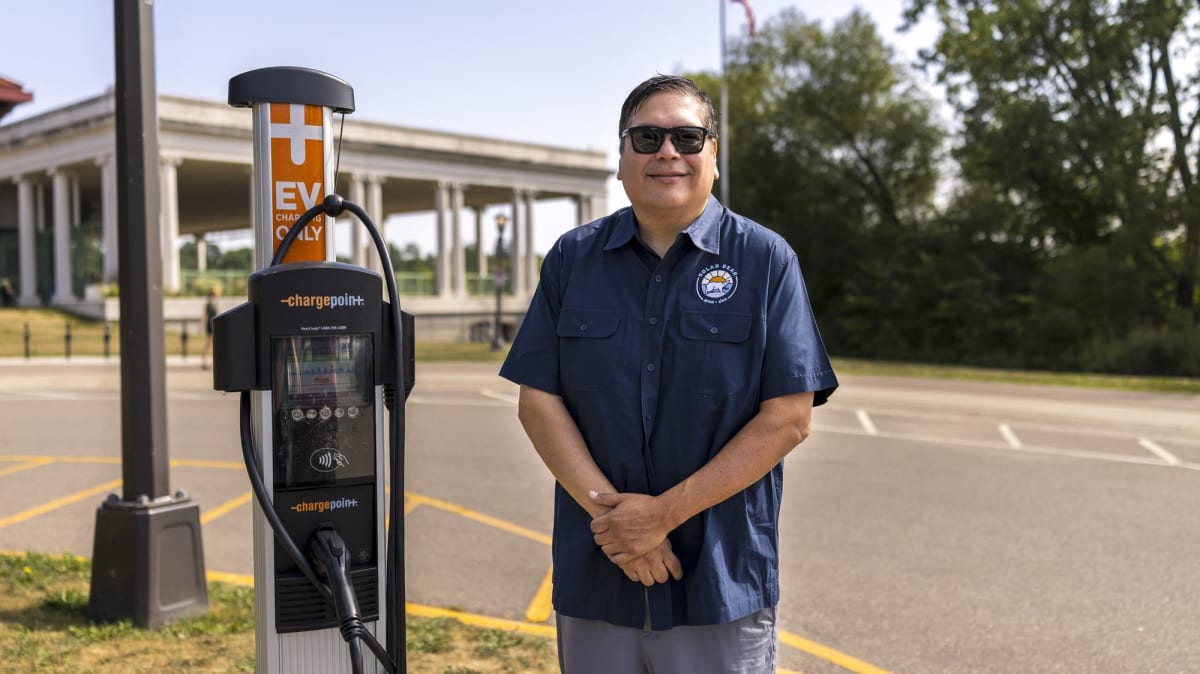
That moment sparked Electric Nation, a project that has now installed 80 electric vehicle charging stations on tribal land across the Midwest. Blake's nonprofit, Native Sun Community Power Development, builds each station and then signs it over to the tribe where it sits.
The model flips traditional energy development on its head. Most developers hold onto charging stations as assets, selling power and collecting revenue for decades. Blake gives ownership directly to tribal nations, keeping money in communities that rarely see this kind of investment.
"If the fossil fuel companies are going to continue to build pipelines through tribal nations' homelands, then we're going to build an electric vehicle charging station network pipeline through our communities," Blake said. "They may win the battle, but we're going to win the war."
At the Shakopee Mdewakanton Sioux Community charging station south of the Twin Cities, a full electric vehicle charge costs about fifteen dollars. That's a fraction of the fifty dollar plus gas fill-ups hitting drivers at pumps hovering around four dollars a gallon.
The project grew bigger than Blake ever imagined. Someone pointed out that his small nonprofit had completed an infrastructure project, which hadn't even been his original goal.
Building in tribal communities requires creative problem solving. Adam Crepelle, a law professor at Loyola University Chicago who studies economic development in Indian Country, explains that traditional business loans often rely on borrowing against owned property. On federal trust land, that option disappears since the government technically owns the land.
Blake has navigated these challenges using federal grant dollars. Last fall, the Trump administration canceled funding for phase two of Electric Nation, along with grants in seven other states based on how those states voted in the 2024 presidential election. Blake and other grantees sued the Department of Energy. The funding was restored this summer.
The Ripple Effect
The benefits extend far beyond reservation boundaries. When tribal nations thrive economically, surrounding communities feel the impact through new jobs and reduced poverty.
For Blake, renewable energy development connects directly to fighting poverty at Red Lake Nation, his home community that struggles with high unemployment and geographic isolation. "If I can fight poverty with renewable energy and distributed energy resources, then I can make my community healthier," he said.
His nonprofit has already begun installing more chargers across Minnesota, Wisconsin, and Michigan, building infrastructure that empowers tribal sovereignty one charging station at a time.
More Images
Based on reporting by Google News - Electric Vehicle
This story was written by BrightWire based on verified news reports.
Spread the positivity!
Share this good news with someone who needs it