Rice Team's Thread-Like Heater Cuts Industrial Emissions
Scientists turned carbon nanotubes into flexible heating threads that could help factories ditch fossil fuels. The breakthrough opens a new path for cleaning up industrial pollution.
📺 Watch the full story above
Scientists at Rice University just made heating gases look as simple as plugging in a space heater, and it could transform how factories fight climate change.
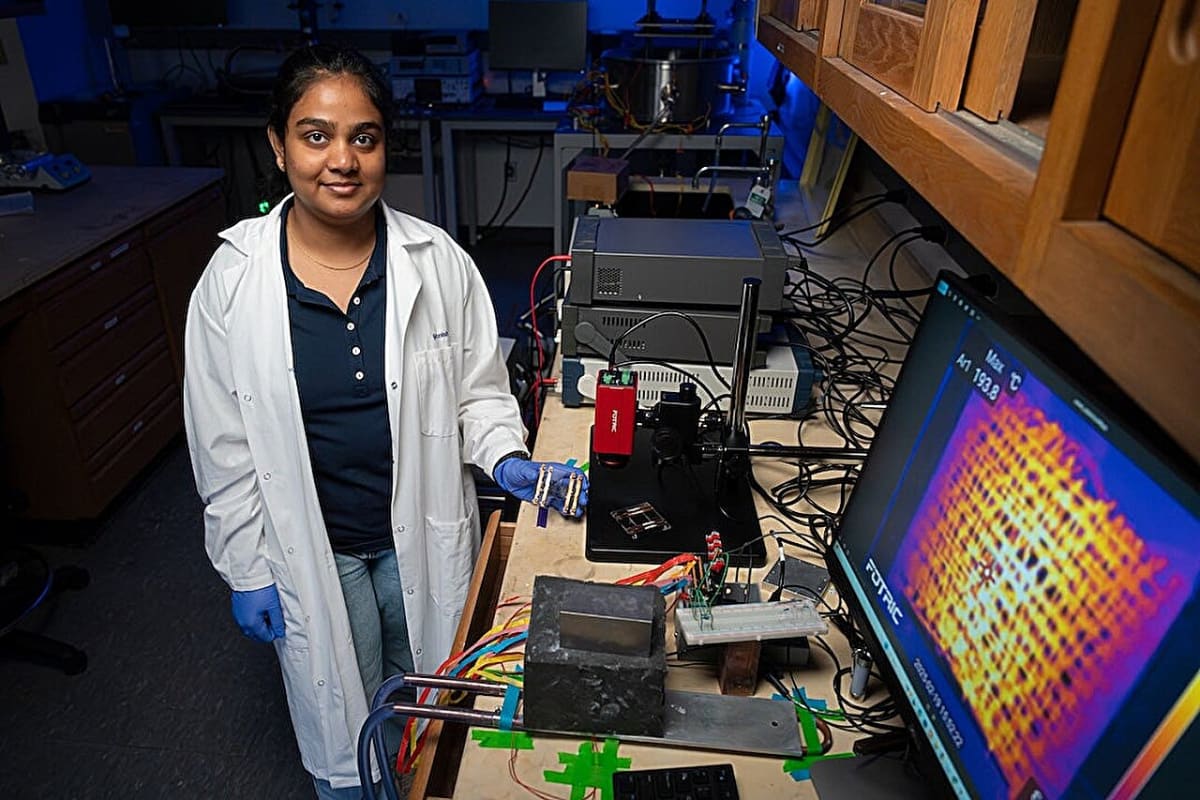
A team led by graduate student Monisha Vijay Kumar created electric heating elements from carbon nanotube fibers that look more like high-tech thread than traditional metal coils. Published in the journal Small, their research shows these fiber heaters deliver far more heating power per ounce than conventional metal heaters when placed directly in flowing gases.
The discovery matters because industrial facilities constantly heat gases for everything from chemical production to manufacturing. Right now, they burn fossil fuels to do it. Electric heating sounds like an obvious switch, but heating moving gases pushes materials to their breaking point with scorching temperatures and brutal mechanical stress.
"Electrifying industrial heat is one of the most important, and most difficult, pieces of decarbonization," Kumar explained. The team wanted to know if a completely different type of material could make it possible.
Carbon nanotube fibers turned out to be the answer. These lightweight, flexible threads combine the electrical resistance needed for heating with remarkable strength and unusually high heat conductivity. Unlike metal wires that struggle at tiny diameters, these fibers stay strong even when thin enough to transfer heat efficiently into gas streams.
The Rice team didn't just test individual threads. They woven, knitted, and assembled the fibers into lightweight fabrics using textile manufacturing techniques. Professor Vanessa Sanchez noted that textile approaches give extraordinary freedom to create three-dimensional heating structures that are porous, lightweight, and mechanically flexible while staying electrically functional.
The fibers' heat conductivity proved crucial for preventing hot spots, a common failure point in traditional heaters. "Their high thermal conductivity helps distribute heat and suppress localized hot spots," said Professor Geoff Wehmeyer, an expert in heat transport.
Professor Matteo Pasquali, who directs Rice's Carbon Hub, emphasized that these fibers behave completely differently from metal wires. You can even tie knots in them without breaking them, opening design possibilities that metal simply can't match.
The Ripple Effect
The breakthrough arrives at a critical moment for climate action. Industrial heating accounts for a massive share of global carbon emissions, but the technical challenges of electrification have kept many facilities burning fossil fuels. This new approach doesn't just replace one component but reimagines how industrial heating systems could work.
The textile-inspired manufacturing also means these heaters could be produced using existing fabric-making infrastructure. That familiarity could accelerate adoption in industries hungry for viable decarbonization pathways.
While the technology still needs real-world testing in industrial settings, the research demonstrates that carbon nanotube fibers aren't just laboratory curiosities anymore. They're becoming practical building blocks for cleaner manufacturing.
The path from laboratory bench to factory floor takes time, but this research just made industrial decarbonization look a little less impossible.
More Images



Based on reporting by Phys.org - Technology
This story was written by BrightWire based on verified news reports.
Spread the positivity!
Share this good news with someone who needs it