Robotic Hand Detaches, Crawls, and Beats Human Dexterity
Engineers in Switzerland just built a robotic hand that can do something yours can't: detach from its arm, crawl away, and work with two opposable thumbs. This breakthrough could transform surgery, rescue missions, and manufacturing.
📺 Watch the full story above
A robotic hand that detaches from its arm and scuttles across a table sounds like science fiction, but engineers at École Polytechnique Fédérale de Lausanne (EPFL) in Switzerland just made it real.
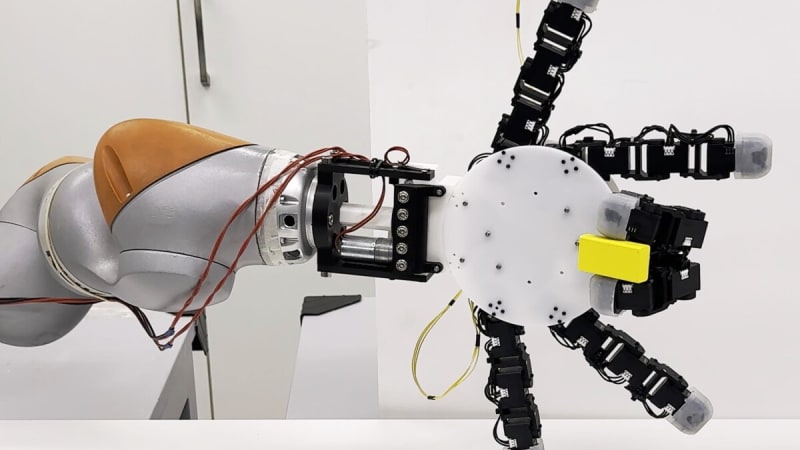
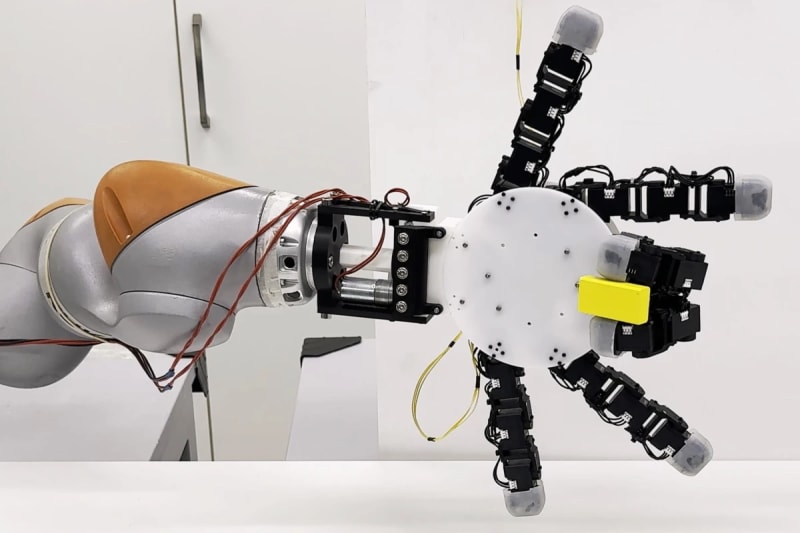
The new device outperforms human hands in controlled tasks, featuring up to six identical fingers that can perform 33 different grasping motions. Unlike traditional robotic hands that copy human design (and human limitations), this one breaks the rules entirely.
Here's what makes it special: the hand has two opposable thumbs, one at each end. The fingers bend both inward and outward, eliminating the concept of a fixed palm and back. Any finger can act as a thumb, giving the device flexibility humans simply don't have.
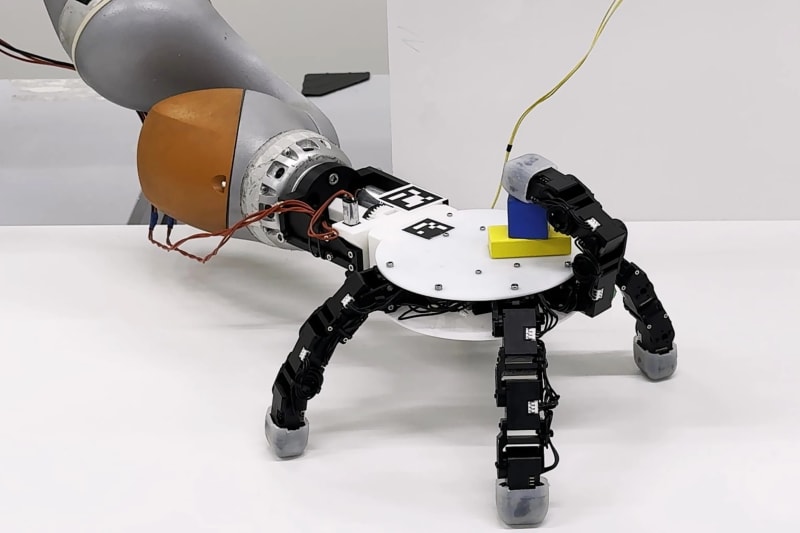
But the real party trick happens when the hand detaches from its robotic arm. Each finger operates independently, allowing the hand to crawl on its own to reach objects beyond the arm's range. Researchers call this "loco manipulation," combining movement with precision handling.
"We can easily see the limitations of the human hand when attempting to reach objects underneath furniture or behind shelves," says Aude Billard, who heads EPFL's Learning Algorithms and Systems Laboratory. Her team looked to nature for inspiration, studying how octopuses and praying mantises use their limbs for both movement and manipulation.
The symmetrical design means the hand can grasp a bottle, pick up a pen, and carry objects on its "back" simultaneously. It can reverse its palm position by simply bending fingers backward. For anyone who's ever wished they had an extra hand while cooking or building something, this device gets it.
Why This Inspires
The applications reach far beyond cool laboratory demos. In surgery, the hand could hold multiple instruments at once, speeding up procedures and improving precision. Bomb disposal teams could use it to retrieve dangerous objects from tight spaces without risking human lives.
Manufacturing could see the biggest impact. Any task requiring delicate, multi-step manipulation, from assembling electronics to intricate sewing, becomes faster and more precise. Even your morning coffee routine could eventually benefit from this technology.
The team believes any industry relying on fine dexterity will find uses for their creation. The hand's ability to work autonomously in confined spaces opens doors that current robotics simply can't reach.
This isn't about replacing human capability, it's about extending what's possible when we stop limiting machines to our own design.
More Images
Based on reporting by New Atlas
This story was written by BrightWire based on verified news reports.
Spread the positivity!
Share this good news with someone who needs it