Robots Get Human-Like Touch With New Graphene Skin
Scientists created artificial skin that lets robots feel pressure, texture, and even slipping objects as sensitively as human fingertips. The breakthrough could transform everything from surgery to prosthetics.
Robots can now feel the world almost like we do, thanks to a breakthrough in artificial skin that rivals the sensitivity of human touch.
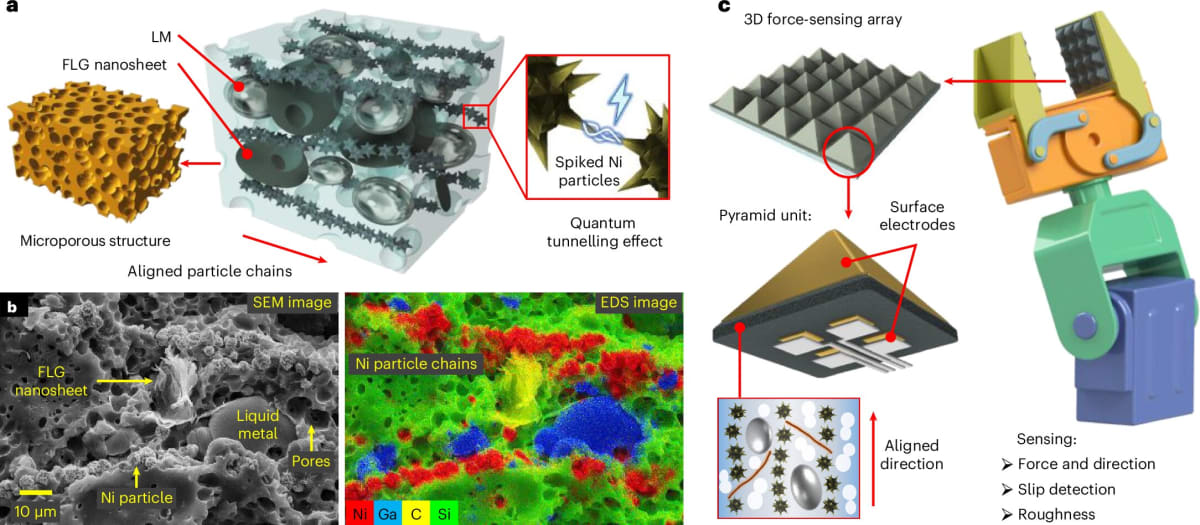
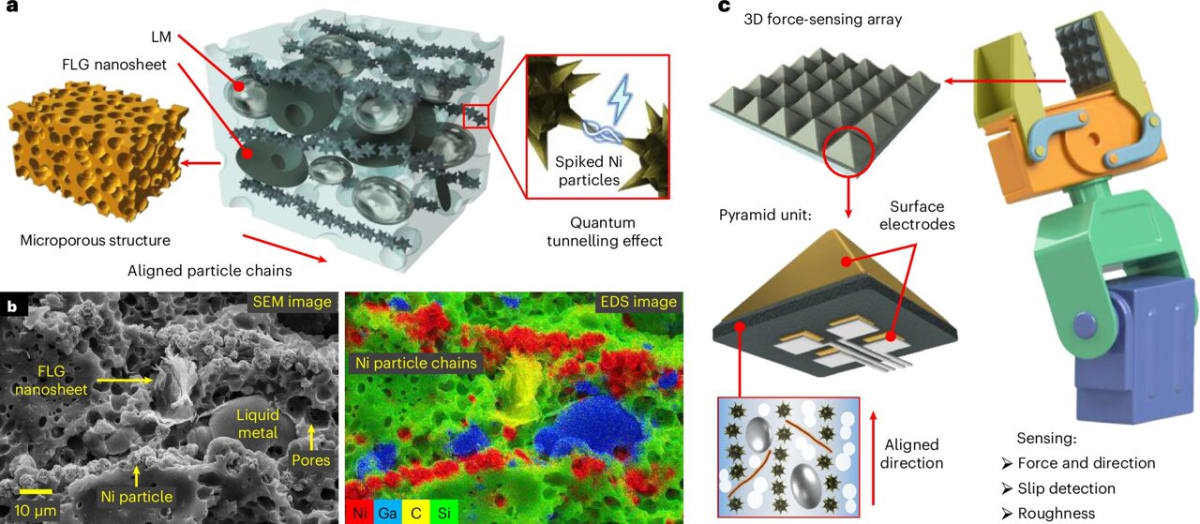
Researchers at the University of Cambridge developed a tiny tactile sensor using graphene and liquid metal that gives robots an incredibly detailed sense of touch. The sensor can detect not just pressure, but also which direction forces are coming from, whether objects are slipping, and how rough surfaces feel.
The technology works by mimicking human skin at a microscopic level. Scientists combined graphene sheets with metal droplets and nickel particles, then shaped them into tiny pyramids as small as 200 micrometers across. These pyramid structures concentrate stress at their tips, making the sensor sensitive enough to detect a single grain of sand.
What makes this remarkable is how much information it captures at once. Human fingers have multiple types of sensors that work together to understand touch, pressure, vibration, and texture simultaneously. Most artificial sensors struggle to match even one of these abilities while staying small and durable enough for real use.
The new sensor does something particularly clever with slip detection. By measuring signals from four electrodes beneath each pyramid, it can reconstruct the full three-dimensional force in real time. When robots equipped with these sensors tried picking up fragile paper tubes, they adjusted their grip automatically without crushing them.
Why This Inspires
This technology opens doors that seemed firmly closed just years ago. Imagine prosthetic limbs that let people truly feel what they're touching again, giving users natural control and confidence. Picture surgeons using micro-robots for delicate operations, with feedback precise enough to work at scales impossible for human hands alone.
The research team already demonstrated the sensors identifying tiny metal spheres by analyzing their mass, shape, and density through touch alone. That level of detail could revolutionize minimally invasive surgery and microrobotics, where current force sensors are simply too large to fit.
Professor Tawfique Hasan, who led the research, emphasized that most existing tactile sensors face major limitations. They're either too bulky, too fragile, too complex to make, or can't distinguish between different types of forces. His team's solution combines smart materials with nature-inspired structures to achieve performance remarkably close to human touch.
The researchers believe they can make these sensors even smaller, potentially below 50 micrometers, approaching the actual density of touch receptors in human skin. Future versions might also sense temperature and humidity, creating truly complete artificial skin.
As robots move from factories into homes, hospitals, and unpredictable real-world environments, advances like this become transformative. The findings, published in Nature Materials, show that machines are learning not just to see and move, but to genuinely feel their way through the world.
More Images
Based on reporting by Phys.org - Technology
This story was written by BrightWire based on verified news reports.
Spread the positivity!
Share this good news with someone who needs it