Saturn's Titan May Be Two Ancient Moons Merged Into One
Scientists just solved a cosmic mystery: Saturn's largest moon Titan might have formed when two ancient moons collided half a billion years ago. This discovery could explain Titan's smooth surface, shifting orbit, and even how Saturn got its famous rings.
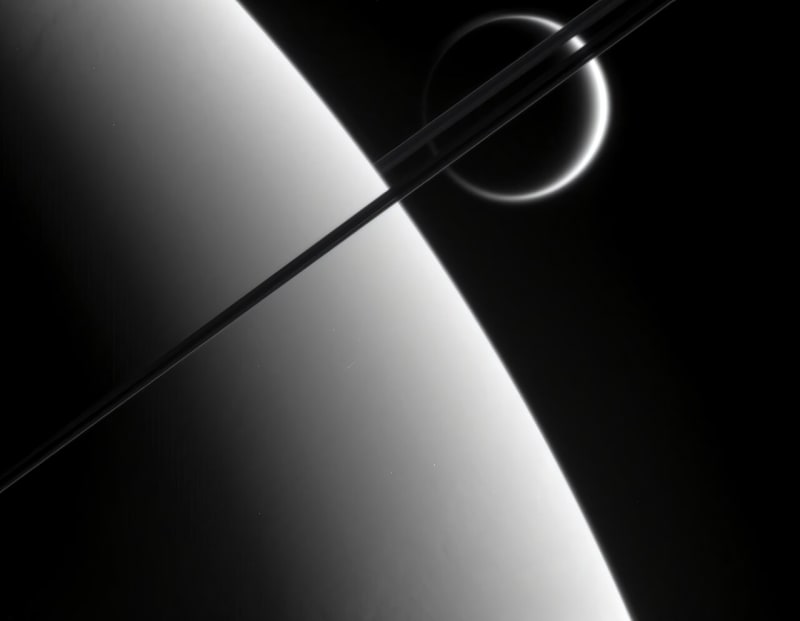
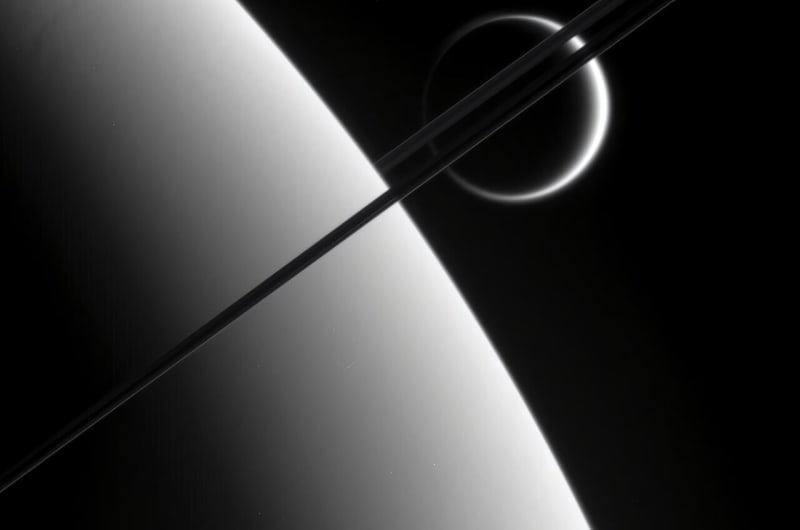
Scientists have uncovered evidence that Titan, Saturn's largest moon, is actually the result of an ancient cosmic collision between two older moons.
Researchers at the SETI Institute used computer simulations to trace back Titan's history and found something remarkable. The moon we see today likely formed when a "proto-Titan" merged with a smaller moon called "proto-Hyperion" roughly 500 million years ago.
The breakthrough came from studying Titan's odd behavior. NASA's Cassini spacecraft discovered that Titan's orbit is changing unusually fast, and the moon has surprisingly few impact craters for its age. These clues didn't match what scientists expected from a moon that formed billions of years ago.
Lead researcher Matija Ćuk found the smoking gun in an unlikely place: Hyperion, Saturn's tiny, tumbling moon. Hyperion's orbit is locked with Titan's, but that lock only formed a few hundred million years ago. In simulations, Hyperion kept disappearing unless it formed from debris after Titan's merger.
The collision would have been violent enough to erase Titan's old craters, explaining its relatively smooth surface. Before the merger, proto-Titan probably looked like Jupiter's cratered moon Callisto and had no atmosphere. The impact transformed it into the hazy, methane-rich world we know today.
Why This Inspires
This discovery shows how cosmic violence can create beauty. Saturn's magnificent rings likely formed from the same dramatic period, when unstable moons collided and scattered debris. What looks peaceful from Earth actually has an explosive origin story.
The research solves multiple mysteries at once. It explains why Titan looks so young, why its orbit is eccentric, and even why distant moon Iapetus has a tilted orbit. Sometimes one answer unlocks many doors.
NASA's Dragonfly mission will test this theory when it arrives at Titan in 2034. The nuclear-powered octocopter will analyze the moon's surface chemistry and geology, searching for chemical signatures of that ancient collision. If confirmed, it means Titan is literally two worlds becoming one.
Scientists are learning that our solar system's history is far more dynamic than we thought. Moons don't just sit quietly for billions of years. They crash, merge, and transform in ways that continue shaping the cosmic neighborhood we call home.
More Images
Based on reporting by Google News - Science
This story was written by BrightWire based on verified news reports.
Spread the positivity!
Share this good news with someone who needs it