Scientists Build 'Electron Catapult' for Solar Power
Researchers discovered vibrations can launch electrons across solar materials in 18 femtoseconds, opening new pathways for cheaper, more efficient solar energy. Instead of fighting molecular motion, scientists can now harness it as a tool.
Scientists at the University of Cambridge just discovered a way to make solar power work faster than anyone thought possible.
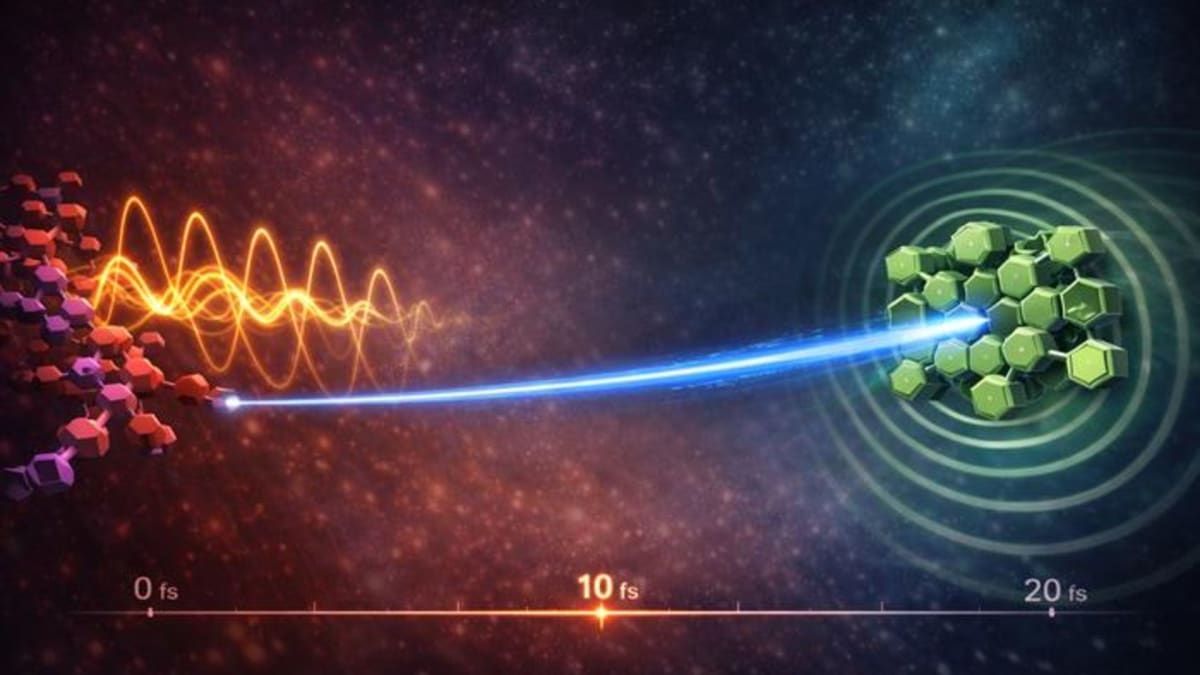
Researchers found that molecular vibrations can "catapult" electrons across solar materials in just 18 femtoseconds. That's 18 quadrillionths of a second, about as fast as a single molecule vibrates.
The discovery could unlock cheaper, more efficient ways to convert sunlight into electricity. Right now, organic solar cells using carbon-based materials could theoretically cost less than traditional silicon panels, but they're much less efficient at generating power.
"We're effectively watching electrons migrate on the same clock as the atoms themselves," said study co-author Pratyush Ghosh, a researcher who studies ultrafast spectroscopy at Cambridge.
Here's what makes this breakthrough special. Scientists previously thought you needed strong electronic coupling or large energy differences between materials to achieve fast charge transfer in solar cells. Both approaches have major drawbacks that limit how much voltage you can get from the device.
The Cambridge team used short laser pulses to watch what actually happens when light hits an organic solar cell. They discovered something completely unexpected.
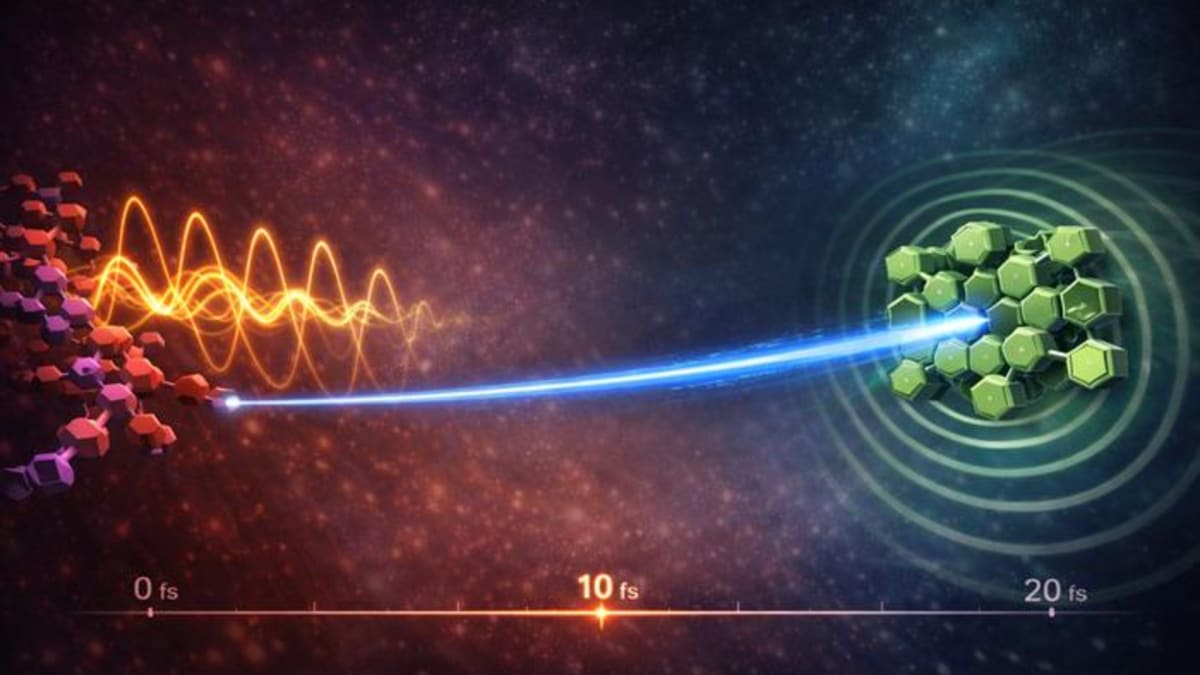
Vibrations in the donor molecule don't just accompany the electron transfer. They actively launch the electron across the junction to the acceptor molecule, like a molecular catapult firing its payload.
"Instead of drifting randomly, the electron is launched in one coherent burst," Ghosh explained. When the electron arrives, it triggers matching vibrations in the acceptor molecule, creating an overlap that speeds everything up dramatically.
Most similar systems take 100 to 200 femtoseconds for charge transfer, and many need ten to a thousand times longer. Seeing it happen in 18 femtoseconds within a single molecular vibration is extraordinary.
The Bright Side
This discovery completely flips the script on how scientists design solar materials. For years, researchers tried to suppress molecular motion because it seemed like it would slow things down or waste energy.
Now they can embrace it. "Instead of trying to suppress molecular motion, we can now design materials that use it, turning vibrations from a limitation into a tool," said study co-author Akshay Rao, a physicist at Cambridge.
The findings establish entirely new strategies for designing organic solar cells and materials. Scientists can now intentionally engineer vibrations into solar materials to speed up charge transfer without sacrificing voltage or requiring expensive specialized materials.
The research opens a clear path toward solar panels that cost less to manufacture while generating electricity more efficiently, bringing affordable clean energy closer to reality for millions of people.
More Images


Based on reporting by Live Science
This story was written by BrightWire based on verified news reports.
Spread the positivity!
Share this good news with someone who needs it