Scientists Control Materials in 30 Femtoseconds With Light
Japanese researchers captured the fastest electronic transformation ever observed, watching a material reorganize itself in just 30 femtoseconds after being hit with light. This breakthrough could lead to electronics that respond almost instantly.
Imagine technology so fast it could respond before you even finish thinking about tapping the screen. Scientists in Japan just took a giant leap toward that future by watching something no one has ever seen before.
A team from Science Tokyo, Tohoku University, and Nagoya Institute of Technology captured an electronic transformation happening inside a material in just 30 femtoseconds. That's 30 millionths of a billionth of a second. To put that in perspective, light only travels about nine micrometers in that time, roughly the width of a human hair.
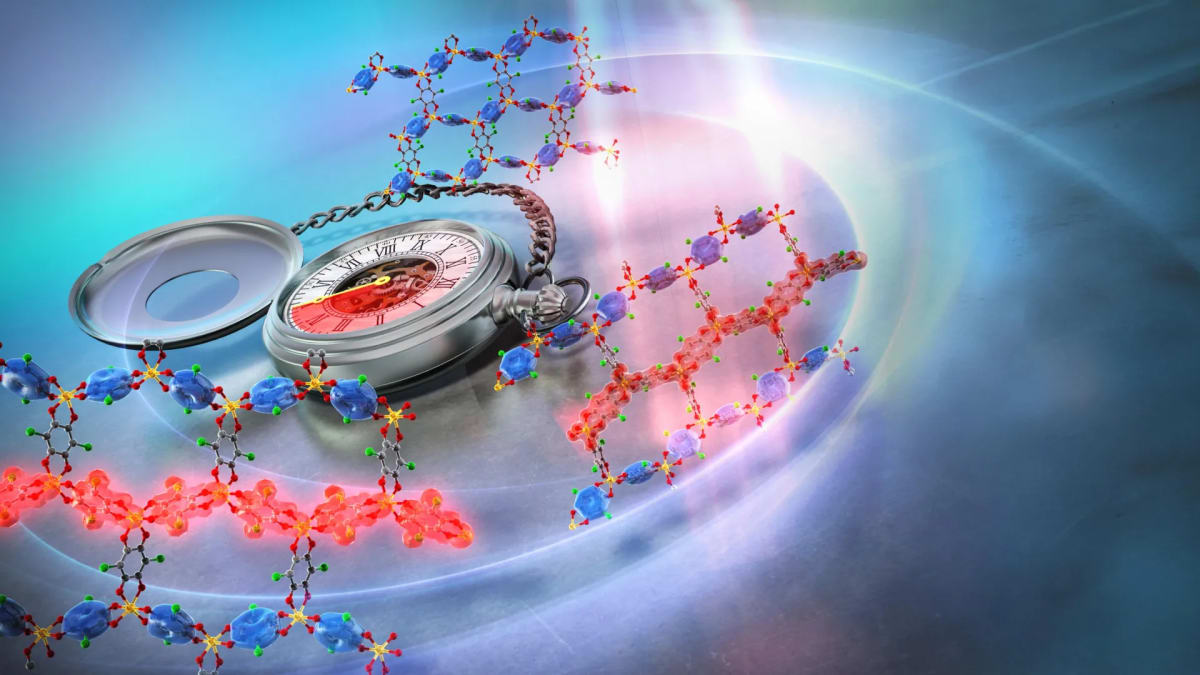
Led by Assistant Professor Tadahiko Ishikawa, the researchers focused a laser pulse on a metal-organic framework, a special material built from metal ions connected by organic molecules. They wanted to see exactly what happens in those first impossibly brief moments after light hits the material.
What they discovered was stunning. The material didn't just suddenly change. It went through a hidden intermediate step that scientists had never observed before.
First, the material entered what's called a bond-order wave state, where the electronic bonds between neighboring atoms alternated between stronger and weaker in a repeating pattern. This fleeting state lasted only a fraction of a fraction of a second. Then tiny atomic movements followed, producing what scientists call a photoinduced hidden state.
The team used laser pulses lasting only six femtoseconds and incredibly sensitive equipment to track how light reflecting off the material changed almost instantly. But the experiments alone couldn't explain everything. They combined their measurements with theoretical calculations to piece together the full sequence of events.
The Ripple Effect
This discovery opens doors that could transform how we interact with technology. Materials that can be controlled with ultrafast pulses of light could lead to electronics that operate at speeds we can barely imagine today.
The newly formed state may also be polar, meaning electrical charges distribute unevenly across the material. If scientists can reliably create and control these photoinduced polar states, they could manipulate electronic properties using nothing but light.
Future smartphones might respond before your finger even touches the screen. Computers could process information thousands of times faster. Medical devices might diagnose conditions in real time. The same experimental approach could extend to other materials, helping scientists design a whole new generation of photoresponsive technologies.
Ishikawa believes their method could help design materials that can be efficiently controlled using light. By revealing these previously invisible ultrafast transformations, researchers are moving closer to technologies that seemed like science fiction just years ago.
The breakthrough shows that even in the tiniest fractions of time, there's still so much to discover about how our world works.
Based on reporting by Google News - Scientists Discover
This story was written by BrightWire based on verified news reports.
Spread the positivity!
Share this good news with someone who needs it