Scientists Create 'Molecular Catapult' for Solar Power
Researchers at Cambridge discovered that molecular vibrations can launch electrons across solar materials in just 18 femtoseconds, opening doors to cheaper and more efficient solar panels. This breakthrough could transform how we harness energy from the sun.
Scientists just watched electrons move faster than ever thought possible, and it could make solar power cheaper for everyone.
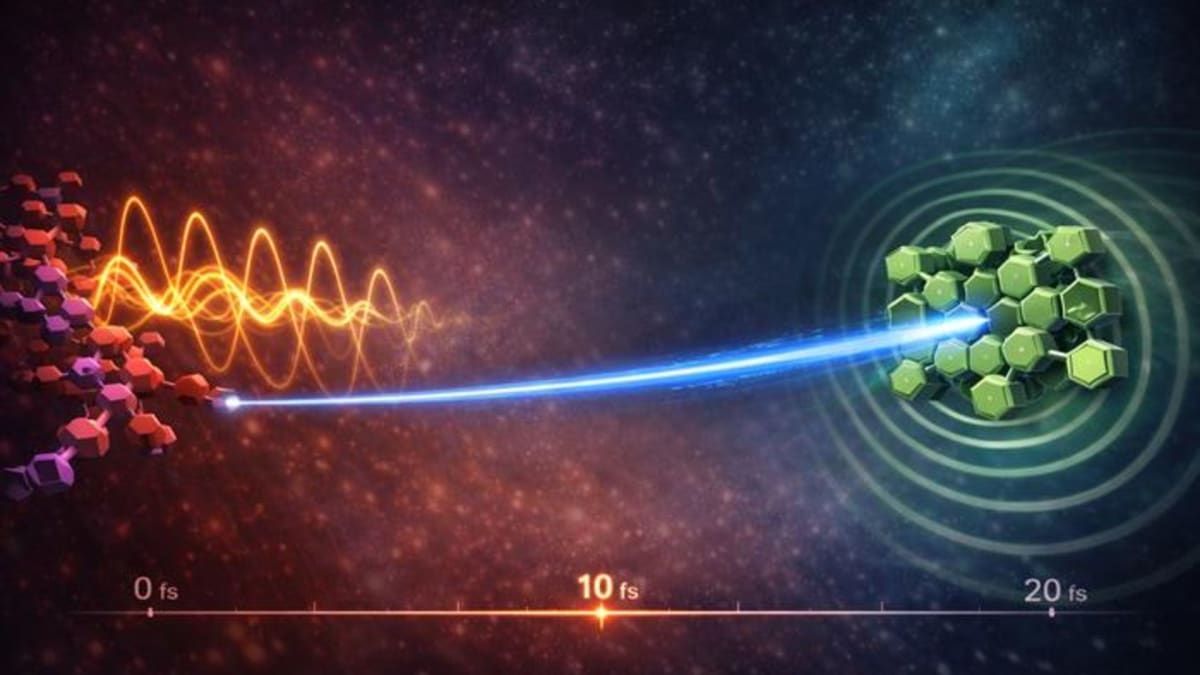
Researchers at the University of Cambridge discovered that molecules in organic solar cells act like tiny catapults, hurling electrons across materials in just 18 femtoseconds. That's 18 quadrillionths of a second, about as fast as a single molecule vibrates.
"We're effectively watching electrons migrate on the same clock as the atoms themselves," said researcher Pratyush Ghosh. The team used ultra-short laser pulses to observe this lightning-fast movement in real time.
This matters because organic solar cells could one day deliver electricity at much lower costs than traditional silicon panels. Right now, they're far less efficient, but this discovery reveals a new path forward.
The team found something unexpected. Instead of needing strong forces to push electrons between molecules, vibrations in the material naturally launch them across in one coherent burst. When the electron lands, it triggers matching vibrations in the receiving molecule, creating a perfect handoff.
"The vibrations don't just accompany the process, they actively drive it," Ghosh explained. Previous organic solar cell designs tried to eliminate molecular motion, thinking it slowed things down. Turns out scientists had it backwards.
The Ripple Effect
This discovery rewrites the playbook for solar cell design. Engineers can now create materials that harness molecular vibrations instead of fighting against them, potentially making solar panels more efficient and affordable.
The breakthrough applies beyond solar power too. Any technology that moves electrical charges between molecules, from batteries to electronics, could benefit from this catapult effect.
Study co-author Akshay Rao captured the shift perfectly: "Instead of trying to suppress molecular motion, we can now design materials that use it, turning vibrations from a limitation into a tool."
The research, published in Nature Communications, establishes new strategies for the next generation of energy materials. While organic solar cells still have a way to go before matching silicon's efficiency, this finding shows researchers exactly where to look.
Sometimes the biggest breakthroughs come from watching nature work at its own incredible speed and learning to work with it instead of against it.
More Images


Based on reporting by Google News - Solar Power Record
This story was written by BrightWire based on verified news reports.
Spread the positivity!
Share this good news with someone who needs it