Scientists Create Stable CO2 Polymer at Lower Pressures
Researchers at Lawrence Livermore National Laboratory discovered how to make a carbon dioxide-based material that stays stable at room temperature, potentially creating cleaner, more efficient energy storage. The breakthrough uses 15 times less pressure than previous methods, making it far more practical to produce.
Scientists just cracked a puzzle that could revolutionize how we store and use energy, and it all started with squeezing carbon dioxide in a completely new way.
When you compress materials to extreme pressures, their atoms arrange themselves in unusual patterns. Diamond is one of the rare exceptions that keeps its compressed structure when the pressure releases. Most materials simply snap back to normal, losing those special atomic arrangements.
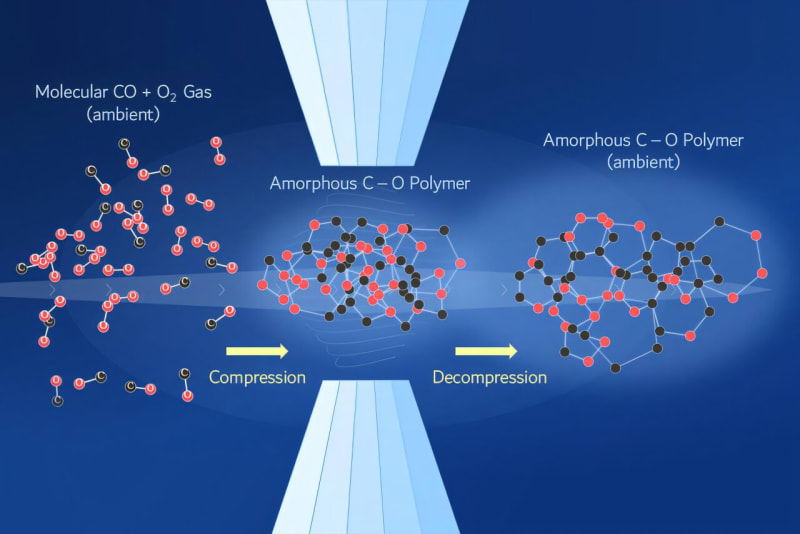
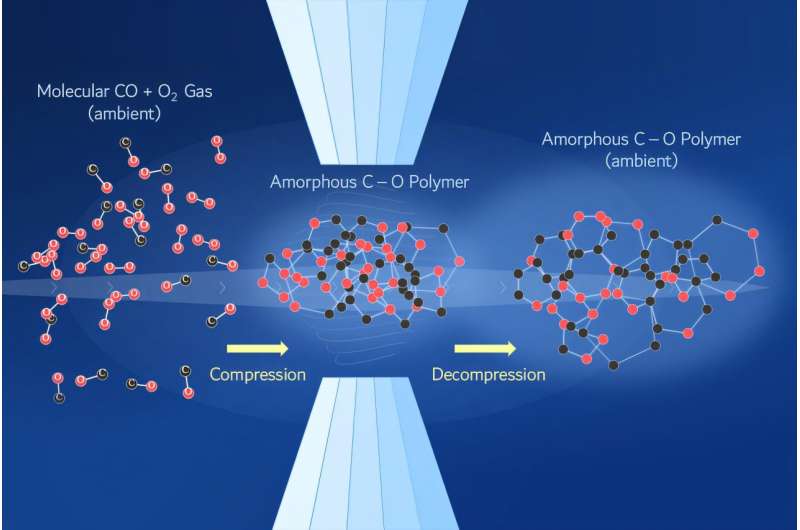
Researchers at Lawrence Livermore National Laboratory figured out how to lock carbon dioxide into a stable, energy-rich form that stays intact at room temperature and normal air pressure. The result is a polymer that stores far more energy than ordinary carbon dioxide because its atoms are locked into a dense, tightly bonded network.
The secret wasn't compressing pure carbon dioxide at all. Instead, the team used a mixture of carbon monoxide and oxygen, which transforms at much lower pressures and creates more flexible reaction pathways. This approach favors forming amorphous solids, which lack the rigid structure of crystals and handle pressure changes much better.
The breakthrough happens at about 7 gigapascals of pressure, more than 15 times lower than the 100+ gigapascals previously needed. That's still incredibly high pressure, but the dramatic reduction makes future production far more realistic and affordable.
Scientist Stanimir Bonev explained that the material's stability comes from carbon-carbon bonds that form readily in the mixture. These bonds create a distinct structure that helps the material stay intact when pressure releases, experiencing less strain than crystal structures would.
The team used quantum molecular dynamics simulations combined with machine learning models to map out exactly how to create the polymer. Their computational approach explored countless pressure and temperature conditions, providing what Bonev calls "a clear recipe for future experimental efforts."
Why This Inspires
This discovery represents a new frontier in materials science that could touch multiple aspects of daily life. High-energy-density materials have applications beyond propellants, including cleaner energy storage systems that could make renewable energy more practical and efficient.
The research team's approach of using mixtures instead of pure compounds, and favoring amorphous structures over crystals, opens doors to discovering entirely new families of recoverable materials. The same technique could work with other light elements like nitrogen and hydrogen, potentially leading to breakthroughs in energy storage, manufacturing, and sustainable technologies.
The scientists are already looking ahead to applying their method to other element combinations, each with potential for creating stable, useful materials that don't exist in nature.
This isn't just about making one new material. It's about unlocking a whole new way to create substances with properties we've only imagined, bringing us closer to cleaner energy solutions and more efficient technologies that could benefit everyone.
More Images
Based on reporting by Phys.org
This story was written by BrightWire based on verified news reports.
Spread the positivity!
Share this good news with someone who needs it