Scientists Create Universe Simulation the Size of 500K Movies
Astronomers just released one of the largest cosmic simulations ever made, containing enough data to fill half a million HD movies. The virtual universe will help scientists unlock mysteries about dark matter, dark energy, and how galaxies formed across billions of years.
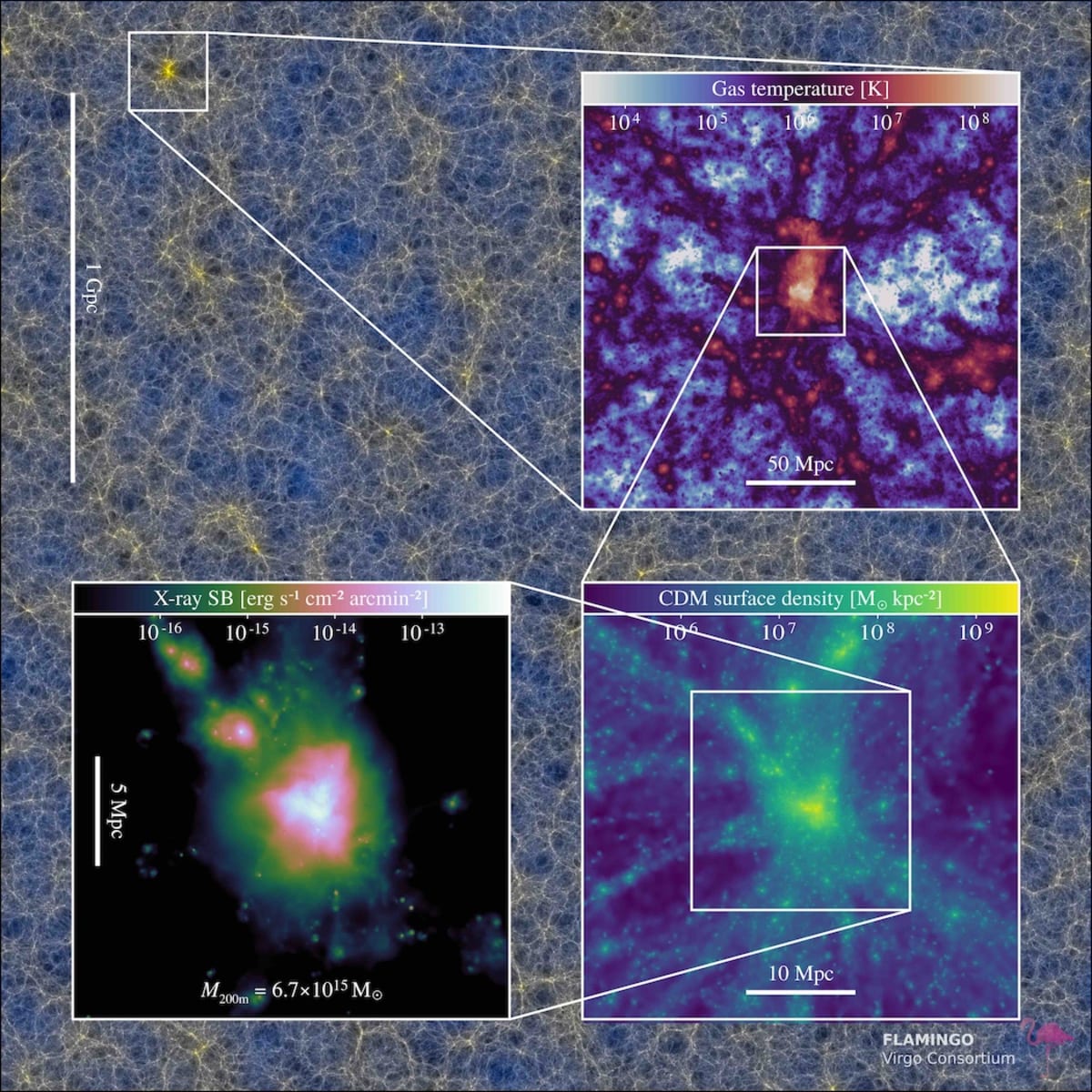
Imagine recreating the entire universe on a computer, from moments after the Big Bang to today. That's exactly what scientists with the FLAMINGO project just accomplished, and they're sharing it with the world.
The simulation contains a staggering 2.5 petabytes of data, roughly equivalent to 500,000 high-definition movies. But this isn't entertainment—it's a powerful new tool that lets researchers explore 13.8 billion years of cosmic history without waiting for telescopes to capture rare events.
What makes FLAMINGO special is its ability to track everything at once. The simulation models dark matter (the invisible stuff holding galaxies together), ordinary matter (stars, gas, and planets), and dark energy (the mysterious force pushing the universe apart) all in one consistent framework.
That means scientists can watch how a single galaxy forms stars while simultaneously seeing how billions of galaxies arrange themselves across the cosmic web. It's like zooming from a single cell to an entire ecosystem without losing detail.
Joop Schaye from Leiden University in the Netherlands helped lead the project. "These simulations allow us to follow the growth of cosmic structure across vast regions of space, while still modeling the complex physics of galaxy formation," he explained.
The massive scale solves a real problem in astronomy. Rare cosmic phenomena like enormous galaxy clusters or brilliant quasars don't show up often in smaller simulations simply because they're uncommon in the real universe too. FLAMINGO's size increases the odds of capturing these cosmic outliers.
Why This Inspires
Modern telescopes are getting incredibly good at mapping the sky in extraordinary detail. But raw observations only tell part of the story—scientists need sophisticated models to interpret what they're seeing and test different theories about how the universe works.
That's where FLAMINGO shines. Researchers can now experiment with virtual universes, tweaking the laws of physics to see what happens, testing predictions before expensive telescope time gets allocated, and discovering patterns that might stay hidden in observation alone.
The team made the entire dataset publicly available to researchers worldwide. Matthieu Schaller, also from Leiden University, emphasized the importance of open access: "We aim to provide a resource that will support a wide range of astrophysical research."
It's a shift from astronomy being purely observational to becoming experimental as well. Scientists can now explore countless "what if" scenarios, comparing their virtual universes against the real one we observe through telescopes.
As next-generation observatories come online and flood researchers with unprecedented detail about distant galaxies and cosmic structures, they'll have FLAMINGO waiting to help make sense of it all. The future of understanding our universe just got a massive upgrade.
More Images

Based on reporting by Space.com
This story was written by BrightWire based on verified news reports.
Spread the positivity!
Share this good news with someone who needs it