Scientists Film Plasma and Electrons in Trillionths of a Second
Researchers can now capture "movies" of invisible events that unfold faster than you can blink 10 billion times. The breakthrough imaging method reveals how plasma forms and electrons move in real time.
Scientists just turned the invisible into movies, filming processes that happen in trillionths of a second with stunning clarity.
A team at East China Normal University created an imaging system that captures ultrafast events in a single shot. Their camera doesn't just record brightness like traditional methods, it also reveals hidden structural changes that were previously impossible to see.
"Many important phenomena in physics, chemistry, biology and materials science happen incredibly fast," said research team leader Yunhua Yao. The new technique called CST-CMFI captures complete changes in both brightness and internal structure in one measurement.
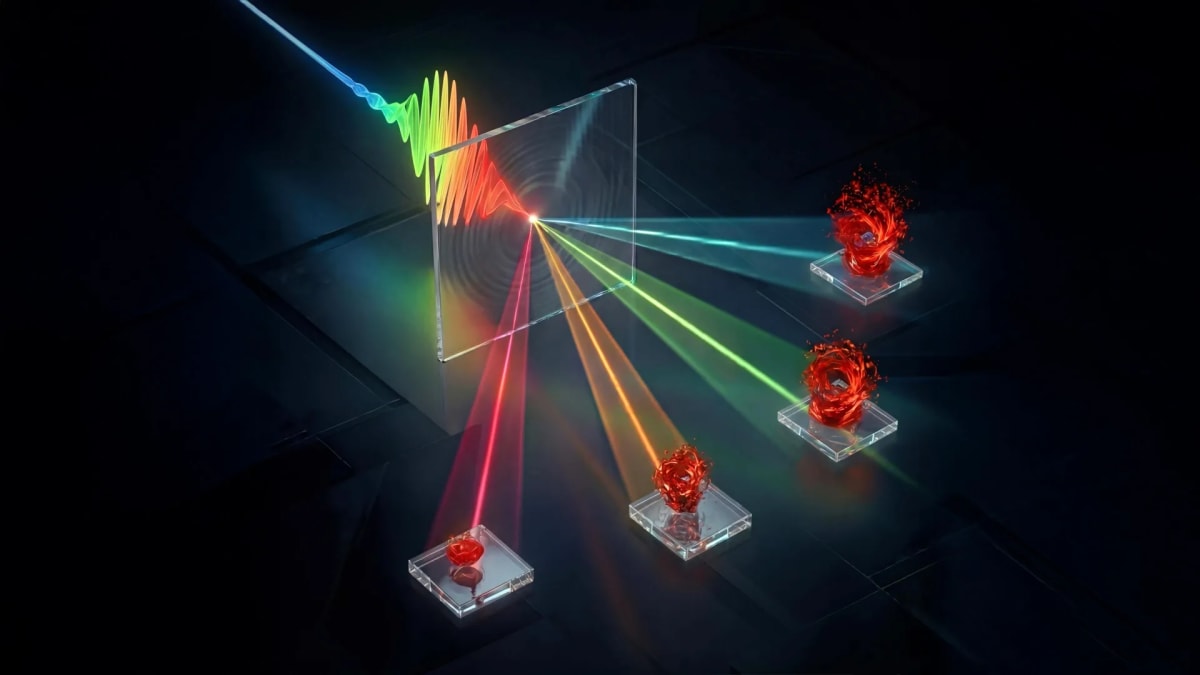
The system works by using a special laser pulse made of multiple wavelengths that arrive at slightly different times. When the pulse interacts with a fast-changing event, it scatters light carrying detailed information about what's happening. A neural network then processes this data and reconstructs it into a sequence of frames, creating an ultrafast movie from a single exposure.
To test their camera, researchers filmed plasma forming in water after a laser pulse. They watched the dense cloud of free electrons appear and tracked how it absorbed light and affected the way light traveled through water. This kind of insight could improve laser-based medical procedures.
The team also studied how electrical charges move in ZnSe, a material used in electronics. Even when the material looked unchanged to traditional cameras, the new system detected subtle phase variations that revealed hidden activity. This sensitivity gives scientists a powerful new tool for understanding how materials behave.
The Ripple Effect
This breakthrough opens doors across multiple fields. Scientists can now watch chemical reactions rearrange atoms at lightning speed and observe how biomolecules behave over incredibly short timescales.
The applications extend beyond research labs. Better understanding of ultrafast material behavior could lead to more efficient solar cells, faster electronics, and improved devices we use every day. The technology might also enhance high-power lasers used for clean energy research and advanced manufacturing.
Medical procedures using lasers could become safer and more precise. Materials scientists can design better products by watching exactly how substances respond to light and energy at the molecular level.
The camera turns moments that were once completely hidden into detailed visual stories. By revealing what happens in the tiniest fractions of time, researchers can finally see the fundamental processes that shape our world and use that knowledge to build a better future.
Based on reporting by Science Daily
This story was written by BrightWire based on verified news reports.
Spread the positivity!
Share this good news with someone who needs it