Scientists Find Ancient Planet Factory Beyond Jupiter
A cosmic dust trap just past Jupiter's orbit churned out wildly different space rocks for millions of years, revealing how our Solar System's building blocks formed. The discovery finally explains why ancient meteorites that crash to Earth come in such varied types.
Scientists just uncovered where some of the Solar System's most important planetary building blocks were born, and the cosmic nursery was surprisingly close to home.
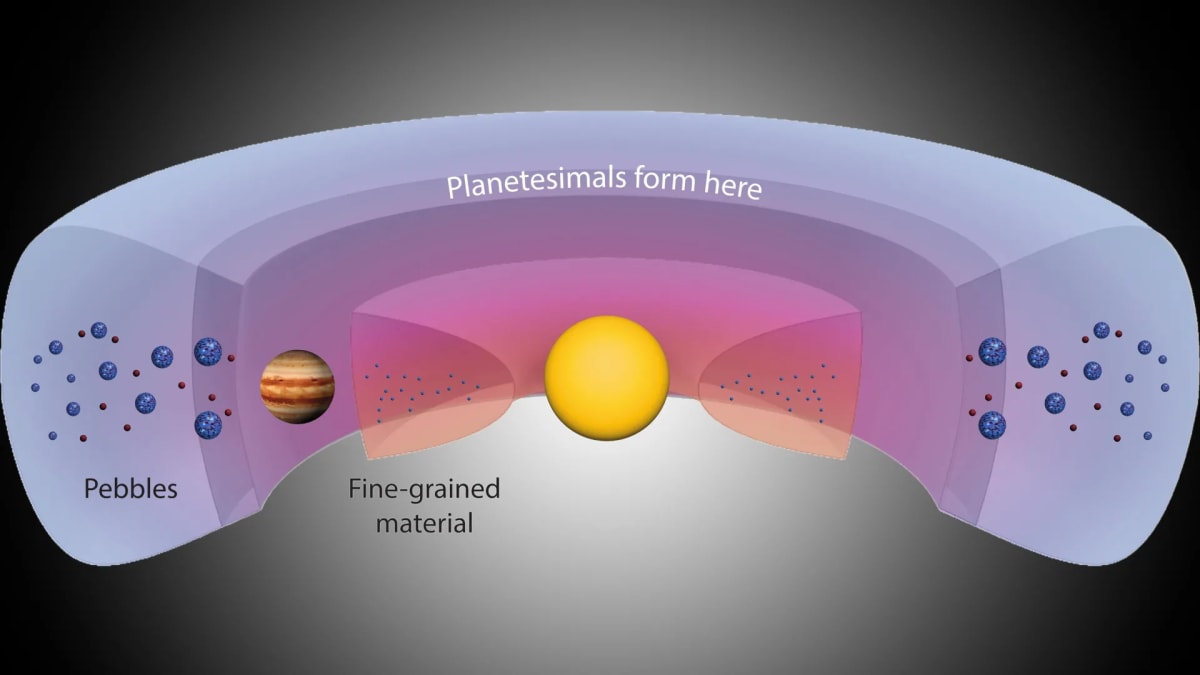
About 4.6 billion years ago, a ring-shaped region just beyond Jupiter acted like a planet-making assembly line. For roughly two million years, this "dust trap" produced different generations of rocky bodies called planetesimals, the raw materials that eventually became planets and asteroids.
Researchers at the Max Planck Institute for Solar System Research in Germany used computer simulations to recreate conditions in the early Solar System. Their models showed how Jupiter's massive gravity created a gap in the swirling disk of gas and dust surrounding the young Sun, forming a pressure zone that trapped enormous amounts of dust particles.
That trapped dust became the perfect environment for rocks to form. Over millions of years, the region produced planetesimals with drastically different compositions, explaining a mystery that has puzzled scientists for decades.
When meteorites fall to Earth today, they come in surprisingly varied types despite forming around the same time. Some are fragile and dusty, while others contain sturdy chunks of material embedded in finer grains. Scientists wondered how such different rocks could form in the same cosmic neighborhood.
The new simulations solved the puzzle. As Jupiter consumed nearby material and new planetesimals formed, the balance of ingredients in the dust trap constantly shifted. During the first 500,000 years, crumbly material decreased before rising again over the next million years, creating distinct generations of space rocks with unique recipes.
Why This Inspires
For the first time, computer models of the early Solar System perfectly match what scientists see when they study ancient meteorites in laboratories. These space rocks serve as time capsules, preserving clues about how our cosmic home took shape billions of years ago.
The discovery connects dots across vast stretches of time and space. Rocks that fall from the sky today carry memories of a dusty ring that existed when dinosaurs were still 4.5 billion years in the future, shaped by the same giant planet we can see with backyard telescopes tonight.
Understanding how planetesimals formed helps scientists piece together the story of how Earth itself came to be. The same processes that created those ancient building blocks in Jupiter's dust trap contributed to forming the rocky worlds of our inner Solar System, including the one beneath our feet.
The findings show that planet formation was far more dynamic and creative than previously thought, with cosmic factories operating in parallel and producing varied products over millions of years. Our Solar System's origin story just got a fascinating new chapter.
Based on reporting by Science Daily
This story was written by BrightWire based on verified news reports.
Spread the positivity!
Share this good news with someone who needs it