Scientists Find First-Ever Egg of Ancient Mammal Ancestor
Researchers discovered the first confirmed egg from a mammal ancestor, solving a 200-year mystery about how these ancient creatures reproduced. The fossil shows how one tough species survived Earth's worst extinction and paved the way for all mammals today.
A tiny fossil curled inside an ancient egg just solved a mystery scientists have puzzled over for two centuries.
Researchers found the first confirmed egg from Lystrosaurus, a small plant-eating animal that lived 252 million years ago. This discovery proves that early mammal ancestors laid eggs, something scientists suspected but could never confirm until now.
The timing makes this find even more remarkable. Lystrosaurus lived through Earth's worst mass extinction, when 90% of species disappeared as the planet turned hot, dry, and deadly. While most animals died off, Lystrosaurus didn't just survive. It became one of the most common land animals on Earth.
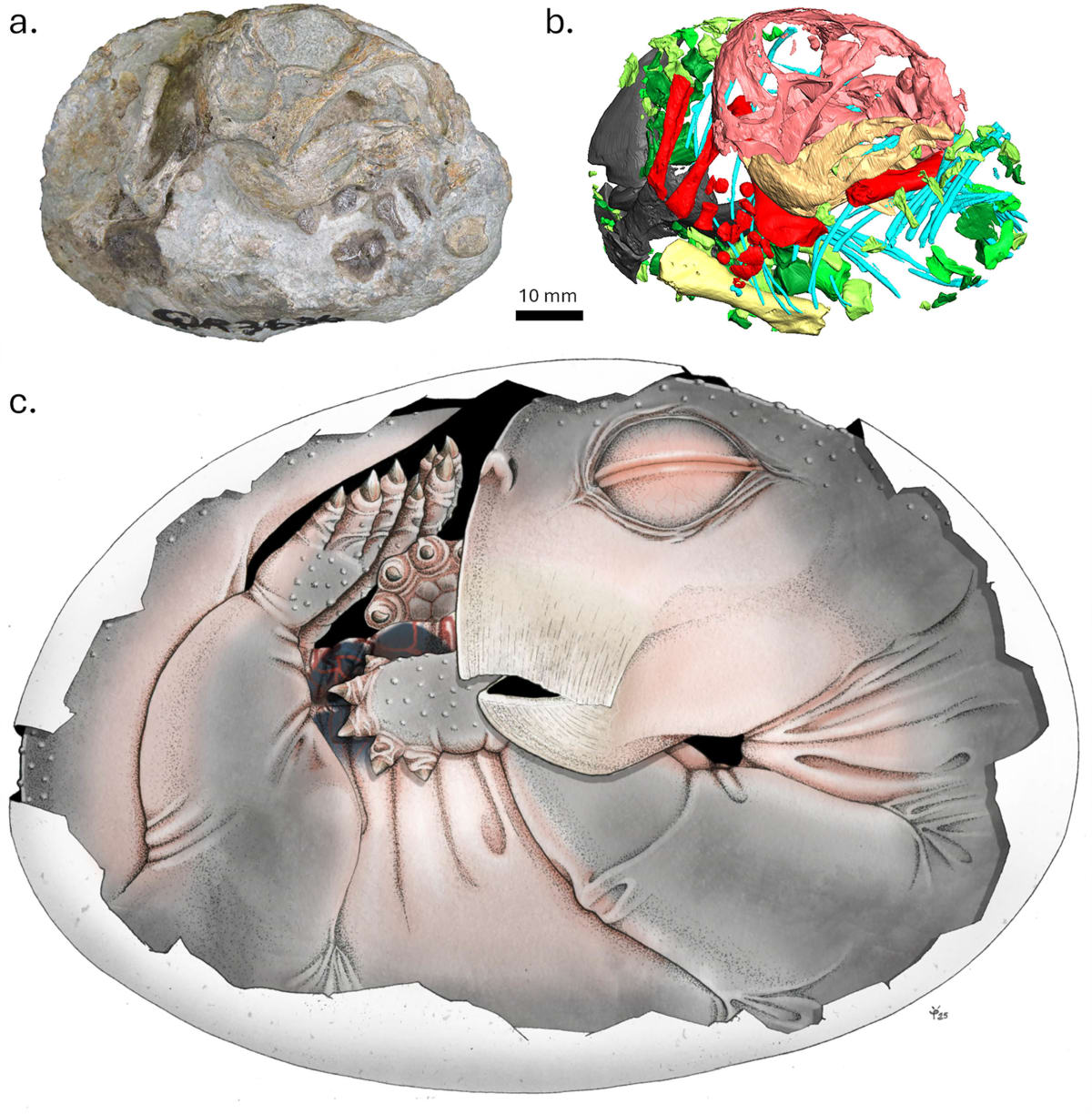
Professor Jennifer Botha discovered the fossil during a 2008 field trip in South Africa. At first, the small nodule showed only tiny bone fragments. As her team carefully prepared it, they found a perfectly curled baby Lystrosaurus, but they couldn't prove it died inside an egg using technology available at the time.
Seventeen years later, powerful X-ray scans revealed the truth. The embryo's tightly curled position matched how babies develop inside eggs. The fossil showed no hard shell, suggesting Lystrosaurus laid soft, leathery eggs like modern reptiles.
The embryo's bones told another important story. Its jaw hadn't fused yet, meaning it couldn't feed itself. Scientists realized the baby died before hatching, frozen in time at a critical stage of development.
These weren't ordinary eggs. Lystrosaurus laid relatively large eggs packed with nutrients, giving babies everything they needed to grow strong before facing the harsh world outside. In the scorching heat after the extinction, large eggs lost less water and gave young animals a better chance at survival.
Why This Inspires
This discovery shows us that survival sometimes comes down to simple strategies executed brilliantly. Lystrosaurus didn't have fancy adaptations or complex parenting behaviors. It laid big eggs that gave its babies a fighting chance in impossible conditions.
Those babies hatched ready to move, feed, and survive on their own. While other species struggled to protect helpless young in a dangerous world, Lystrosaurus offspring hit the ground running. This straightforward approach helped them spread across the planet when everything else was dying.
The fossil also reveals how mammals evolved over millions of years. Modern egg-laying mammals like platypuses lay smaller eggs and feed their young milk after hatching. Lystrosaurus represents an earlier chapter in that story, before milk feeding evolved.
Sometimes the biggest scientific breakthroughs come from the smallest fossils, waiting patiently in the ground for technology to catch up with curiosity.
Based on reporting by Google: fossil discovery
This story was written by BrightWire based on verified news reports.
Spread the positivity!
Share this good news with someone who needs it