380-Million-Year-Old Fish Shows How We Left the Water
Scientists used neutron imaging to peek inside an ancient Antarctic fish skull and discovered features that help explain how life first moved from water to land. The find reveals how our distant ancestors began adapting to breathe air and survive near the surface.
Scientists just unlocked secrets hidden inside a 380-million-year-old fish skull that help explain one of evolution's biggest moments: when animals first walked on land.
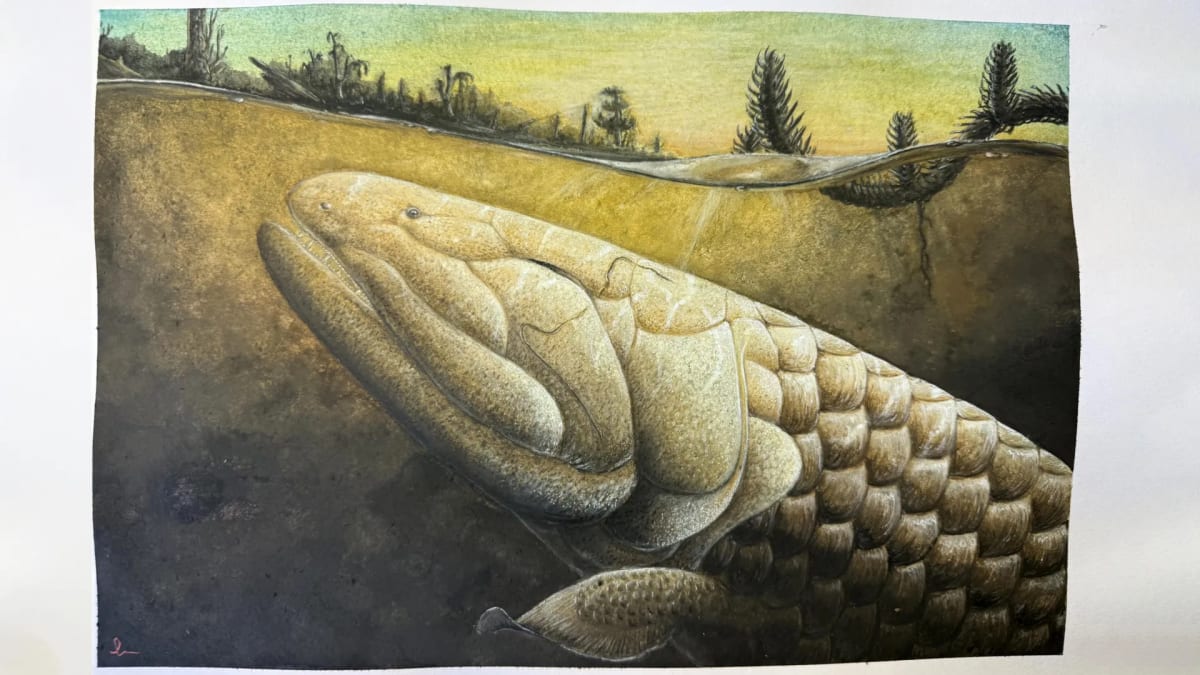
Researchers at Flinders University in Australia used advanced scanning technology to study Koharalepis jarviki, a meter-long predatory fish discovered in Antarctica's Lashly Mountains. This wasn't just any ancient fish—it belonged to a group closely related to the first four-legged animals that eventually left the water.
The scans revealed something surprising. The fish had openings in the top of its skull that likely helped it gulp air at the water's surface, plus a light-sensitive organ in its brain that tracked day and night cycles.
"This precious fossil highlights the ancient links between Australia and Antarctica," says Dr. Alice Clement, a research fellow who co-authored the study published in Frontiers in Ecology and Evolution. The fish lived during the Devonian Period, often called the "Age of Fishes," when waters teemed with predators that were our very distant relatives.
Lead researcher Corinne Mensforth, a PhD candidate at Flinders, says this particular fossil is special because it's the only one in its entire family that preserved the internal skull bones. That gave scientists their first look at the braincase and how this ancient creature sensed its world.
The fish was an ambush predator with relatively small eyes, meaning it relied heavily on other senses to hunt smaller animals in freshwater systems. These adaptations suggest it thrived in shallow environments where getting oxygen from the surface mattered for survival.
The Bright Side
This discovery adds another crucial piece to understanding how vertebrates evolved from water-dwelling creatures into land animals. Modern imaging technology made it possible to study these delicate internal structures without damaging the one-of-a-kind fossil—something that would have been impossible when it was first described back in 1992.
The research shows how gradual changes, like developing ways to breathe air while still living in water, paved the way for one of life's greatest adventures. These fish weren't trying to conquer land—they were simply adapting to their shallow-water homes, one small change at a time.
Those tiny adaptations eventually led to every land animal alive today, including us.
Based on reporting by Science Daily
This story was written by BrightWire based on verified news reports.
Spread the positivity!
Share this good news with someone who needs it