Scientists Find "Off Switch" for Spreading Breast Cancer
Researchers at Hiroshima University discovered how to break apart protein pairs that help breast cancer spread, opening the door to a new type of treatment. Small protein chains tested in mice successfully stopped tumor growth and prevented cancer from reaching lymph nodes.
Scientists just found a way to flip off a molecular switch that helps breast cancer spread through the body.
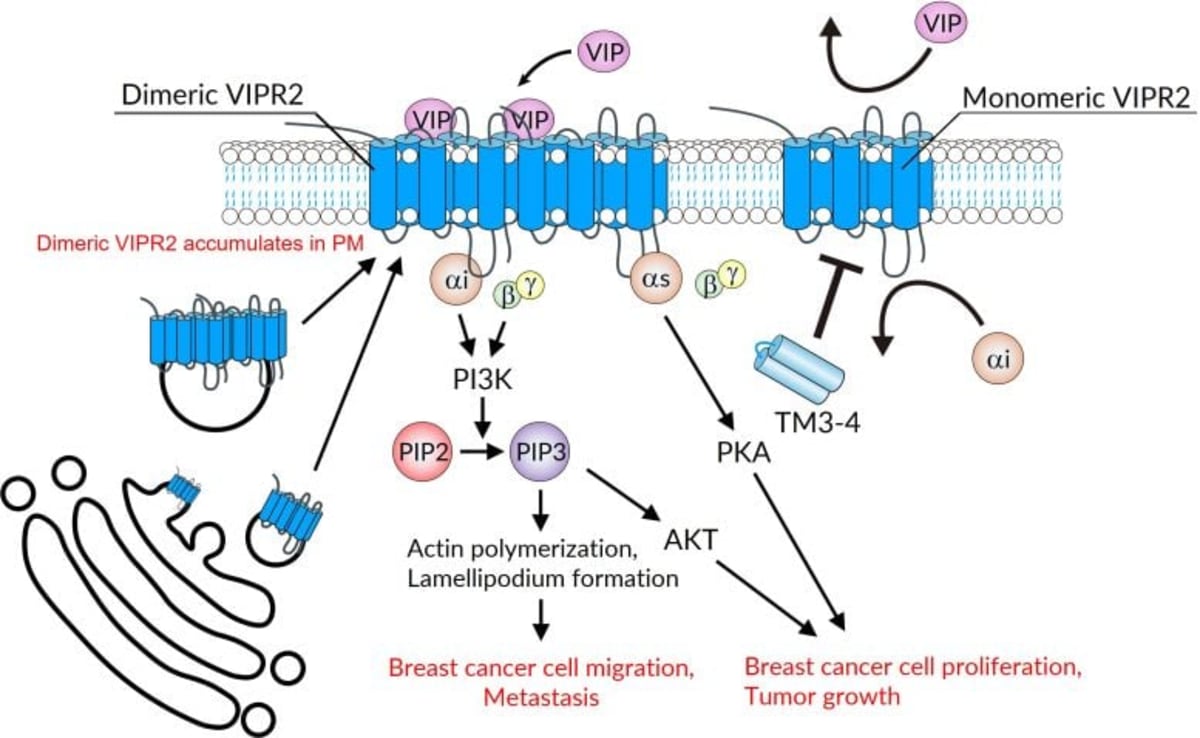
Researchers at Hiroshima University identified a receptor called VIPR2 that normally helps regulate sleep cycles and immune responses. But when cells produce too much of it, this receptor becomes a problem. It pairs up with copies of itself to create structures that fuel tumor growth and help cancer travel to new tissues.
The team discovered something remarkable about these paired receptors. They found the exact spot where two VIPR2 molecules connect: regions called transmembrane domains 3 and 4. More importantly, they figured out how to break them apart.
Small chains of amino acids called TM3-4 peptides can wedge between the paired receptors and force them to separate. When the researchers tested this approach in breast cancer cells, the results were striking. Cells expressing these peptides showed significantly reduced tumor growth and couldn't spread to lymph nodes in mice.
"VIPR2 moved further apart in cells expressing TM3-4 peptides," said assistant professor Satoshi Asano. The separated receptors lost their ability to activate the signaling pathways that drive cancer cell multiplication and movement.
This matters because surgery can remove visible tumors but often misses individual cancer cells that have already started traveling. Those escaped cells cause the disease to return. A treatment that targets the mechanism cancer uses to spread could stop the disease before it reaches new organs.
Why This Inspires
This research offers hope for the hardest part of treating breast cancer: stopping it from spreading. The team didn't just identify a problem. They found a solution and proved it works in living systems.
The peptides represent a completely new approach to fighting cancer. Instead of poisoning rapidly dividing cells like chemotherapy does, these molecules specifically target the pairing process that overactive VIPR2 receptors use to promote cancer spread.
Professor Yukio Ago said the team plans to test purified TM3-4 peptides in animal models next, with the goal of developing new anticancer drugs. The treatment would specifically target cancer cells where VIPR2 is overexpressed, potentially sparing healthy tissue from damage.
The research received support from multiple Japanese scientific organizations and was published in the British Journal of Pharmacology. For patients whose cancer depends on this particular mechanism, a targeted therapy could one day make the difference between disease progression and long-term survival.
Sometimes the most powerful discoveries come from understanding exactly how something works, then finding the precise way to turn it off.
More Images
Based on reporting by Google News - Scientists Discover
This story was written by BrightWire based on verified news reports.
Spread the positivity!
Share this good news with someone who needs it