Scientists Find Tiny Whirlpools Covering the Sun's Surface
Scientists discovered thousands of tiny plasma whirlpools swirling across the Sun's surface, some just 20 kilometers wide. These hidden vortices could finally explain how our star builds up and releases magnetic energy.
Scientists just spotted something incredible hiding in plain sight on the Sun: thousands of tiny whirlpools that could solve mysteries about how our star actually works.
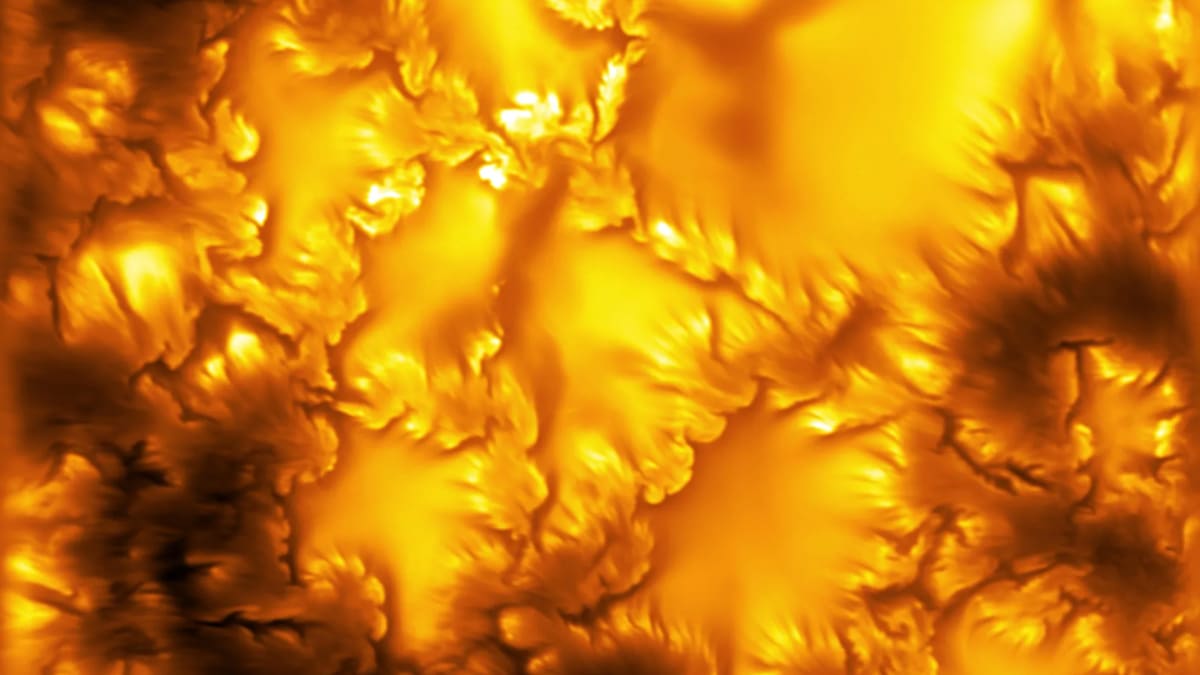
Using the world's largest solar telescope in Hawaii, researchers found plasma vortices spinning across the Sun's surface, with some measuring just 20 kilometers across. To put that in perspective, spotting these whirlpools is like seeing a coin from 180 kilometers away.
The discovery comes from a team at the National Solar Observatory, the Max Planck Institute for Solar System Research in Germany, and the High Altitude Observatory. They combined images from the Daniel K. Inouye Solar Telescope with advanced computer simulations to reveal these previously invisible structures.
The whirlpools appear along the edges of granules, the bubble-like structures that cover the Sun's surface. These granules form when hot plasma rises from deep inside the Sun, cools at the surface, and sinks back down. The vortices develop where different layers of plasma move at different speeds, creating the same kind of swirling motion you might see in ocean waves or clouds on Earth.
The Bright Side
These tiny spinning structures could answer two big questions that have puzzled scientists for years.
First, they might explain how the Sun's magnetic field lines get twisted and coiled up with energy. When these twisted field lines eventually snap and reconnect, they release bursts of energy called nanoflares. The newly discovered vortices appear everywhere the magnetic field is strong enough, giving scientists a clear mechanism for how this twisting happens continuously.
Second, the whirlpools are incredibly good at mixing magnetized and non-magnetized plasma. This mixing could help explain how the Sun's magnetic field changes fast enough to complete its eleven-year activity cycle. Current models struggle to show how magnetic fields can spread through the Sun's atmosphere quickly enough to match what we observe.
Michiel van Noort from the Max Planck Institute says detecting these vortices pushed the limits of what even the world's best solar telescope can see. The team needed special imaging equipment and processing techniques to reveal structures this small.
The discovery opens new doors for understanding how the Sun stores, moves, and explosively releases energy, giving us better insight into the star that makes all life on Earth possible.
Based on reporting by Science Daily
This story was written by BrightWire based on verified news reports.
Spread the positivity!
Share this good news with someone who needs it