Scientists Generate Quantum Entanglement Using Sunlight
Researchers transformed ordinary sunlight into quantum entanglement, a breakthrough that could slash energy costs for quantum computers and satellites. The outdoor experiment achieved 94% quality without needing powerful lasers.
Scientists just cracked a problem that could make quantum technology far cheaper and greener: they created quantum entanglement using nothing but sunlight.
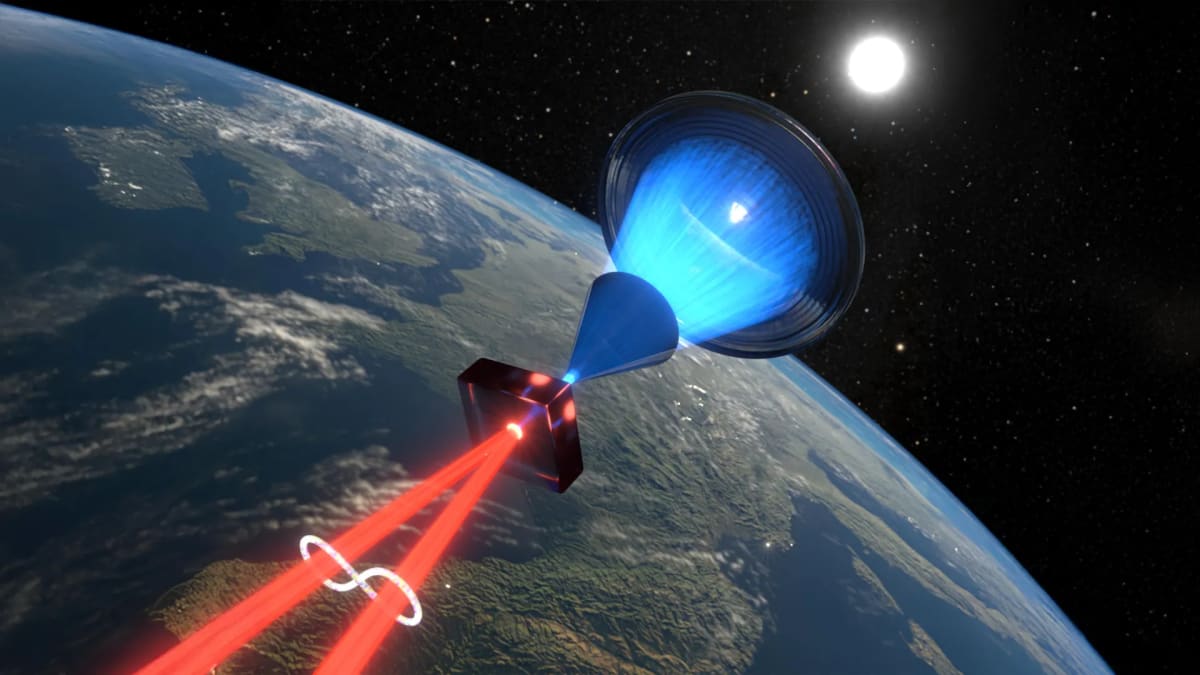
Researchers from the University of Ottawa and Germany's Max Planck Institute achieved what many thought impossible. They generated entangled photons, the building blocks of quantum computing and secure communication, by concentrating sunlight instead of relying on energy-hungry lasers.
The team used a clever cone-shaped concentrator to funnel sunlight through a Fresnel lens the size of a household window. That concentrated beam then passed through a fiber thinner than a human hair into a tiny crystal just a millimeter wide. Inside that crystal, individual photons split into entangled pairs with 94% similarity to a perfect quantum state.
"Quantum entanglement is crucial for applications such as secure communication, ultra-precise sensing and high-performance computation," said Cheng Li, who recently graduated from the University of Ottawa and led the research. The work challenges a long-held belief that only coherent light from lasers could create the strong correlations needed for entanglement.
The breakthrough builds on earlier work showing that messy, incoherent light from LEDs could produce entanglement. Sunlight presented a far tougher challenge because it scatters in all directions and contains every color of the spectrum. The researchers designed their system so these variations didn't interfere with the photons' polarization, the property through which they became entangled.
The Ripple Effect
This discovery could transform how we build quantum technology in space and on Earth. Satellites might generate secure encryption keys using abundant sunlight rather than carrying heavy laser systems and power supplies. That means lighter launches and lower costs for quantum communication networks.
On the ground, the technology offers a path to scale up quantum computing without adding to our energy burden. As quantum systems grow larger and more widespread, their electricity demands have become an increasing concern. Sunlight-driven entanglement could provide a renewable alternative just when we need it most.
The team published their findings in Optica, demonstrating that when you account for differences in light bandwidth, sunlight performs comparably to laser-based techniques. The research proves that light can be disordered in some characteristics while still creating perfect quantum entanglement in others.
Nature just handed us a cleaner path to the quantum future.
Based on reporting by Science Daily
This story was written by BrightWire based on verified news reports.
Spread the positivity!
Share this good news with someone who needs it