Scientists Learn Robot Control by Watching Sheepdog Videos
Researchers discovered that sheepdogs manage unpredictable flocks by waiting for the perfect moment to act, inspiring a breakthrough algorithm for controlling swarms of robots and AI. The secret weapon? Embracing chaos instead of fighting it.
Scientists spent hours watching sheepdog competition videos on YouTube and emerged with a breakthrough that could transform how we control everything from delivery drones to self-driving cars.
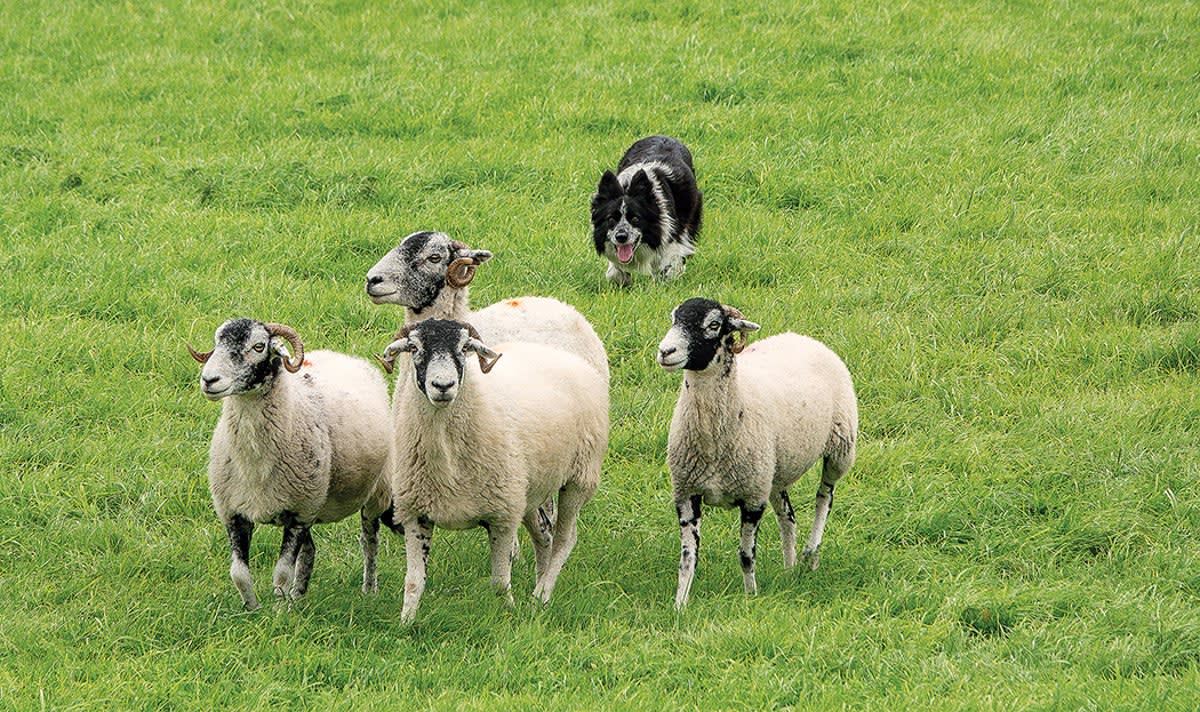
The researchers from Georgia Institute of Technology noticed something fascinating. Sheepdogs competing in century-old trials face a uniquely difficult challenge: controlling just four or five sheep instead of large herds. Small groups are unpredictable, with individual personalities causing them to constantly flip between panicking and staying calm.
So how do expert sheepdogs succeed? They wait. The dogs pause until all the sheep randomly face the right direction, then immediately chase them forward. When the sheep break formation again, the dog stops and waits for another perfect alignment.
"It's a slow, delicate dance," says study co-author Saad Bhamla, comparing it to sailing only when the wind blows your way. The dogs exploit the sheep's own randomness instead of fighting against it.
The team turned this insight into something called the Indecisive Swarm Algorithm. They programmed robots to constantly switch between following a central controller and following their neighboring bots. This created a system that's surprisingly easier to control than robots that rigidly follow one strategy.
The Bright Side
This discovery flips conventional thinking on its head. Engineers typically view unpredictability as a problem to eliminate. But this research proves that a little chaos can actually make systems work better.
The applications extend far beyond robot labs. Future drone swarms could use this approach to coordinate deliveries without crashing into each other. Self-driving cars could avoid the deadlocks that recently paralyzed groups of autonomous vehicles. Teams of AI agents could collaborate more smoothly on complex tasks.
"Indecisiveness prevents the group from binding up and makes it more pliable," explains Ted Pavlic, a computer scientist at Arizona State University who wasn't involved in the study.
Raphaël Sarfati, a physicist at Goodfire AI, sees even broader implications. "We tend to think of noise as a problem that makes systems less predictable, less optimized," he says. "But we see everywhere that noise, a little bit of noise at least, is really, really good for driving systems toward a better optimum."
The research team gathered insights not just from YouTube but from talking directly with farmers in Georgia, combining digital observation with real-world expertise. Their findings appear in the journal Science Advances.
Sometimes the best solutions come from watching nature work, whether that's a patient sheepdog in a field or the beautiful chaos of animals just being themselves.
More Images


Based on reporting by Scientific American
This story was written by BrightWire based on verified news reports.
Spread the positivity!
Share this good news with someone who needs it