Scientists Map Milky Way in Stunning New Radio Colors
Astronomers just released the most detailed radio image of the Milky Way ever created, revealing hidden star nurseries and the glowing remains of exploded stars in vivid detail. The breakthrough lets scientists study how stars are born and die across our galaxy like never before.
Our galaxy just got a stunning makeover, and the results are revealing secrets about life and death among the stars.
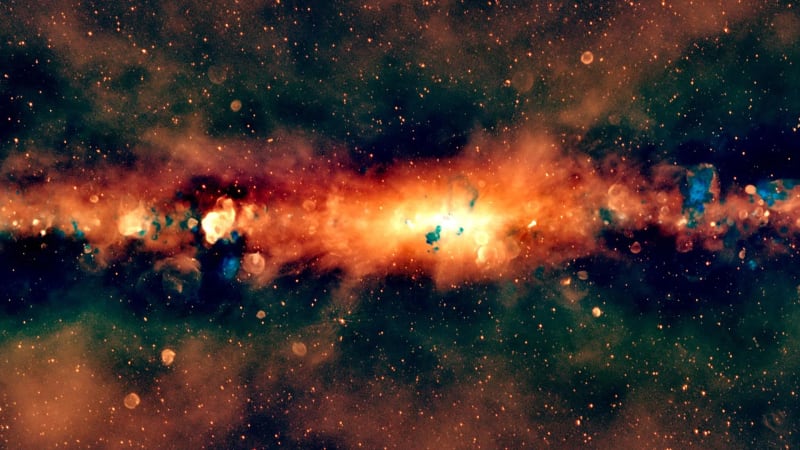
Astronomers at the International Centre for Radio Astronomy Research in Australia have created the largest and sharpest radio image of the Milky Way ever assembled. The image shows our galaxy in "radio colors" that human eyes can't see, exposing structures that have remained hidden until now.
PhD student Silvia Mantovanini spent 18 months processing the enormous project, using 1 million hours of supercomputer time to combine data from hundreds of nights of telescope observations. The Murchison Widefield Array telescope in Western Australia captured radio waves across different frequencies, creating a cosmic portrait that's twice as sharp and ten times more sensitive than previous images.
The breakthrough comes from viewing the galaxy at low radio frequencies, which reveal different features than visible light telescopes can capture. Red circles in the image show supernova remnants, the expanding clouds left behind when massive stars explode. Blue regions mark stellar nurseries where new stars are actively forming.
This distinction solves a major challenge astronomers have faced for years. Separating the material around newborn stars from the gas clouds of dead ones has been incredibly difficult, but the new image makes these different stages of stellar life clearly visible across the galaxy.
The image catalogued around 98,000 cosmic sources, including pulsars (rapidly spinning stellar remnants), planetary nebulae, dense gas clouds, and distant galaxies beyond the Milky Way. Many researchers believe thousands of supernova remnants remain undiscovered, and this detailed map provides the best tool yet for finding them.
The Ripple Effect
This achievement represents more than just a pretty picture. The new map gives astronomers a powerful tool to understand how our galaxy has evolved over billions of years, tracking the cycle of stellar birth, life, and death that has shaped the Milky Way into its current form.
The detailed radio data may also help scientists better understand pulsars by analyzing how bright they appear across different frequencies. This could reveal new insights into how these extreme objects produce their radio waves and where they're distributed throughout our cosmic neighborhood.
Associate Professor Natasha Hurley-Walker notes that this marks the first time anyone has published a low-frequency radio image of the entire Southern Galactic Plane. Only the Square Kilometre Array Observatory's telescope, currently being built in Western Australia and set for completion in the next decade, will have the power to surpass this groundbreaking view.
The universe just became a little less mysterious, one radio wave at a time.
Based on reporting by Science Daily
This story was written by BrightWire based on verified news reports.
Spread the positivity!
Share this good news with someone who needs it