Scientists May Have Detected Dark Matter in South Dakota
After nearly a century of searching, researchers working nearly a mile underground in South Dakota's Black Hills believe they've made contact with dark matter, the invisible substance that makes up 85% of the universe's matter. If confirmed through peer review, this discovery would revolutionize our understanding of physics and the cosmos.
Deep in an old gold mine beneath South Dakota's Black Hills, scientists may have just solved one of the universe's greatest mysteries.
Researchers at the Sanford Underground Research Facility believe they've detected dark matter for the first time in human history. The invisible substance has puzzled scientists since astronomer Fritz Zwicky first theorized its existence in the 1930s.
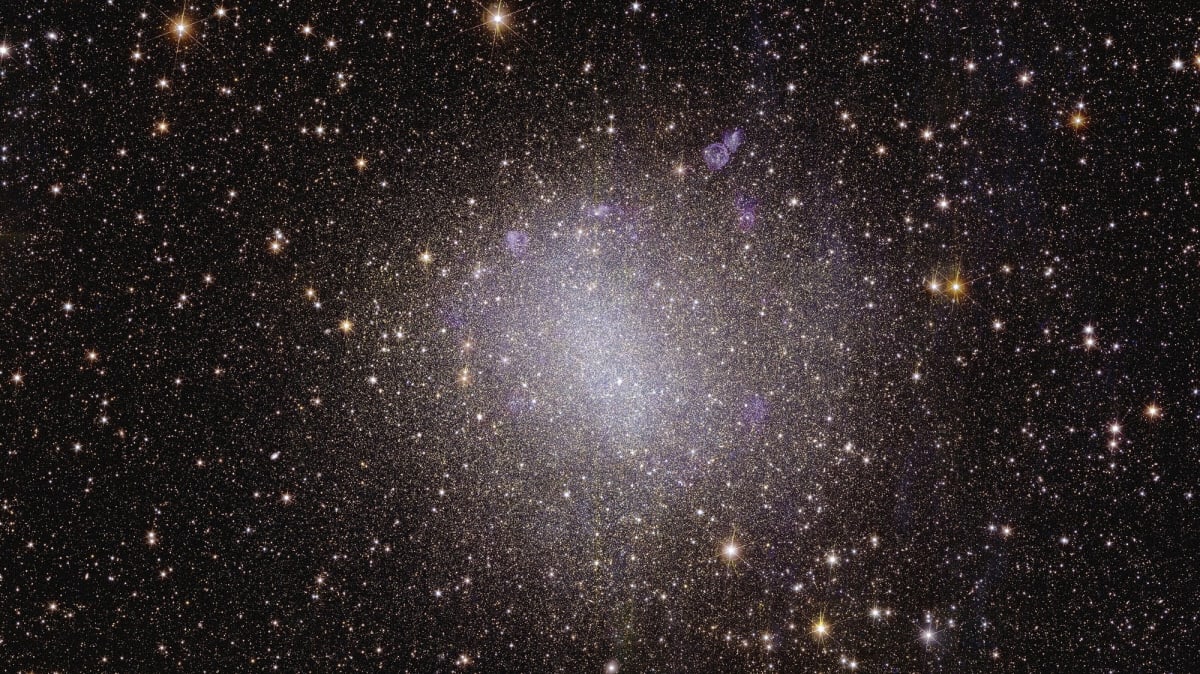
Dark matter is called "dark" because it doesn't emit light, making it impossible to see directly. NASA describes it as "the invisible glue that holds the universe together," shaping galaxies and cosmic objects across the cosmos.
The team has been hunting for weakly interacting massive particles, or WIMPs, using a sophisticated detector filled with liquid xenon. When a WIMP strikes a xenon atom's core, it creates a tiny flash of light that scientists can measure.
Finding these flashes requires extreme precision and isolation. The experiment sits nearly a mile underground to shield it from cosmic radiation and other interference that could create false signals.
Jaret Heise, the facility's director of science, says the team is carefully reviewing months of data before making any final claims. "What haven't we thought of? What could this be that isn't dark matter?" he asks, expressing the cautious optimism permeating the lab.
The stakes couldn't be higher. Dark matter accounts for 85% of all matter in the universe, yet humans have never directly detected it on Earth.
Why This Inspires
This potential breakthrough shows what's possible when scientists pursue answers to questions that seem impossible to answer. The team's careful, methodical approach reminds us that the greatest discoveries often require patience, collaboration, and the courage to keep searching even when the goal seems unreachable.
The work builds on decades of global research, including earlier attempts at Minnesota's Soudan Underground Laboratory in the early 2000s. Now, scientists from around the world are collaborating to peer review the South Dakota findings.
If confirmed, this discovery would fundamentally change our understanding of the universe and prove that the "invisible glue" holding galaxies together is real and measurable. It would validate nearly a century of theoretical work and open entirely new fields of research.
For now, Heise and his team aren't celebrating yet. They're doing what scientists do best: gathering more data, checking their work, and making absolutely certain before announcing they've seen something no human has ever witnessed before.
The universe may have just revealed one of its deepest secrets in a converted gold mine beneath the Black Hills.
More Images

Based on reporting by Google News - Science
This story was written by BrightWire based on verified news reports.
Spread the positivity!
Share this good news with someone who needs it