Scientists Name Merging Black Holes After Lord of the Rings
Astronomers discovered two supermassive black hole binaries and named them Gondor and Rohan after the iconic Lord of the Rings locations. The discovery uses a groundbreaking technique that could map cosmic collisions across the universe.
Scientists just lit the beacons of hope for understanding our universe, and they're celebrating with names straight from Middle-earth.
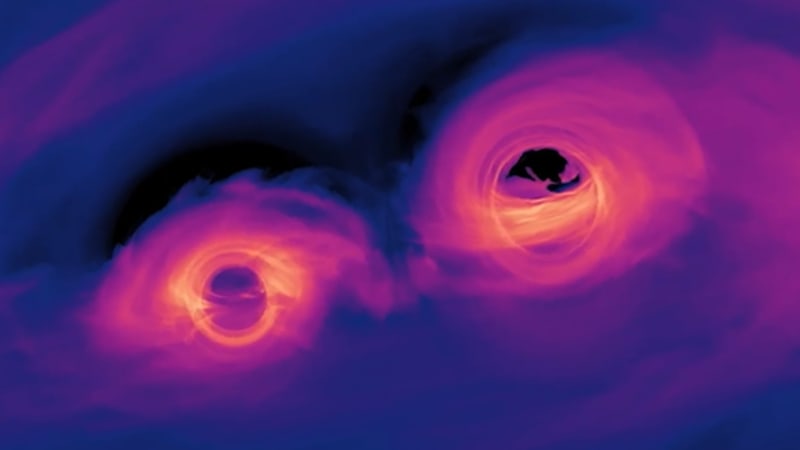
Astronomers have discovered two merging supermassive black hole systems and named them after locations in J.R.R. Tolkien's "Lord of the Rings." One is called Gondor, the other Rohan, and their discovery marks a major breakthrough in how we find these cosmic giants.
The North American Nanohertz Observatory for Gravitational Waves (NANOGrav) found these black hole pairs using an innovative new method. They listened for the background hum of gravitational waves, ripples in space itself, while watching quasars, the brilliant beacons powered by feeding black holes.
Here's the clever part: when two supermassive black holes spiral toward each other before merging, they emit gravitational waves that create a detectable background hum. Merging black holes are five times more likely to appear in quasars, making these bright objects cosmic lighthouses pointing to where the action is happening.
NANOGrav team member Chiara Mingarelli explained the playful naming choice. "Rohan was first, for Rohan Shivakumar, the Yale student who first analyzed it, and Gondor was next, because, well, the beacons were lit!"
The team searched 114 active galactic nuclei, the bright central regions where supermassive black holes gorge on surrounding material. Out of this systematic search, Gondor and Rohan rose to the top as clear examples of binary black hole systems.
Why This Inspires
This discovery gives scientists their first concrete roadmap for hunting merging black holes across the cosmos. Instead of randomly searching the sky, astronomers now have a proven technique to create a map of these titanic collisions.
The research helps us understand not just black holes themselves, but how entire galaxies merge and evolve. Each discovery adds another piece to the puzzle of how our universe formed and changed over billions of years.
Since NANOGrav first detected the gravitational wave background in 2023, they've been refining their methods. The team believes even a small catalog of black hole mergers could help create a comprehensive gravitational wave background map.
The work continues as scientists hunt for more of these cosmic pairs. With each new detection, we move closer to understanding the most powerful events in the universe, one fantasy-inspired name at a time.
More Images

Based on reporting by Space.com
This story was written by BrightWire based on verified news reports.
Spread the positivity!
Share this good news with someone who needs it