Scientists Solve 30-Year Black Hole Mystery With Pen & Paper
Physicists just cracked a puzzle that stumped Stephen Hawking for years, proving exotic cosmic objects might actually exist. Their breakthrough came not from supercomputers, but from creative math on paper.
A team of physicists just solved a cosmic mystery that's been nagging scientists since the early 1990s, and they did it with nothing more than clever equations and determination.
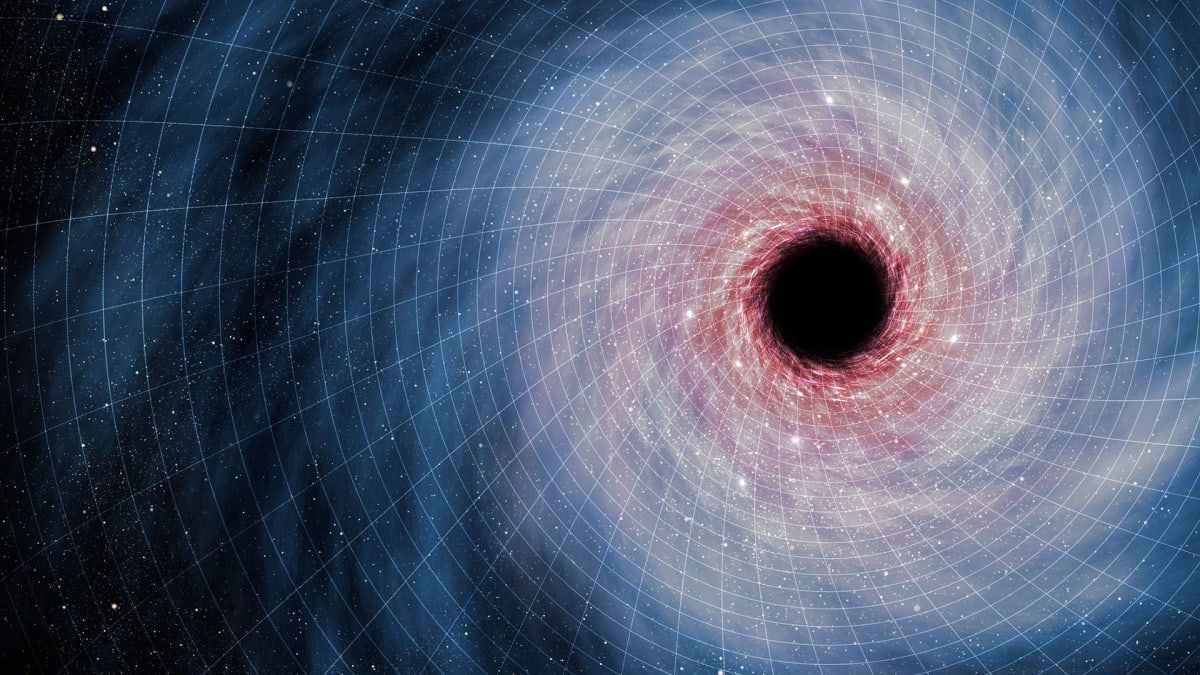
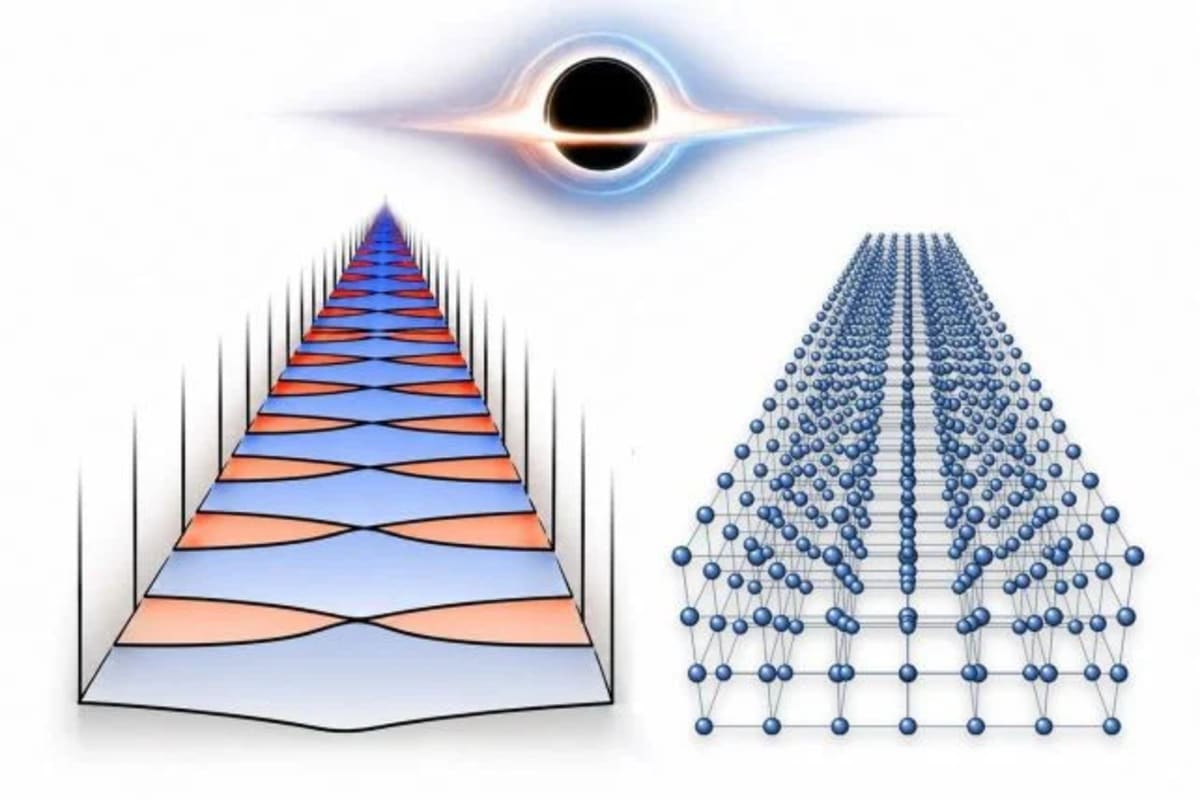
Researchers at Goethe University and Vienna University of Technology found a way to mathematically prove that "space-time crystals" could exist. These aren't your kitchen counter crystals, but rippling patterns in the fabric of reality itself that might create rare, observable black holes.
The puzzle started in 1991 when Stephen Hawking bet fellow physicists Kip Thorne and John Preskill about whether "naked singularities" could exist. These would be objects with black hole-like properties but without the event horizon that normally hides them from view. In 1997, Hawking conceded defeat and awarded the winners T-shirts "to cover their nakedness."
But scientists weren't entirely convinced. The evidence came from 1990s supercomputer simulations that could only calculate so many decimal places before running into accuracy problems. For three decades, physicists couldn't be sure if these exotic objects were mathematically real or just computer glitches.
Christian Ecker and Daniel Grumiller took a different approach. Instead of building bigger computers, they added extra dimensions to the problem. By imagining the universe with 52 dimensions instead of our familiar four, suddenly the impossible equations became solvable.
Their pen-and-paper solution fits on just a few lines and precisely describes how space-time crystals, naked singularities, and microscopic black holes could form. It's like finding the perfect angle to solve a Rubik's cube that everyone else was brute-forcing.
The team hasn't closed the gap completely. Their mathematical solution works for 52 dimensions, while computer simulations reach up to 14 dimensions. They're working to meet in the middle, which would provide compelling evidence these objects are possible in our universe.
Why This Inspires
This breakthrough shows how human creativity can outmaneuver even the most powerful computers. Sometimes the solution isn't more processing power but a fresh perspective on an old problem.
The research also demonstrates how physics continues to reveal unexpected beauty in the universe. Space-time itself might form crystalline patterns under the right conditions, adding another layer of elegance to Einstein's equations.
Most importantly, it proves that big scientific mysteries don't always require billion-dollar equipment. Two determined researchers with paper, pencils, and imagination just advanced our understanding of reality's deepest structures.
The universe keeps surprising us, and human ingenuity keeps finding ways to decode its secrets.
More Images

Based on reporting by Live Science
This story was written by BrightWire based on verified news reports.
Spread the positivity!
Share this good news with someone who needs it